
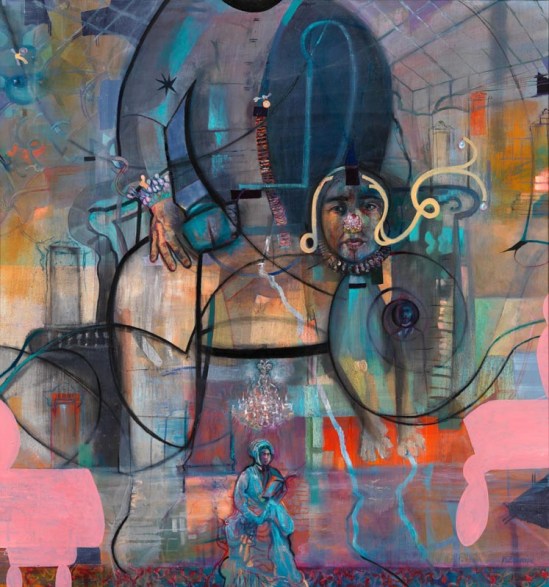
Nick Dorey, An ointment isn’t an antidote, 2016, site-specific mixed media installation. Courtesy the artist. Photo: Zan Wimberley. Part of the exhibition Dämmerschlaf at Artspaceuntil 28 February 2016
BY VRASIDAS KARALIS
The recent death of the poet Dimitris Tsaloumas (1921-2016) offers the sad but necessary opportunity to revisit and re-read his work — not only as a conventional tribute to his life but mostly as a re-interpretation of his moment in the literary life of Australia. It is true that it took some time to include his work in the official anthologies of mainstream Australian poetry. By the nature of his work also he was never included in anthologies of anti-mainstream poetry; his work had something profoundly conservative in its own constitution yet at the same time, when he appeared in Australian letters in 1983, he brought something new, somehow challenging to the reading and writing addictions of that era.
Tsaloumas’ work evolved during a period when all possibilities were re-opened in Australian society. It was a period of intense optimism, curiosity and existential naiveté. Borders collapsed, communications were intensified and the need to express the visible social differentiation became imperative. Such optimism was both a need and a desire: by the 80s, the old elaborate poetic edifices of Kenneth Slessor, A.D. Hope and Judith Wright were revered but seriously questioned by the anarchic voices of Les Murray, John Tranter, Bruce Beaver, John Blight, Robert Adamson, Robert Gray amongst others. His first translated collection of poems The Observatory (1983) was in a way the culmination of his poetic trajectory in Greek, one which had started almost 35 years earlier. In the collection, through the mediation of Philip Grundy, Tsaloumas entered the English language, expressing, like so many bicultural creators, Greek emotions in English words. His second translated work The Book of Epigrams (1985) characterised by its constant concern for formal completeness, framed the iconography of a deep poetic territory full of symbols and images that reached back to classical Greece.

Dimitris Tsaloumas. Image thanks to UQP
After 1988, Tsaloumas wrote his work in English. He became an Australian writer—although identity politics or the need to belong, the faddish ideologies of the period, never played any significant role in his work. HisFalcon Drinking (1988) is one of the most intricate and complex poetic works of the 80s in Australia. It is characterized by many competing voices, (he calls them variations,) which somehow converged on the solidity and the precision of a ‘strong’ poetic form. Tsaloumas’ poetry is structured around the music pattern of theme and variation—and most of his works in English maintain this tonal configuration as the basis of his poetic voice. In a sense he is the Stravinsky of Australian English: through his Hellenic classicism he tamed and subdued the fierce outbursts of his romanticism. His romanticism was the result of his nostalgia for his native island as well as a consequence of his politics. Tsaloumas migrated to Australia in 1952 for political reasons, and ideological rage against injustice can be felt throughout his poetry, as it could through his personality. His migration to English, however, established the need for what W.H. Auden called ‘formal order’—and this essentially provided the poet with a focused landscape and a centred vision of the world.
Even before this translingualism, there was always a unified poetic subjectivity in his verses. Furthermore, despite his modernist origins, in the works of T.S. Eliot and George Seferis, the aesthetics of fragmentation never exercised any serious allure for him. By writing in English, Tsaloumas experimented with new formal arrangements and formations, testing the limits of his own poetic world and the limitations of his Australian English. Sometimes, his language is heavy and slow, but when he succeeds, his work is full of energetic fluency and vibrant demoticism. This can be felt in Portrait of Dog (1991), The Barge (1993) and The Harbour (1998), three collections replete with the irregularities of Australian colloquialisms, the emotional force of oral directness and the agility of vocal intonations all tamed by the steady pace of versification, the exactness of verbal expression and the precision of his stanzas.
In his later work, like New Poems (1999), Sunrise with Sparrow (2000) andHelen of Troy and Other Poems (2007), Tsaloumas simplified his idiom, by dissolving the dense patterns of theme and variations and exploring the absolute simplicity of expression, through the rediscovery of the trite and the banal. These works are precious examples of Edward Said’s ‘late style’ as the poet abandoned all the verbal complexities that gave his known style its very specificity. With them he immersed himself into what Roland Barthes considered the ‘zero degree of writing,’ discarding all metaphors and pre-ordained orders of expression. His last works are structured around verses of felicitous transparency and Edenic freshness, despite the fact that they resonate with ominous feelings and articulate necromantic utterances. His modernist experimentation with form received in them its most astute re-imagining. Now the subtle rhythmic patterns underneath the verses marked the imperceptible transitions to musical tonalities beyond meaning; the central theme of these poems, that all explore the ‘truth of noble substance’ (‘Helen of Troy’), is the ineffability of death, the silence of all history in front of the unanswerable mysteries of being. The Greek word ‘telos’, meaning both end and purpose would have been the proper way of finishing a complete life, a life of juxtapositions and convergences.
Tsaloumas’ work is an emblematic achievement of poetic translingualism. Poets live in specific places and specific times: the quest of the critic is to find that place and time, localize its coordinates and give it a name. Sometimes the homelessness of the critics and their mind is projected on the imaginative universe of the poet; thus the very specificity of the poem becomes a shadow marker of the critic’s own question for domesticity. The critical task is to reconstruct the homeliness of the specific poetic language, to see the poet’s world as an autotelic form and not as a comment on society, politics or sexuality.
Tsaloumas’ poetry is prone to be fragmented by its interpretation: Greek-Australian, Australian-Greek, modernist, formalist, conservative, diasporic and much more. We must see his work as a totality, as the formal crystalisation in language of the existential experience of a specific individual and not as the fragment of a missing reality. He was all of the above and his language clearly shows it: from his early poems in Greek to his mature poems in English and Greek, the poetic world was expanding, contracting and simplifying itself in an admirable and somehow challenging way. If there is a constant parameter of his language, it can be characterised as an assembly of nouns and not as a collection of adjectives. Structured around raw materials and based on the gravity of solid references, his verses resonate with the staunch attempt of many poets worldwide in the same period to save the language of poetry from the danger of meaninglessness and the anxiety of trivialisation.
With his deep classical education, he avoided the over-sophistication of contemporary self-referential modernist forms. His verses are rough and somehow harsh; so they have to be read as unities, as complete stanzas, and not as isolated verses. Tsaloumas was the poet of formal quest; he struggled to formulate the density and the regularity of a distinct formal configuration in order to localise his poetic voice and avoid the accusation of a poet writing in a foreign language, de-territorialised, un-centred, homeless.
His poems will be read time and again by young poets who want to feel the otherness of poetic language or experience the otherness within the poetic language. His translingualism is the home of contemporary sensitivity: ‘I arrived on time though I had no address,’ he says one of his poems. He reached Australian poetry at the right moment, when a poetic regime change was necessary and desired. He contributed with his polyphonic variations to re-arrange the tonalities of poetic language until he reached the limitations of his own idiom. ‘Your struggle,’ he says in another poem, ‘is with the unseen, the beast that never yields.’ In his best poems, we have the impression that the unseen had found its proper musical translation and has localised a home for his poetic existence. As long as young poets exist who worship the plasticity and the solidity of poetic expression, his work will be read—and that’s greatest praise anyone can give a poet.
*
Our first essay this week is by Sophia Barnes, who considers three new books by Australian women writers: Beth Yahp’s Eat First, Talk Later, Drusilla Modjeska’s Second Half First and Debra Adelaide’s The Women’s Pages. What these books share is an interest in how the stories of women are told and retold. In ‘What To Leave Out’, Barnes writes:
Two memoirs, one fiction? Or one family history, two fictions entwined into a single narrative, and a ‘reflection on the arc of a life’? All three of these books show women writing themselves into being, as they construct narrative from the raw materials of unwieldy lives, whether imagined or real. Each writes and rewrites sensation, tactile detail, exchange or confrontation, revising and rediscovering through the process. The compulsion to self-transcription is persistent, whether it be in the service of self-discovery, exploration or interrogation; whether it comprises reflection, hindsight, or the recovery of stories which might otherwise be lost; whether it functions to challenge or to reinforce, as transformation or as testament – or simply as record.
William Finnegan’s memoir of surfing is the subject of our second essay this week, ‘Mushburgers’ by Knox Peden. Finnegan is a writer for the New Yorkerwho has filed stories from around the world, including Australia. Peden writes:
The expectation in reading Barbarian Days is that one will learn the roots of this passion, that we will see its organic emergence from the world travel treated in its pages. But this passion seems incidental too. The memoir is, after all, of a surfing life. And herein lies the book’s most enchanting aspect. Figurative language abounds—I defy anyone to find better descriptions of surfing, whatever the criteria might be, and regardless of whether you’ve surfed or tried to. But the book as a whole is not a metaphor; it is astonishingly literal. We expect a child of the 1950s to take us through the disappointments of the counterculture. We expect a memoir dedicated to the author’s teenage daughter to take us through the challenges of marriage and the miracle of fatherhood. The wife and kid are in the book, but they are never its subject, much less its object. The wonder of Barbarian Days is to provide us with a literary experience that is not a stand in for other experiences, that is not an allegory of effort and victory and disappointment and loss that memoir culture has conditioned us to expect.
This week in From the Archive, we return to Kerryn Goldsworthy’s essay on the launch of Text Classics, ‘What We Talk About When We Talk About Australian Literature’, one of the first to appear on the Sydney Review of Books on our launch in early 2013. In that essay, Goldsworthy reflects on the transformation of the idea of ‘Australian literature’ since 1988, both within the academy and beyond it:
Why 1988? The Bicentennial celebrations and the lead-up to them had made a lot of people do some hard thinking about exactly what we talk about when we talk about Australian literature, and that was reflected in the way it had begun to be taught in universities. Nor was it just the academics; many of the writers themselves were suspicious of the historical triumphalism that the Bicentennial unavoidably represented. Kate Grenville’s 1988 novel Joan Makes History was a witty bit of feminist revisionism intended to destabilise traditional accounts of Australian history, while Patrick White, as David Marr reports in his biography, ‘decided that nothing of his would be performed or published in Australia in the bicentennial year of white settlement.’ In a 1985 letter to a friend, White had written ‘I hope I am dead before 1988 when we are supposed to celebrate our emptiness in a great shower of bullshit.’ Grenville sent him a copy of Joan Makes History, which he liked. ‘I was carried away,’ he wrote to her. ‘When I finished I even had a cry.’

*Vrasidas Karalis teaches Modern Greek at the University of Sydney. He has published Recollections of Mr Manoly Lascaris (2007), The Demons of Athens (2014) and Reflections on Presence (2016).
**This article published in Sydney Review of Books at http://www.sydneyreviewofbooks.com/dmitris-tsaloumas-and-the-music-of-the-unseen/

 To Koskino