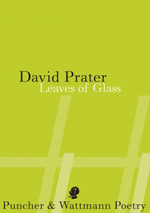
Leaves of Glass
by David Prater
Puncher & Wattmann, 2013
David Prater’s latest collection Leaves of Glass is based on three years’ correspondence in the late nineteenth century between young Australian poet Bernard O’Dowd and the ageing master Walt Whitman. The epistolary material between these two men, a collection of twenty or so letters currently archived at the State Library of Victoria, forms the skeleton for this collection. Prater deftly plays with these two personae, offering a kaleidoscopic vision of their relationship alongside a number of poems that experiment with the ambiguities of written language and the shifting levels of intimacy revealed by the O’Dowd–Whitman letters. Many of the poems will speak most strongly to a reader who is more than passingly familiar with Whitman’s work. It is not a book to be picked up idly, but one that engages with the often-overlooked sympathies between Australian and American poetic traditions, and offers a compelling insight into the lesser-known figure of Bernard O’Dowd. Beyond this, however, Prater’s artisanal use of language and style demonstrates his flexibility and intelligence as a contemporary poet.
Personal correspondence is a tricky source for creative material. Balancing these individuals’ inner thoughts, their intimate writings to another, and publicly available archived material requires careful attention and creativity. The tension between the categories of private, intimate and public leads to spaces and ambiguity: gaps between what is felt and what is expressed, between what is answered and what is ignored, between what can be found, later, in the archives and what has been left out or lost. Personal letters, or what Dierkz terms ‘familiar letters’, which are ‘devoted to the expression of affection and duty among kin, family and friends’, are used to close the distance between individuals, usually on a very intimate level. Prater’s poems create a fictionalised account of these two men’s lives around the details found in their correspondences, often drawing epigraphs from the archival material to contextualise the poems. For example, epigraphs from O’Dowd’s letters head the poems written from O’Dowd’s point of view. These poetic personae, part real and part imagined, are vibrantly formed, with the O’Dowd persona in particular being marked by a clear and distinctive style. This collection is dominated by O’Dowd’s voice – fittingly, perhaps, given the abundance of critical and creative material written on Whitman and the comparative dearth of writing by and on O’Dowd. O’Dowd’s work, as Judith Wright acknowledges, ‘has dated badly’ despite public appreciation for his poetry during his life (quoted in Prater’s book). Prater offers a poignant and troubled vision of the aspiring young poet: a man beset by self-doubt, entering into a correspondence, both epistolary and spiritual, with Whitman the ‘revered Master’.
Continue reading →


 To Koskino