Πολλές φορές μας δημιουργείται η εντύπωση ότι η ποίηση είναι ένα χαρτογραφημένο τοπίο. Περιλαμβάνει δύο σκέλη: το λυρικό και το μη λυρικό και δύο αισθητικές κατηγορίες: του ωραίου και του υψηλού – αυτό είναι όλο. Διαβάζοντας μια συλλογή μπορεί κάποιος σχετικά εύκολα να την κατατάξει σε κάποιο από τα σκέλη ή σε κάποια από τις αισθητικές κατηγορίες, ενώ υπάρχουν και συλλογές που προσπαθούν ένα μεταμοντέρνο αποτέλεσμα και περιέχουν δείγματα απ’ όλα τα παραπάνω, ενίοτε με αμφίβολο αποτέλεσμα.
Το Γκρόζνι, όμως, είναι πραγματικά διαφορετικό. Το Γκρόζνι δεν θέλησε ποτέ να ενταχθεί σε κάποια συμβατική κατηγορία ποίησης, αυτό που θέλησε εξαρχής ήταν να δώσει μια γροθιά στο στομάχι. Και τα κατάφερε μια χαρά. Τα ποιήματα συνιστούν όχι μόνο επίθεση στις βολεμένες ζωές και την αδράνεια, αλλά και ένα επαναστατικό μανιφέστο:
Μη λυπηθείτε την ειρήνη –
σπάστε την στο ξύλο,
ποδοπατήστε την,
διαπομπεύστε την,
πάρτε της τα παιδιά,
γκρεμίστε τα κρεματόριά της,
ελευθερώστε τις δούλες της.
[…]
Πυρπολήστε! Πυρπολήστε!
Το πρωινό ξύπνημα,
τα ΑΤΜ,
όλα τα σχολεία (ναι, όλα τα σχολεία)-
τα βιβλία ιστορίας,
τις ταμπέλες που γράφουν προς ομόνοια,
την εθνική συνοχή».
Οι αναγνώστες του Τεφλόν ξέρουν την ποίησή του από τα τεύχη του περιοδικού. Οι υπόλοιποι ίσως πιαστούν εξ απίνης.
Μα ποιος είναι τέλος πάντων αυτός ο Γιάζρα Χαλίντ; Το ιστολόγιό του δεν είναι πολύ κατατοπιστικό. Πιο διαφωτιστικό είναι το κείμενο που δημοσιεύεται στο thecricket.gr και μας απαλλάσσει από ανούσια ερωτήματα του τύπου: Είναι Τσετσένος; Είναι Μουσουλμάνος; Βασικά, όπως ομολογεί ο ίδιος στο πρώτο-πρώτο ποίημα του Γκρόζνι, είναι ο Παναγιώτης. Ο Παναγιώτης που θέλησε «να ξεπλύνει από πάνω του την ντροπή του λευκού αρσενικού», της μονάδας δηλαδή πάνω στην οποία έχει κτιστεί ολόκληρος ο δυτικός πολιτισμός. Αφαιρώντας την ταυτότητα με την οποία γεννήθηκε και αντικαθιστώντας τη με μια μάσκα, τον Γιάζρα Χαλίντ (Jazra Khaleed), νιώθει ελεύθερος να μιλήσει. Και αυτό που λέει, ενοχλεί: «Μα πιο πολύ, πιο πολύ, αυτό που σε πονάει/ άνθρωπε,/ ανθρωπούλη,/ ανθρωπάκι,/ είναι ότι ζυγίστηκε και βρέθηκε αχαμνή η βία σου» την ίδια στιγμή που αλλού μιλάει για τον «ιμπεριαλισμό των μικροαστών».
Ένα φτύσιμο καταπρόσωπο, αυτή είναι η ποίησή του. Η κραυγή του ανέργου, του στερημένου από ευκαιρίες, του αδικημένου, του μετανάστη:
«Δώστε μου έναν άνθρωπο να με βοηθήσει
καθώς μπαίνω και βγαίνω απ’ τα χέρια μου,
καθώς μου πέφτουν τα παντελόνια
ή πατάω τα κορδόνια της ετερότητάς μου».
Σημείο των καιρών αυτή η ποίηση; Αναπόφευκτη κατάληξη; Μένει να διαπιστωθεί. Μα μέχρι να γίνει αυτό ο Γιάζρα θα γράφει, θα διαβάζεται, θα μεταφράζεται (δεν είναι τυχαίο που περιλαμβάνεται στην αγγλική ανθολογία ελληνικής ποίησης Austerity Measures: The New Greek Poetry) και θα προσπαθεί να γίνει η τύψη για την ενοχή, η φωνή της συνείδησης, ο λόγος του δικαίου:
«Περιμένω μια επανάσταση να με εφεύρει –
ποθώ τη γλώσσα του ταξικού ανταγωνισμού,
μια γλώσσα που ‘χει γευτεί την εξέγερση.
Καμία λέξη δε θα μείνει αιχμάλωτη πίσω –
αναζητώ ένα πέρασμα».
Ο Γιάζρα δεν φοβάται να μιλήσει. Δεν φοβάται να ενοχλήσει. Δεν επιδιώκει να τον συμπαθήσουν. Είναι θυμωμένος. Επιδιώκει την επανάσταση που θα φέρει έναν καλύτερο κόσμο. Εγώ πάλι πιστεύω ότι, παρά το τρομακτικό του προσωπείο, δεν είναι παρά ένας ονειροπόλος.
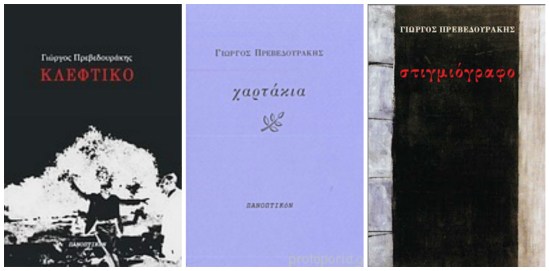
George Prevedourakis (1977) is the author of three collections of poems: Στιγμιόγραφο (Planodion ed., 2011), Κλέφτικο (Panoptikon ed., 2013) and Χαρτάκια (Panoptikon ed., 2016). He has also translated poems by Hans Magnus Enzensberger, which were included in the History of Clouds and other poems collection published last spring by Panoptikon Editions.
George Prevedourakis spoke to Reading Greece* about his latest collection of poems, Χαρτάκια, ‘a series of untitled, brief fragments and meditations’ resembling ‘the ambiance and feeling of an empty room’. He comments on how the notion of time is imprinted on his work, noting that it has treated time as ‘the fleeing moment’ in his first collection, a ‘series of moments-incidents’ in his second and an ‘empty signifier’ in his third. He also talks about Kleftiko, a transcription of Howl by Allen Ginsberg, as well as his translation in Greek of Hans Magnus Enzensberger’ s poems and how he was fascinated by the latter’s ‘elegant, cosmopolitan wit, playful spirit and persevering, all-embracing social criticism’.
Asked about whether poetry can act as a political paradigm, he comments that “once we decide to communicate our writings we should do it foremost as readers-citizens and not as a bunch of uninformed, detached and uninterested, self-proclaimed priests of some obscure religion, that are in a state of privileged communication with God himself”, concluding that luckily, “our current psychological state, where despair and/or determined anger, fear, confusion and/or passive withdrawal are most probably the prevailing sentiments” is adequately represented by an abundant number of contemporary poets.
Your third collection of poems titled Χαρτάκια was recently published. Could you tell us a few things about the book?
With Χαρτάκια I wanted to produce a work that closely resembles the ambiance and feeling of an empty room. The book consists of a series of untitled, brief fragments and meditations, with the notion of time comprising the predominant axis around which these fragments revolve. I approached this material in the same way that one processes a long, yet interrupted synthesis. In other words, my aim was not to present a series of short poems that stand autonomously from one another —though some of them unintentionally do. My principal intention was to take the minimalist form to its extremities, to condense the already condensed, in a non-linear, abrupt manner, while also conveying an intact and coherent gesture to the reader. I don’t know if I have accomplished this rather ambitious goal, yet I have the impression (or perhaps the illusion) that with this small book my initial objective has been met. After all, it was the room I was interested in, not its decoration.
In his review, Antonis Psaltis wrote that “five years after capturing and recording the moment as the eternal imprint of the presence of time in ‘Στιγμιόγραφο’, the question in ‘Χαρτάκια’ seems to shift as to whether the current, inconceivable and increasing speed allows for integral moments”. How is time, in all its forms, imprinted in your work?
I suppose that time must have been a personal obsession of mine, even before I had the slightest desire for writing, let alone publishing, poetry. A somewhat commonplace obsession, I must admit, yet obsessions are to be followed and carried out meticulously, to the degree that one, literally, collapses upon them. In Στιγμιόγραφο (Planodion ed., 2011), as the title suggests, the main focus was placed upon the fleeing moment, trying to seize and depict the instantaneous within the instant, in an almost ‘photographical’ manner. In Kleftiko (Panoptikon ed. 2013), time is rather dispersed and extended, stretched out of its original proportions, engulfing a series of moments-incidents. Lastly, in Χαρτάκια, I’m treating time as an ‘empty signifier’. In reality though, it is time that treats me as such. A gesture of inadequate and futile retaliation had to take place, and, up until now, it has.
Your second collection of poems Kleftiko is a take on Allen Ginsberg’s Howl set in Greece amid the crisis. How was the title inspired? How does ‘kleftiko’ fit in the context of modern Greece?
The title was inspired instantaneously, as most things that get inspired usually do. I was looking for a three-syllable word that would directly lead the reader to ‘Ουρλιαχτό’ (the Greek translation of Howl) while also suggesting a series of other meanings, open to interpretation. For example, the title functions as a hint to the gesture of ‘μεταγραφή’ (transcription), given that I kindly yet unreservedly robbed poor old Ginsberg’s Howl (parts I+III), America and Aunt Rose framework, rhythm and form so that I could put into words my own, personal howling. In addition, Kleftiko is a part of the Greek folk music genre (indicative of the flamboyant, long-winded form and articulation of these particular poems). Kleftiko is also a traditional recipe for cooking lamb, but perhaps this is completely irrelevant.
In relative terms, Kleftiko has fitted quite comfortably within the context of modern Greece; it has been widely read, critically praised and/or refuted, while, to my surprise, it has interacted with other arts; theater, music and, lately, even film. One cannot complain.
Although I was never a devoted ‘fan’ of the great Allen Ginsberg, the idea of a meta-writing/transcription of Howl has been occupying my mind since the early 00s, when (according to some, at least) we were supposedly enjoying ‘the long summer of our content’. My points of reference, the imagery and the material which comprised the background and the basis of this book, derived rather from the sociopolitical setting of my puberty (i.e. the 90s) and not from the blurred, violent and disturbed scenery that we’ve become accustomed to calling ‘Greek crisis’. Hence, I would have written this book even if the entire issue of our current misfortunes had proven to be a major hoax, a flick played out for a short time, instead of the aggressively metastatic cancer it proved out to be.
How challenging was it for you to translate Hans Magnus Enzensberger, one of the greatest living German poets?
Η.Μ.Enzensberger once stated that he is the “saboteur’ of his depression”. Having logged countless hours in exploring and translating his poetic work over the past 6 years (a work that spans the course of more than 7 decades) I could say that translating Enzensberger has become my own, highly effective antidepressant. Furthermore, as I am sure you know from your own experience, translation is a process that teaches humility and cultivates a dual sense of respect: you have to respect the writer but also the reader. In other words, there isn’t much room for your private experimentations, the borders and the setting cannot be twisted in accordance to your personal taste and beliefs. Additionally, a certain kind of mutual trust is gradually established between the poet and the translator. As commonplace as it may sound in the face of H.M. Enzensberger I have discovered a true friend and a faithful companion.
Having been acquainted with his works since my late teens, when I was a student in Britain, I was instantly fascinated by his elegant, cosmopolitan wit, playful spirit and persevering, all-embracing social criticism. I translated few of his Lighter than Air poems back then, more as an exercise, with no real intention in publishing these translations. It was almost ten years later (with his History of Clouds collection) that I began to steadily plunge into his work. To my surprise, I realized that his poetry has never been systematically translated into Greek, besides a wonderful translation of some of his younger works that was published way back in 1978, along with some scarce poems found in literary magazines and websites. I therefore chose to provide the reader with a detailed illustration of his works and not a “best-of” type of anthology. Enzensberger is a protean poet, constantly changing angles, methods and forms. As mentioned above, I had to respect and pay dues to my ‘friendship’.
History of Clouds and other poems was hence published last spring by Panoptikon editions and it includes 109 poems from 4 different collections; History of Clouds (Die Geschichte der Wolken, 2003), Lighter than Air (Leichter Als Luft, 1999), Kiosk (Kiosk, 1995) and Music of the Future (Zukunftsmusik, 1991). A second anthology focused on his earlier works, titled The Defense of the Wolves and other poems, is currently on the making, covering the time period 1957-1980. I sincerely don’t know what will become of me once I’ll have completed this 2nd anthology. It’s hard to look for alternatives once you’ve thoroughly translated a poet of such magnitude. Let’s just hope I won’t start popping pills in order to accommodate my frustration.
Your work has been included in Futures: Poetry of the Greek Crisis, which features some of the most daring new voices in Greek poetry “that mourn the fall, damn the greed, and pound a drum for change”. Can poetry act as a political paradigm? Is it in the capacity of poetry to be ‘politically militant’?
I am very suspicious of those who pound a drum. Usually they are the first ones to conform and willingly pound the same drum for others. At the same time, one does not necessarily need to be “politically-militant” to acknowledge that we are in a state of sociopolitical (and hence, ideological) war, one should not even be considered “political” if he/she chooses to occasionally remind us of that fact. Nonetheless, highlighting and diving into the inherent contradictions and adversities of our times is one thing. Writing within the safe and predefined confinements of dominantly constructed fanfares is another. Literature walks hand in hand with history, ideology and desire, all these are known. Reading, writing and publishing poetry may very well mean that you are unconsciously or intentionally joining a foreign legion of some kind; it never presumes, however, that you are a member of an armed militia charged with the divine duty of ideological safekeeping and guidance.
Simultaneously, we are constantly ideological, drenched in the waters of our times, shaped and fashioned by the circumstances of our era. I believe that once we decide to communicate our writings (be it furious confessions, existentialist prayers or mere letters to a honeybee) we should do it foremost as readers-citizens and not as a bunch of uninformed, detached and uninterested, self-proclaimed priests of some obscure religion, that are in a state of privileged communication with God himself.
On a final note, and since you’ve mentioned this anthology, I would like to congratulate the translator and editor Theodoros Chiotis for his excellent work; some of his translations are even better than the original and I can honestly say that this applies for the samples of my work included in this volume.
Writing about the ‘generation of the crisis’ (poets maturing in the 2000s), Vassilis Lambropoulos notes that in the verses of this generation “political hopes have inspired no emancipatory visions”, while it characterizes their poetry as “the poetry of left melancholy”. How would you comment on that?
With all respect to Dr. Lambropoulos, I find the term ‘left melancholy’ rather mild and problematic in describing the harsh reality we are experiencing in the last 10-15 years. And I consider the application of this term into the modern poetic field, even more problematic. One does not have the luxury to comfortably sink into his/her melancholic sentiment while living amidst a collective (and often interpersonal) collapse. To paraphrase William Blake: “the crushed bee has no time for melancholy”. There is a sense of warmth and serenity attached to melancholia, attributes totally incompatible with our current psychological state, where despair and/or determined anger, fear, confusion and/or passive withdrawal, are most probably the prevailing sentiments. Luckily all this range of emotions is adequately represented by the abundant number of contemporary poets along with a subsequent variety of psychological maladies that overwhelmingly transcend the sphere of melancholia. And if I may add, some of them are right-wing, if not in theory, then definitely, in praxis.
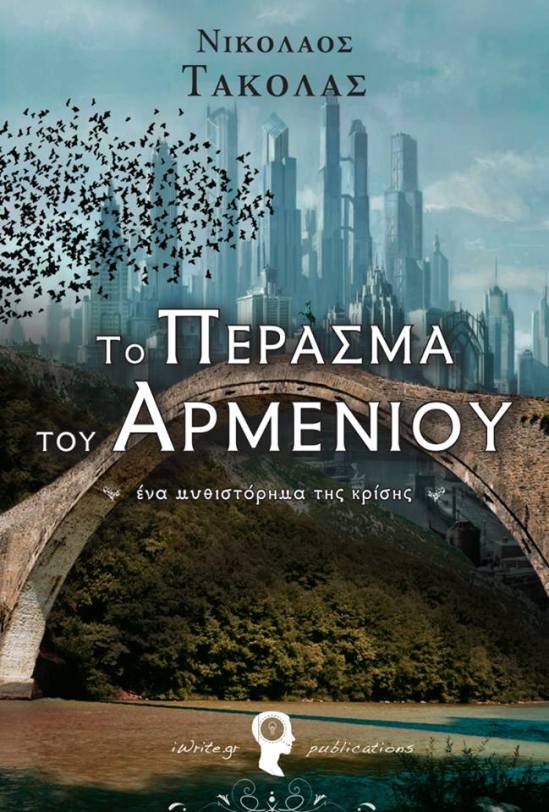
Γνώρισα τον συγγραφέα Νίκο Τακόλα μέσα από τις σελίδες του βιβλίου του «Το Πέρασμα του Αρμένιου». Τον αναζήτησα και δώσαμε ραντεβού στη Θεσσαλονίκη, τον τόπο διαμονής του για μια κουβέντα λύνοντας τις απορίες μου, θέτοντας τους προβληματισμούς μου και μιλώντας για όλα περί συγγραφής και οικολογίας…
Κύριε Τακόλα ευχαριστώ για τη συνέντευξη που μου παραχωρείτε για το Bookia. Μιλήστε μου για το συγγραφικό ταξίδι σας. Για τα βιβλία που έχετε γράψει μέχρι σήμερα.
Εγώ σας ευχαριστώ για την ευγενική σας πρόσκληση, κυρία Παπαδημητρίου-Σαμοθράκη. Μέχρι σήμερα εξέδωσα 2 συλλογές διηγημάτων (α. «Το κρυμμένο αριστούργημα του Ζοζέφ Ινεμπράο», β.«ΤΟ ΚΑΣΤΡΟ ΤΗΣ ΝΙΦΑΔΑΣ») και ένα μυθιστόρημα, το περί ού ο λόγος. Ένα δεύτερο μυθιστόρημα αξιολογείται στους εκδότες. Επειδή μου αρέσουν και τα δύο είδη λογοτεχνίας, επιθυμώ να συνεχίσω εναλλάξ, διήγημα – μυθιστόρημα, όσο μπορώ. Από διαγωνισμούς διηγημάτων συνέλεξα δυο πρώτα βραβεία, ένα δεύτερο, ένα τρίτο και δυο επαίνους. Αλλά ιδιαίτερα καμαρώνω για τις οκτώ συλλογικές συμμετοχές μου.
«Το Πέρασμα του Αρμένιου» είναι ένα φανταστικό, οικολογικό μυθιστόρημα.
Θα ‘λεγα ότι το βιβλίο έχει αυτές τις όψεις, του φανταστικού, οικολογικού και αρκετές άλλες ίσως, όπως πολιτικές, μετα-επιστημονικές και ψυχολογικές. Ωστόσο η πρόθεσή μου ήταν αμιγώς λογοτεχνική, δηλ. να εκφράσω την εποχή της κρίσης και του μέλλοντός μας μέσα απ΄ τις δυνατότητες της λογοτεχνίας να φτιάχνει αμάλγαμα πολλών συστατικών, μιλώντας σιγανά κι όσο γίνεται πειστικά στην ψυχή. Εκεί που αναζητώ την τοποθέτηση του ατόμου στο πρόβλημα.
Ο αναγνώστης που θα το διαβάσει το βιβλίο θα κάνει ένα πέρασμα από τα χρόνια του Μαρίνου Αντύπα στο θεσσαλικό κάμπο στο μέλλον που, όπως το διάβασα, δεν απέχει πολύ από σήμερα μ’ αυτά που βλέπω ότι συντελούνται. Γιατί κάνατε συγγραφικά αυτό το «πέρασμα.
Το βιβλίο αναζητά την πηγή των κρίσεων στους αιώνες. Πώς έρχονται οι κρίσεις, ποιος τις προκαλεί, ποιο είναι το μέλλον μας, γιατί οι άνθρωποι δεν αντιδρούν; Επειδή, όμως, δεν πρόκειται για δοκίμιο αλλά για λογοτεχνία επέλεξα τις κοντινότερες σε μας ιστορικές πραγματικότητες, ενδεικτικά. Το μετά το 1900 και το μετά το 2030 διάστημα, σχηματικά.
Μάξιμος Καλλεργάς και Κάνον! Οι δυο ήρωες που έχουν το δικό τους σημαντικό ρόλο στο μυθιστόρημα. Ποια είναι τα μηνύματα που δίνουν στον αναγνώστη;
Λογοτεχνικά πρόκειται για τον «ίδιο» άνθρωπο, αν και ζουν με διαφορά 100 χρόνων τουλάχιστον μεταξύ τους. Προβάλλεται όχι το μοντέλο του «επαναστάτη», αλλά του «πολίτη» που νοιάζεται για την εποχή του και συμμετέχει, όπως στις αρχαίες κοινωνίες.
Τι σημαίνει για εσάς Οικολογία; Πρωτογενής παραγωγή, Νερό, ενέργεια.. Οι πολυεθνικές μας οδηγούν στα μεταλλαγμένα, το νερό ιδιωτικοποιείται, η ενέργεια επίσης . Οι ανεμογεννήτριες τι ρόλο θα παίξουν; Ποιο είναι το μέλλον μας;
Πολύ απλά Οικολογία είναι το ενδιαφέρον του ανθρώπου, όχι μόνο για το περιβάλλον (κλιματική αλλαγή, υπερθέρμανση του πλανήτη, λιώσιμο των πόλων κλπ) αλλά και για τις συνθήκες διαβίωσης στον πλανήτη (δικαιώματα των ανθρώπων, μεταλλαγμένα προϊόντα, κοινωνικές ανισότητες κλπ). Ένα κινηματικό δόγμα της οικολογίας είναι πως αν θέλεις ένα καλύτερο μέλλον ..φτιάξτο.
Γράφετε ότι «χωρίς όραμα ελευθερίας η ζωή γίνεται ανούσια και πεζή» Δεν έχουμε σήμερα οράματα; Κι αν όχι, υπάρχει κάτι που θα μας ταρακουνήσει; Πιστεύετε ότι ένα βιβλίο είναι ικανό ότι μπορεί να προβληματίσει και να ξεσηκώσει τον αναγνώστη; Ή όπως γράφετε διά στόματος Γάιου Ιούλιου Καίσαρα χρειάζεται τόλμη, οργάνωση και κυρίως δράση;
Ο συγγραφέας Paul Auster ισχυρίζεται πως η πραγματική δημοκρατία, άρα και η ιδανική ελευθερία, έζησε μόνο 5 μήνες στην Αθήνα του Περικλή. Εμείς δημοκρατία ονομάζουμε την καθεστηκυία βαρβαρότητα της εποχής μας, όπου βομβαρδίζονται χώρες, νοσοκομεία και νηπιαγωγεία, χωρίς παγκόσμια ανατριχίλα. Τα σημερινά βιβλία λίγα πράγματα μπορούν να προσφέρουν στην κοινωνική αλλαγή, ενώ η Βίβλος και τα Ομηρικά Έπη καθόρισαν την εποχή τους. Σίγουρα ένα καλό βιβλίο αλλάζει το μυαλό των ανθρώπων αλλά πρέπει να ακολουθήσει και αντίστοιχη δράση.
Γράφετε στο βιβλίο σας: «Λίγη η στοργή, μεγάλη η Γη, περισσεύει οργή» Μήπως η κρίση μας έχει κάνει κι εμάς να είμαστε όπως οι άνθρωποι μέσα στο Κάστρο; Πειθήνια όργανα που μας έχουν βάλει ένα τσιπάκι να μας ελέγχουν χωρίς δικαίωμα αντίδρασης;
Λίγο πολύ όλη η ανθρωπότητα ρέπει στη διαίρεση της κοινωνίας του βιβλίου. Οι φτωχοί να μην έχουν ορατό μέλλον και οι μεσαίες τάξεις να αρκούνται μόνο σε ό,τι το σύστημα προσφέρει.
Όταν ήμασταν παιδιά βλέπαμε φανταστικές ταινίες στην τηλεόραση με αυτοκίνητα που μιλούσαν. Σήμερα έχουμε τα GPS και τα ρομπότ που είναι κάτι παρόμοιο. Σύγχρονες εφευρέσεις αφήνουν ουρές ανέργων. Τι ακόμη μπορεί να δούμε αν αφήσουμε τη τύχη μας σε οποιαδήποτε εξουσία;
Είναι προφανές ότι η ωφέλιμη κοινωνικά επιστήμη, πχ φάρμακα, είναι απαραίτητη. Υπάρχει και η επικίνδυνη επιστήμη, όμως. Π.χ τα όπλα, η καταχρηστική αυτοματοποίηση και η τεχνητή ευφυΐα, όπως επεσήμανε πρόσφατα ο Στήβεν Χώκινγκ. Θεώρησε μάλιστα την τεχνητή ευφυΐα απειλή αφάνισης του ανθρώπινου είδους.
«Και τι μπορείς να κάνεις με τραγούδια και πανηγύρια; Εδώ πρέπει να πείσουμε τον κόσμο πώς πρέπει να κάνει κάτι. Κοιμήθηκαν όλοι». Θέλουμε πάντα ένα αρχηγό να μας καθοδηγεί ως ποίμνιο; Πώς ο καθένας μας μπορεί να δράσει για το μέλλον το δικό του μα και των παιδιών του; Οι αρχηγοί είναι απαραίτητοι για να δείξουν το δρόμο. Από κει και πέρα η ευθύνη περνάει στη μαζική συμμετοχή.
Τα λογοτεχνικά βιβλία, ελληνικά ή ξένα σήμερα τα διαβάζουμε για ευχαρίστηση ή προβληματισμό; Τι επιδιώκουν σήμερα οι εκδόσεις και στη συνέχεια οι αναγνώστες; Να ξεφεύγουν από τα οικονομικά προβλήματα;
Οι αναγνώστες ρέπουν έντονα στο εύκολο και το διασκεδαστικό. Τα «βιβλία παραλίας», με πέντε βασικά μοτίβα, έχουν την τιμητική τους. Παγκόσμια κυκλοφορούν κυρίαρχα ανώδυνα βιβλία, ερωτικά και αστυνομικά κυρίως. Η χώρα μας μετά τη δεκαετία του 80, προσχώρησε στη λέσχη αυτή, συν ευυπόληπτα περί χαμένων πατρίδων (Πόντος, Πόλη, Αλεξάνδρεια κλπ).
Φοβόμαστε και κοιτούμε τον εαυτούλη μας ή νιώθουμε προδομένοι και αδιαφορούμε για τα πάντα;
Υπάρχει έλλειμμα Ελευθερίας, όπως προαναφέραμε. Δημοσίως δεν αναφέρονται βασικά προβλήματα που αφορούν τον καθένα αλλά άσχετα υποκατάστατα.
Πάντα γράφετε με οργή όταν πρόκειται να μεταφέρετε μηνύματα στους αναγνώστες γιατί υποψιάζομαι ότι «το πέρασμα του Αρμένιου» γράφτηκε με φορτισμένη διάθεση…
Η οργή ήταν και το κίνητρο γραφής αυτού του βιβλίου, αφού ένιωθα να προσβάλλεται βάναυσα μια ολόκληρη χώρα, ως χώρα τεμπέληδων ανίκανων, ανέντιμων και αδιάφορων. Παρά τη σοβαρή διάβρωση μεγάλου μέρους του πληθυσμού, ένα άλλο μέρος ήταν το αντίθετο αυτού ακριβώς. Οι διακρίσεις των Ελλήνων στο εξωτερικό το επαληθεύουν. Έζησα σε πολλά κράτη και ξέρω καλά τα όριά τους. Οι ξένοι, θεωρώ, υστερούν ημών στη συνολική σκέψη των επιστημών και στην κοινωνική άποψη. Εμείς στην οργάνωση, στην πειθαρχία και στη διαχρονικότητα.. Την τελευταία τη δικαιούνται μόνον οι αρχαίοι μας πρόγονοι.
Πριν κλείσω και σας ευχαριστήσω για τη συνέντευξη, θέλω να ομολογήσω ότι κέρδισα πολλά από αυτό το βιβλίο. Ποια συγγραφικά σχέδια έχετε στο μέλλον κι αν θέλετε να μας δώσετε το μότο σας ή την ευχή σας.
Και εγώ ευχαριστώ για την τιμή να διαβάσετε το βιβλίο μου και χαίρομαι αν αυτό σας πρόσφερε κάτι. Λόγω της τάσης μου να γράφω συνεχώς διηγήματα θα …προκύπτουν βιβλία διηγημάτων. Αυτό είναι το μισό του ..ουρανού. Το άλλο μισό είναι τα μυθιστορήματα. Στα μυθιστορήματα φιλοδοξώ να συμπεριλάβω και ένα με θέμα την ιδιαιτέρα πατρίδα μου, τα Γρεβενά, με το σεβασμό του Κοσμά Πολίτη στο Γυρί.
Το Bookia σας εύχεται να είναι καλοτάξιδο όπως και τα επόμενα βιβλία σας που θα ακολουθήσουν.
Ο ποιητής έχει πάντα μέσα του το ένστικτο, που τον σπρώχνει να γράψει. Ξεκινάει από το ορμέμφυτο
Ο ποιητικός λόγος του Θεοχάρη Παπαδόπουλου είναι οξύς, κόβει σαν λεπίδα τον αναγνώστη με την αμεσότητα του συναισθήματος και την ίδια τη δυναμική της εκφραστικότητας του ποιητή.
Λόγος που εμφορείται από μια υποβόσκουσα κριτική ματιά για τη γύρω πραγματικότητα την οποία καυτηριάζει με μια υποδόρια ειρωνική διάθεση που πολλές φορές ανοίγει πολλαπλούς δρόμους στην ποίησή του.
Το νόημα δεν δίνεται εύκολα σ’ αυτόν που θα διαβάσει την ποίηση του Θεοχάρη Παπαδόπουλου. Ο αναγνώστης πρέπει να μπει στον τρόπο σκέψης του ίδιου του ποιητή για να διανοίξει τον ποιητικό κόσμο του Θεοχάρη Παπαδόπουλου.
Ο κόσμος της ποίησης του Θεοχάρη Παπαδόπουλου καθρεφτίζει την κοινωνική καταχνιά που μαστίζει το σήμερα. Τοπία έρημα, σπίτια γεμάτα αναμνήσεις που τριβελίζουν, άδειες καρέκλες που κουβαλούν ιστορίες, μάτια θλιμμένα και παράθυρα με «κρυσταλλιασμένο» χιόνι.
Και ανάμεσα στο ποιητικό τοπίο που φτιάχνει ο Θεοχάρης Παπαδόπουλος ο ανολοκλήρωτος έρωτας που δεν του έχει απομείνει κάτι να κρύψει τη γύμνια του.
Μόνο που ο ποιητής μέσα από τη δική του οπτική γωνία μας δείχνει όλην τη γύμνια που κυριαρχεί μέσα και γύρω μας…
Πως αντιμετωπίζετε την ποίηση: ως μια ταυτότητα ή ως μια ετερότητα μέσα στη σύγχρονη ζωή;
Η ποίηση ξεκινάει σαν ταυτότητα, δηλαδή, προέρχεται από την έμφυτη τάση, που έχουν μέσα τους οι άνθρωποι για δημιουργία, όμως, πολλές φορές η ποίηση καταλήγει ως ετερότητα, δηλαδή, επηρεάζεται από τον κοινωνικό περίγυρο.
Ένας ποιητής μπορεί να εμπνευστεί από τις εικόνες της οικονομικής κρίσης και να τις μετουσιώσει σε ποίημα. Αυτό δεν σημαίνει ότι ξεκίνησε να γράφει με αυτή την προοπτική. Όμως, για να είναι κάποιος ποιητής, πρέπει να το έχει μέσα του. Όπως έχει γράψει και ο Ρίλκε να μην μπορεί να ζήσει χωρίς να γράφει.
Ο ποιητής είναι μια περσόνα γύρω από τις λέξεις ή λειτουργεί με έναν ενστικτώδη ορμεμφυτισμό;
Ο ποιητής έχει πάντα μέσα του το ένστικτο, που τον σπρώχνει να γράψει. Ξεκινάει από το ορμέμφυτο. Δεν μένει, όμως, εκεί. Η έμπνευση είναι μεθύσι. Μπορεί να οδηγήσει ακόμα και σε λογικά λάθη ή λάθη, που δεν μπορούν να δικαιολογηθούν από την περίφημη ποιητική αδεία.
Ο Paul Valery έχει γράψει: «Τον πρώτο στίχο μας τον δίνουν οι θεοί». Και με τους υπόλοιπους, τι γίνεται;
Ο Διονύσιος Σολωμός έρχεται να συμπληρώσει: «και μετά με καιρό και κόπο θα γραφτεί το ποίημα». Η ποίηση χρειάζεται διορθώσεις.
Προσεχτικό ξαναδιάβασμα του ποιήματος, λίγες μέρες αφού έχει γραφτεί και σβήσιμο, γράψιμο, ξανασβήσιμο και ξαναγράψιμο. Ακόμα και σκίσιμο αν χρειαστεί. Πολλοί σπουδαίοι ποιητές ήταν πολλοί σκληροί με τον εαυτό τους και γι’ αυτό μας άφησαν έργο, που δεν φημίζεται για την ποσότητα, αλλά για την ποιότητά του.
Ο Καβάφης έφτασε να αποκηρύξει τα πρώτα του ποιήματα, ενώ τα ποιήματα των Καββαδία, Πορφύρα και άλλων γνωστών ποιητών είναι λίγα και καλά. Σήμερα, πολλοί ποιητές γράφουν τα ποιήματά τους και χωρίς να τα ξανακοιτάξουν τα σκορπάνε στο facebook και στα διάφορα λογοτεχνικά blogs. Δεν θεωρώ ως κακό το ότι γράφουν, αλλά το ότι δεν διορθώνουν όσα γράφουν.
Μπορεί η τέχνη να κλείσει τις πληγές των ανθρώπων μέσα σε μια ενδότερη υπαρξιακή διαλεκτική;
Σίγουρα η τέχνη μπορεί να βοηθήσει τον άνθρωπο να ξεπεράσει ορισμένες δυσάρεστες καταστάσεις. Διάφορες τέχνες έχουν ήδη χρησιμοποιηθεί για θεραπευτικούς σκοπούς και ιδιαίτερα η μουσική είναι μια τέχνη, που μπορεί να βοηθήσει, ενδεχομένως και η ποίηση.
Όμως, άλλο το προσωρινό βάλσαμο και άλλο το κλείσιμο των πληγών. Οι κοινωνικές αδικίες δεν διορθώνονται με την τέχνη. Έχει ειπωθεί πως «ουκ επ’ άρτω μόνο ζήσεται άνθρωπος» και ότι ο άνθρωπος χρειάζεται άρτον και θεάματα, όμως, τι γίνεται, όταν εκλείπει ο άρτος και μένουν μόνο τα θεάματα;
Υπάρχει μια πολλή όμορφη λαϊκή παροιμία, που λέει πως: «Νηστικό αρκούδι δεν χορεύει». Όμως, μέσα από την τέχνη, μπορεί να εμπνευστούμε για το πώς κλείνουν οι πληγές, συμπεριλαμβάνοντας και τις κοινωνικές αδικίες.
Πιστεύετε ότι ακολουθείτε το δρόμο άλλων ποιητών ή ακολουθείτε μια μοναχική πορεία μέσα στη γραφή σας;
Θα ήταν πολύ μεγάλη ασέβεια να πω ότι έχω καταφέρει να ακολουθώ τον δρόμο άλλων ποιητών. Εννοείται πως εμπνέομαι από τους άλλους ποιητές. Στην ποίηση δεν υπάρχουν παρθενογενέσεις. Όσο πιο καλός είναι ένας ποιητής, τόσο περισσότερο έχει διαβάσει.
Είχαν ρωτήσει κάποτε έναν νεαρό ποιητή, ποια είναι τα πρότυπά του στην ποίηση και είχε απαντήσει ότι διαβάζει ελάχιστα για να μην επηρεαστεί η έμπνευσή του! Το διάβασμα είναι απαραίτητο. Όλοι οι ποιητές ξεκινούν με μιμήσεις και μετά διαμορφώνουν το δικό τους προσωπικό στυλ. Το δικό μου στυλ είναι μια προσπάθεια απογείωσης στο τέλος του ποιήματος.
Ένας τελευταίος στίχος, που να ανατρέπει, να ξαφνιάζει, να απογειώνει το ποίημα. Δεν πιστεύω ότι το πετυχαίνω πάντα, αλλά, τουλάχιστον, το προσπαθώ.
Ποιές εικόνες κρατάτε μέσα σας από τη ζωή σας; Ποιές εικόνες με άλλα λόγια εφορμούν στη γραφή σας;
Είναι οι εικόνες της καθημερινότητας, που ζω. Από απλές εικόνες, που θα μπορούσαν να θεωρηθούν πεζές , μέχρι και εικόνες, πολύ ποιητικές. Μπορεί να με εμπνεύσει ένα ωραίο ηλιοβασίλεμα, μπορεί, όμως, να με εμπνεύσει και κάποιος, που ψάχνει στα σκουπίδια ή η είδηση ότι πνίγηκαν πρόσφυγες στο Αιγαίο. Μπορώ να εμπνευστώ ακόμα και από απλά, καθημερινά αντικείμενα. Όπως έχει γράψει και ο Τσέχωφ: «Φέρτε μου ένα ποτήρι κι εγώ θα σας γράψω ένα διήγημα για το ποτήρι».
Ποια ερωτήματα καλείται να απαντήσει ο ποιητής διαχρονικά αλλά και στο παρόν που ζούμε;
Τα διαχρονικά ερωτήματα, που καλείται να απαντήσει ο ποιητής έχουν να κάνουν με θέματα, που έχουν ασχοληθεί οι περισσότεροι ποιητές. Ο έρωτας και τα μεγάλα υπαρξιακά ερωτήματα του ανθρώπου, νομίζω ότι έχουν απασχολήσει λίγο-πολύ τους περισσότερους ποιητές, ενώ αρκετοί έχουν ασχοληθεί και με τον κοινωνικό προβληματισμό της εποχής τους.
Στην εποχή μας, όλο και περισσότεροι ποιητές ασχολούνται με την κρίση και αυτό συμβαίνει, ιδιαίτερα στην Ελλάδα, όχι από κάποια μόδα, αλλά από αναγκαιότητα έκφρασης και αναζήτησης διεξόδων.
Ποιο το νόημα της λέξης στην ποίηση; Μια απλή μορφή έκφρασης ή ένα ψυχικό αποτύπωμα;
Εξαρτάται από το πώς θα χειριστεί τη λέξη ο ποιητής. Μια λέξη μπορεί να χρησιμοποιηθεί για να δώσει πολλά και διαφορετικά νοήματα. Από μόνη της μια λέξη δεν σημαίνει τίποτα αν δεν προσδιοριστεί. Σήμερα συναντάμε πολλούς ποιητές, που έχουν επηρεαστεί από το κίνημα του γλωσσοκεντρισμού. Δηλαδή, παιχνίδι με λέξεις, έτσι ώστε να δημιουργούνται όσο γίνεται περισσότερες παρηχήσεις, χωρίς να έχει σημασία το νόημα του ποιήματος.
Κάπως έτσι είχε εξελιχθεί και η λετριστική ποίηση. Σήμερα, κατά τη γνώμη μου, αυτά τα είδη είναι ξεπερασμένα. Ο ποιητής, για να θυμηθούμε λίγο και τον Coleridge, πρέπει να βάλει τις κατάλληλες λέξεις στη σωστή σειρά.
Είναι η ποίηση το καταφύγιο του ανθρώπου;
Ναι, η ποίηση μπορεί να γίνει καταφύγιο του ανθρώπου, γιατί τόσο ο άνθρωπος που διαβάζει ποίηση, όσο και ο άνθρωπος που γράφει ποίηση την έχουν ανάγκη. Ο άνθρωπος, που διαβάζει ποίηση, καταφεύγει σε εκείνη για να ζήσει ορισμένες όμορφες στιγμές.
Για να συγκλονιστεί και να εξυψωθεί πνευματικά. Ο άνθρωπος, που γράφει ποίηση, πολλές φορές γράφει για να ξεσπάσει, για να πνίξει τον πόνο του, για να νιώσει καλύτερα. Πολλοί ποιητές, γράφοντας σε στιγμές μεγάλου πόνου μας έδωσαν τα καλύτερά τους ποιήματα.
Μπορεί ο κόσμος να ζήσει ποιητικά;
Στη σύγχρονη κοινωνία κρίσης και παρακμής, όχι. Όταν, οι περισσότεροι άνθρωποι, έχουν μια εξοντωτική ρουτίνα σπίτι – δουλειά – δουλειά – σπίτι, όταν ο ελεύθερος χρόνος συρρικνώνεται όλο και περισσότερο, τότε δεν μπορούμε να μιλάμε για ποιητική ζωή.
Σε μια καλύτερη μελλοντική κοινωνία, αν έχει εκλείψει η εκμετάλλευση ανθρώπου από άνθρωπο, τότε, ίσως, ο κόσμος να μπορεί να ζήσει ποιητικά. Ίσως ο άνθρωπος να μπορεί να βάλει περισσότερη ποιητικότητα στη ζωή του.
*Ο Αντρέας Πολυκάρπου είναι υποψήφιος διδάκτορας στο Πάντειο Πανεπιστήμιο στο τμήμα Επικοινωνίας Μέσων και Πολιτισμού. Επιστημονικά άρθρα του δημοσιεύτηκαν σε Ελλάδα και Κύπρο. Εξέδωσε δύο ποιητικές συλλογές στην Κύπρο και το 2013 εξέδωσε την τρίτη του ποιητική συλλογή «Απρόσωπα Φαγιούμ», στις εκδόσεις Άπαρσις στην Αθήνα. Το 2014 εκδόθηκε το θεατρικό του έργο «Κατά Ιωάννη Αποκαθήλωση» από τις εκδόσεις Vakxikon.gr στην Αθήνα. Ποιήματα του δημοσιεύτηκαν σε έντυπα και ηλεκτρονικά λογοτεχνικά περιοδικά και μεταφράστηκαν στα αγγλικά. Το 2008 και το 2010 βραβεύτηκε από τη European Commission για δημοσιογραφικές του έρευνες και εκπροσώπησε τη χώρα του σε Σλοβενία και Κωνσταντινούπολη αντίστοιχα.
Η Λίνα Φου, αγαπημένη ποιήτρια, ηθοποιός, δημοσιογράφος, και διανοούμενη του «δημιουργι-κού μηδενός», απαντά σε 15 ερωτήσεις, του Μανώλη Νταλούκα.
Πριν λίγους μήνες, θαυμάσαμε την ερμηνεία της, στο βιντεοκλίπ του Παύλου Παυλίδη, Έλα Κοντά μου.
1.Πες μου ένα βιβλίο, που θα σου μείνει αξέχαστο
“Les Misérables”, Victor Hugo.
2.Ένα μικρό κορίτσι, κάθεται στα σκαλιά, του σπιτιού του και κλαίει. Γιατί; Τι έχει συμβεί πριν, και τι θα γίνει μετά; Συμπλήρωσε την εικόνα.
Τσάντες, γύρω της, αζήτητα πράγματα γεμάτες. Το λούτρινο γατί δεν ήταν στο στομάχι καμιανής. Κλαίει. Δυνατά. Πιο δυνατά. Μα το κλάμα των παιδιών μοιάζει με νιάου των γατών. Ένα ορφανό γατί ακούει στο κλάμα τη μαμά του. Ένα γατί με καρδιά μέσα, να χτυπά. Ξαπλώνει δίπλα της. Εκείνη χαμογελά. Γελά. Ουρλιάζει από χαρά. Αχώριστες έως σήμερα.
3.«Θα’ ρθει μια μέρα που η γη θα ενωθεί με τον ήλιο». Το πιστεύεις αυτό;
Είναι ένα από τα επικρατέστερα επιστημονικά σενάρια για το μακρινό μέλλον του ηλιακού μας συστήματος. Η νομοτέλεια του σύμπαντος προβλέπει πάντοτε την καταστροφή και την αναδημιουργία. Τα καύσιμα του ήλιου θα τελειώσουν. Θα γίνει ένα πελώριος ερυθρός γίγαντας. Πιθανότατα να καταπιεί τη γη. Τότε θα είναι σαν να μην υπήρξαμε ποτέ. Σε κάποιον άλλον πλανήτη θα υπάρχουν ίσως οι κατάλληλες συνθήκες για ύπαρξη ζωής. Στο δικό μου μυαλό όμως, κάποιοι άνθρωποι, φλογεροί άνθρωποι, θα επιβιώσουν και τότε. Είναι αυτοί που σήμερα φωνάζουν παθιασμένα στους δρόμους για λευτεριά. Αυτοί δεν καταλαβαίνουνε απο φωτιά, την έχουνε να καίει μέσα τους. Εξού και το ποίημα που έγραψα.
4.Ποιο θεωρείς το μεγαλύτερο εμπόδιο, στην κίνηση προς την ελευθερία;
Την εκπαίδευση. Είναι προς λάθος κατεύθυνση. Εκπαιδευόμαστε να γίνουμε παραγωγικοί δούλοι. Η δουλικότητα του ανθρώπου λοιπόν πίσω από την οποία βρίσκεται και η εκπαίδευση πίσω από την οποία βρίσκεται και η εξουσία.
5.Τι ήταν αυτό, που κάποτε έκανες, και τώρα θεωρείς ως μεγαλύτερή σου βλακεία;
Όλα τα έκανα με πάθος. Τίποτα δε θυμάμαι ως βλακεία, ούτε καν τη μεγαλύτερη.
6.Για ποιο λόγο, θα έλεγες σε κάποιον ή κάποια «άντε γαμήσου ρε μαλάκα!»
Βία σε ζώο ή παιδί. Προσβολή για φυσικά χαρακτηριστικά όπως το χρώμα. Για αδικία. Αλλά σιγά μην του έλεγα μόνο αυτό, αυτό το λέω για πλάκα σε φίλους.
7.Έχεις μισήσει άνθρωπο; και αν ναι, για ποιον λόγο;
Δε θυμάμαι να έχω μισήσει ή να μισώ. Έχω πάρει τόση αγάπη από την οικογένειά μου που δεν μου έχει αφήσει αυτό το περιθώριο. Συνήθως δικαιολογώ πράγματα. Ωστόσο θα μπορούσα να πω πως μισώ την αδικία συνεπώς και όποιον τη διαπράττει. Αλλα δεν είναι κάτι παθητικό για εμένα, σίγουρα θα το δείξω στην πράξη.
8.Πιστεύεις στον Θεό;
Όχι. Ωστόσο.
9.Πώς νομίζεις ότι θα είσαι, μετά από δέκα χρόνια;
Δηλαδή στα 37; Μπερμπάντισα.
10.Ο μεγαλύτερος φόβος σου, είναι…
Το μυαλό μου. Μπορεί να πυροδοτήσει πυρηνικό πόλεμο στο σώμα μου αλλά και σ’ όλον τον κόσμο..
11.Αγαπημένο τραγούδι σου, είναι…
Κάτι από The Cure. Ισως το Homesick. Ή απο Lebanon Hanover. Ή απο Sisters of Mercy.
12.Αγαπημένο σου ποίημα, είναι…
Το πρώτο και άτιτλο απο τη συλλογή της Γώγου «Απόντες». Ωστόσο αγαπώ και το «Dreams» από τη συλλογή «The Death Baby» της Sexton.
13.Έχεις κλέψει ποτέ; Και τι;
Αν έχω απαλλοτριώσει εννοείς; Θα ήθελα να είμαι ο Ρομπέν των Δασών…
14.Νομίζεις ότι το περιβάλλον, επηρεάζει τον άνθρωπο; Και αν ναι, ποιο είναι το ιδανικό περιβάλλον;
Βέβαια επηρεάζει. Ενα παιδί είναι tabula rasa. Διαμορφώνεται βάση του πού πότε με ποιούς γιατί. Το ιδανικό περιβάλλον είναι αυτό πού έχει δικαιοσύνη και αγάπη, αγάπη, αγάπη. Ό,τι έχει ζωή θέλει αγάπη για να προχωρήσει. Οξυγόνο. Νερό.
15.Λες πάντα ψέματα ή πάντα αλήθεια;
Δεν έχω το θάρρος ακόμα να λέω πάντα αλήθεια. Το δουλεύω όμως.
Άλλες πληροφορίες για την Λίνα Φου (Φούντογλου)
Τώρα, μπορείτε να την δείτε, στον ρόλο της Ρόουζ, στην θεατρική παράσταση:
Χορεύοντας στη Λούνασα [Brian Friel]
ΔΗΠΕΘΕ Κοζάνης – ΔΗΠΕΘΕ Ιωαννίνων
Κατόπιν πρόσφατης διαδικτυακής ανασκαφής, νέα λογοτεχνικά ιστολόγια- κοινώς blogs- ήρθαν να προστεθούν στους σελιδοδείκτες μου, ανοίγοντας ένα νέο παράθυρο σε εκείνη την αφανή- αλλά όχι άφατη λογοτεχνία- που στριμώχνεται στις παρυφές του ιστοχώρου και όλο λανθάνει της ευρείας αποδοχής και αναγνώρισης, δίχως συχνά να υστερεί σε περιεχόμενο και πρωτοτυπία.
#1 “caricature of intimacy”
Το ιστολόγιο “caricature of intimacy” κατέχει τα σκήπτρα της διαδικτυακής αυτής εξόρυξης, συγκροτώντας ένα σκληρό λογοτεχνικό πυρήνα με μια γραφή τραχιά μα συνάμα και νεόκοπη. Το εν λόγω blog μετράει σχεδόν τέσσερα χρόνια διαδικτυακής παρουσίας και διατίθεται ελεύθερα προς σφυγμομέτρηση του ποιητικού παλμού της δημιουργού του. Ολίγον τι αιρετική και ταυτόχρονα παιδιάστικα αθώα, η Τσεβή Τζιτζίκου εξορμεί στις ουτοπίες του λόγου, για να αποκρυσταλλώσει στο χρόνο τις δικές της καθημερινές συναισθηματικές ευτοπίες και δυστοπίες. Τα ποιήματά της αναδίδουν μια αφοπλιστική αυθεντικότητα και η ανάγνωση κυλά εν είδει λαχταριστού χρονογραφήματος. Η προκλητικότητα του ύφους της, και η ευθύβολη ματιά της στα πράγματα μετατρέπουν εκείνο το άλλοτε κρυφό νόημα στην πιο άμεση δήλωση ενώ απογυμνώνουν το περιεχόμενο των ανθρώπινων σχέσεων στα πιο καθαρά και σχιζοειδή θραύσματα του είναι.

Caricature of intimacy: «Γέμισαν τα δειλινά τον αέρα με τ’ άρωμα του ήλιου που πήγε να πνιγεί πίσω απ’ των αιώνων το λαμπρό νεκροταφείο»
Καιρός
Το παραμύθι δεν τελειώνει
αν δε το πω εγώ.
Πότε θα γκρεμίζω
πότε θα χτίζω
τα υποθετικά μας κάστρα
τα φανταστικά μου άλογα.
Πότε θα καίω εσένα
πότε ολάκερο το βασίλειο.
Πύκνωσε η βλάστηση,
μέσα στην ομορφιά της
σκίστηκα γυμνή,
ανάμεσα στ’ αγκάθια.
Η νίκη μου θα είναι
να περάσω το πλακόστρωτο
κάνοντας μια σκέψη
για εκείνο το μπαλκόνι,
που να μην έχει στίγμα
πραγματικότητας.
Το παραμύθι δεν τελειώνει
αν δε χορέψεις στο σκοπό.
Αυτόν που σου ψιθυρίζω
μέσα από τις λέξεις
που άτακτα εγκαταλείπω.
Εδώ.
Πάλι εσύ
Ποια είναι τα όρια σου, κι αν τα ξεπεράσεις τι θα συμβεί;
Ακούω μελωδίες και τ’ αυτιά μου πλημμυρίζουν από σένα.
Στο μυαλό μου σ’ αγγίζω με φτερά αγγέλων
τόσο απαλά ώστε να νομίζεις πως κοιμάσαι.
Θαυμάζω το δέρμα σου και κλαίω που τα κύτταρά μου
δε θα μπορέσουν ποτέ να το διαπεράσουν.
Δύο όντα, ένας έρωτας, ο δικός μου.
Κάθε φορά που αναπνέω καθαρό αέρα
μπαίνεις μέσα μου σαν σκόνη
κάθεσαι πάνω στα πνευμόνια μου
και στέκομαι στο λιμάνι
σκέφτομαι να πηδήξω
για να σε πνίξω
να πάψεις.
Ζητάω να δω στα μάτια σου
όλα τα μυστήρια του μάταιου κόσμου
το μειδίαμα σου μου εξομολογείται
το φόβο σου να ‘ρθεις κοντά μου
και το λατρεύω, όπως λατρεύω κάθε τι
που ήρθε δίπλα μου σπασμένο
κι άφησε να το σπάσω δυο φορές.
Πρώτη, δεύτερη, 5 μέρες
5 χρόνια.
Πόσες φορές ζητάς να μ’ αρνηθείς;
#2 “Cenicero”
Ακόμα, από το λογοτεχνικό ψηφιδωτό του αχανούς διαδικτύου, το blog της Μέλπως Μέντε, “Cenicero”, που στα ισπανικά σημαίνει τασάκι, υπερέχει στις λογοτεχνικές μου προτιμήσεις, ίσως διότι η εν λόγω ποιητική μάζα κάθε άλλο παρά με στάχτη μοιάζει, κι όμως οι στίχοι της επιμένουν να αιωρούνται στην μνήμη, καιρό μετά την πρώτη ανάγνωση. Έρωτες και καθημερινά πάθη, ιδέες και λύσεις που δεν βρίσκονται παρελαύνουν σε σκοτεινό φόντο, και καπνίζονται με εξίσου συμβατή μουσική υπόκρουση. Τα αποτελέσματα αυτών των αναζητήσεων κατατίθενται και προσπαθούν να σβήσουν στο φιλόξενο τασάκι της δημιουργού τους. Το εν λόγω ποιητικό αποθετήριο [“Cenicero”] αριθμεί έξι χρόνια ηλεκτρονικής ζωής και φέρει πάνω του θετικά τα αγγίγματα του χρόνου. Η γραφή νοσταλγική και φορτισμένη, προδίδει σκληρές αναμετρήσεις με τα φαινόμενα, τα τυχόν αδιέξοδα και τις υπαρξιακές απορίες , ενώ δεν είναι λίγες οι φορές που η γλαφυρότητα της απόδοσης μας ξεναγεί στα παρασκήνια, μιας ζωής, αν μη τι άλλο, συγγενικής με τη δική μας.

Cenicero:«Και θα σου λέω παραμύθια τις νύχτες, για να κοιμάσαι πιο εύκολα αλλά μόνη σου…Και ‘γω θα σβήνω, όταν θα σβήνει και η οθόνη σου».
But I still have to face the hours, don’t I?
Τώρα που τίποτα δεν σκέφτομαι
και παραιτήθηκα από την προσπάθεια να καταλάβω
κρύβομαι απ΄όλους αυτούς που μου ζητάν το λόγο
και γυρνάω στην βέβαιη ανασφάλεια μου
Τώρα που εκείνος ξεθωριάζει αντί να εκρήγνυται
και με κάνει να αμφιβάλλω για την ύπαρξή του
έρχεται στον νου μου η σκιά του δέντρου πίσω του
και όχι η δική του αυστηρή όψη
Τώρα που εκείνη έφυγε και εκείνη θρηνεί
θρηνώ μαζί τους την χαμένη συνήθεια
μαζεύω τα χυμένα τους δάκρυα
και τα κρατώ πετρωμένα κάτω απ το μαξιλάρι
Τώρα που ανακαλύπτω αυτόν
που τον φοβάμαι και τον ποθώ
και τρέμω στην ιδέα της απουσίας του
γίνομαι πάλι εκείνη που έλειπε για χρόνια
Τώρα που γνωρίστηκα με την απουσία της
κρατιέμαι με κόπο στην κατάλληλη απόσταση
τόσο που ο πόνος της να μην ξεπερνάει τον δικό μου
τόσο που τίποτα να μην ισχύει
Τώρα που δήλωσα την σειρά των πραγμάτων
νιώθω τα λόγια στιβαρά και άκαμπτα
ανίκανα να ανταποκριθούν σε όλα εκείνα
που έγιναν και όχι, μέσα η έξω από το μυαλό μου
Νιώθω εκείνες τις ώρες ανάμεσα
να βαραίνουν στο σώμα μου
να μαζεύονται και να μου ζητάν το λόγο
ψάχνω λοιπόν μια βολική γωνιά στην άκρη του εαυτού μου
Ψάχνω την μουσική που θα με φιλοξενήσει
θα γεμίσει το τρομακτικό κενό
θα φροντίσει τις πληγές- όχι τις δικές μου
μα όλων εκείνων που με βασανίζουν και μου δίνουν νόημα
Ο ελάχιστος ή επί 2
Κρύφτηκε πίσω από το βιβλίο της
-μπορούσα ακόμη να την δω
Έμοιαζε απορροφημένη
-πώς θα μπορούσε να ξεγελάσει εμένα
Γύρισε την σελίδα αδιάφορα
-όπως και την κόρη του ματιού της
Διέκρινα πλέον την ακτίνα του βλέμματός της
να περιεργάζεται την μορφή του
να σκαλίζει την περίμετρο του σώματός του
να μετράει τις ρυτίδες που όριζαν τη προσοχή του
Αυτό ήταν όλο.
Όταν με αντιλήφθηκε
της θύμισα
και μ ευχαρίστησε.
Κάθισα εκεί που καθόταν,
συνέχισα το βιβλίο της
ενώ έψαχνα αφορμή
να γυρίσω ακόμη μια φορά την σελίδα…
#3“Rhythm And Poetry»
Ολοκληρώνοντας αυτήν την ιστολογική ποιητική περιήγηση, το ποντίκι μου κοντοστέκεται στο “Rhythm And Poetry», και σε στίχους άλλης αισθητικής. Το blog – ενεργό από το 2014- φέρει την υπογραφή του Παράταιρου και εξιστορεί τον μίτο της δικής του υπαρξιακής κατάστασης. Μια υποκειμενικότητα που δίχως άλλο απλώνει γέφυρες με το συλλογικό υποσυνείδητο, προσφέροντας αμοντάριστα πλάνα μιας απαιτητικής πραγματικότητας. Αναγνωρίζοντας ο ίδιος ότι το να παραμείνεις ζωντανός ικανοποιείται με υπερπροσπάθεια, εξημερώνει το χάος και τα αδιέξοδα σε στίχους. Το ύφος του λιτό και γκροτέσκο, φωτίζει τα πιο σκληροτράχηλα ερεθίσματα που συνθέτουν την δική του αλήθεια. Στις λέξεις του, εξίσου έντονα, φιλοξενείται το κρητικό ιδίωμα, προδίδοντας λίγη πατρίδα στον λόγο. Η γραφή του κοφτή κι ελεύθερη, εκκινεί από αυτοβιογραφικές μεταδόσεις ενώ παράλληλα απλώνει δίχτυα σε κοινούς τόπους του εκάστοτε τώρα.
Rhythm And Poetry: «Η έντονη στεναχώρια ίσως και να ‘ ναι πιο ανάλαφρη απ’ την απάθεια Ασύγκριτα όλα με το πλησίασμά σου και μόνο Να με βλέπεις να μετανιώνω για κάθε λέξη που δεν πρόλαβα ή για παραπανίσιες λέξεις που έλεγα χωρίς να σ ‘ αγγίζω»
 Έξω απ’ το παράθυρό μου
Έξω απ’ το παράθυρο
μου βλέπω μια ιατρική καρέκλα
Πιο δίπλα ένα άλλο παράθυρο
και πίσω απ ‘ αυτό ένα σύνθετο γεμάτο βιβλία
Μέσα απ’ το παράθυρο μου είναι μια στοίβα βιβλία
που δεν κατάφερα να διαβάσω ποτέ
Γιατί σκεφτόμουνα εσένα.
Πιο ψηλά όμως έξω απ’ το παράθυρο μου
υπάρχει ένα άλλο παράθυρο
και εσύ ευτυχώς δεν είσαι πια εκεί
Ούτε μέσα απ ‘το παράθυρο μου βέβαια.
Έξω απ ‘το παράθυρο μου είναι ένας κόσμος
γεμάτος με σημεία που συναντηθήκαμε
όταν αποφασίσαμε να δούμε τι κρύβεται έξω απ ‘τα παράθυρα μας
ακόμα και να αποφύγω αυτόν τον κόσμο δεν έχει νόημα
Γιατί πάντα έξω από αυτό εδώ το παράθυρο που γράφω τώρα
θα υπάρχει πάντα το παράθυρο σου
ΣΙΝΕΜΑΣ Ο ΠΑΡΑΔΕΙΣOΣ
«Ένα αποχαιρετιστήριο πράγμα καθώς ανάσαινε,
κατέβαινε στο χολ»
Τσαρλς Μπουκόφσκι
Εγώ από την άλλη
Πέρασα την μέρα μου
κλεισμένος στον φωταγωγό
M’ ένα σκοτάδι πηχτό τόσο
που ένιωσα το χρώμα που ‘χουνε οι κόρες μου
Ύστερα βγήκα περιχαρείς στους δρόμους
και το αγέρωχο βήμα μου
προέδιδε την βασιλική μου καταγωγή
Στο ξεπεσμένο μου βασίλειο
κατοικούνε μυριάδες καρέ φιλμ
πάντα της ίδιας γωνίας λήψης
Το υλικό τους εύφλεκτο
και για να κρατήσω ζωντανή την μνήμη
χίλιους αιώνες τώρα γυρνάω με τα χέρια μου την μηχανή
σε δημόσιες υπαίθριες προβολές
Μετά τους τίτλους τέλους
απλώνω την τραγιάσκα μου στους περαστικούς
Μα όταν ξεχνιέμαι πότε πότε
πάντα στο ίδιο καρέ
Τα βλέπω όλα αυτά που με κόπο γέννησαν οι θύμησες
να λαμπαδιάζονται
Κι αφού δεν υπάρχει τίποτα άλλο
να καεί σε μια άδεια πλατεία από πέτρα
το πυρομάνι εικόνων κυνηγάει να κάψει εμένα τον ίδιο
Κάθε καλοκαίρι όμως όταν ο ήλιος πέφτει
στην ψάθινη τρύπια καρέκλα μου
Συνειδητοποιώ ότι οι μόνες επιλογές μου
κινούνται ανάμεσα σε στάχτες και ένα μυαλό Σίσυφο
20 τσιγάρα μετά
Δεν έχει καμία σημασία
Αφού ξέρω
«Η Αγάπη είναι ένας σκύλος απ ΄την κόλαση»
In January 1960 the San Francisco Examiner offered Kenneth Rexroth
a job writing a weekly column. He accepted. The column proved popular
enough that he was soon asked to do two and eventually three per week.
All told, Rexroth wrote more than 760 columns for the Examiner until he
was fired in July 1967 (apparently due to a controversial article he wrote
about the American police).
During the last seven years I’ve been posting all of these columns, 50 years
after their original appearance. They’re now all online at my website.
Needless to say, they vary widely in topic and interest. Some offer
incisive commentary that remains astonishingly relevant on all sorts of
general issues — social, political, cultural, ecological. Others are more
dated, such as reviews of particular musical or theatrical performances.
I think you will find, however, that his remarks about even the most
ephemeral topics are full of amusing observations and perceptive
insights, and that the ensemble constitutes a unique and fascinating
chronicle of those eventful years.
Here are just a few of the hundreds of different topics he treats:
Beckett and Ionesco
Ferlinghetti, Ginsberg, and the Modern Jazz Quartet
In praise of amateur Shakespeare
The Civil Rights movement
The execution of Caryl Chessman
The HUAC riot
Merits and faults of the San Francisco Ballet
Kabuki theater
Chinese opera
The Tao of fishing
Japanese art
Aida and Ornette Coleman
Mathematical elegance and classic fiction
An appeal for Kenneth Patchen
Radio KPFA
The Peace Corps
The death of Hemingway
Rigoletto and Coltrane
Henry Miller
Pablo Casals at the White House
The San Francisco Mime Troupe
Golden Gate Park
Camping in the Sierras
Igor Stravinsky
The death of Marilyn Monroe
The Cuban missile crisis
Why not abolish Market Street?
Brecht’s philosophy
The film Elektra
Victor Serge’s Memoirs of a Revolutionary
Diebenkorn at the De Young
The Kennedy assassination
H.L. Mencken
The Coit Tower murals
Tom Jones and The Ginger Man
Ideas for replanning the city
Charles Mingus
Homosexuality
Greeks and Buddhists in Afghanistan
The Harlem riots
Mysticism, ethical and chemical
Wagnerian Tartuffery
The fall of Khrushchev
The Vatican Council
The Mafia invasion of North Beach
Proposals for Chinatown
The assassination of Malcolm X
Bob Dylan
Cowboy diplomacy
The strategy of peace
Wine – French versus Californian
The Watts riot
The FSM
Harassment in Haight-Ashbury
Urban alienation renewal
Marijuana
LSD
Marxism and the persistence of alienation
The international cultural revolution
Camouflaging the rape of the environment
What I will miss in San Francisco [as he starts off on a nine-month trip around the world]
The crises in Germany
Wandering the streets of London
The Amsterdam Provos
Bolshevism as state capitalism
The arts of Finland
Sexual liberation in Denmark
Wandering the streets of Paris
The architecture of Gaudi
The undergrounds in Spain
Power struggle in Italy
Tintoretto and the Painters of Venice
The Italian Communist Party
Ruins of ancient Greece
Istanbul
Iran’s “two culture” peril
Afghanistan
India’s political demoralization
Buddhism and Hinduism in India
Thai Buddhism
I plan to continue by posting all of Rexroth’s articles and columns for
the San Francisco Bay Guardian (1967-1972) and San Francisco magazine
(1967-1975). But meanwhile, you can now peruse the entire Examiner
series here: http://www.bopsecrets.org/rexroth/sfe
**The Bureau of Public Secrets website features writings by Ken Knabb,
Knabb’s translations from Guy Debord and the Situationist International,
and the Rexroth Archive (texts by and about the great writer and social
critic Kenneth Rexroth).
BUREAU OF PUBLIC SECRETS
P.O. Box 1044, Berkeley CA 94701 http://www.bopsecrets.org
“Making petrified conditions dance by singing them their own tune.”
I am a slave to the cocoa bean
So too the children who harvest it
It was these lines from Lizz Murphy’s book of micro poetry, Shebird, which entranced me into selecting it for review. The simple yet effective metaphor, the point at which the mundanity of western life and the horrific reality of child labourers converge, at the crossroads of consumerism: this was what brought me into entering the world of Shebird, the ‘woman or girl who wears the shroud of widows, guards the new grave, tastes gun’. The physical and emotional pain that the Congolese women experience is conveyed expertly in the sensory language that Murphy wields.
When I received the book, I felt like I was holding something fragile and intimate. The paperback format of Shebird gives the volume a textile, delicate feeling, much like the downy feathers of a bird. As the sixth poetry volume in Murphy’s career, the work is highly refined, and finely crafted. Readers of Murphy will appreciate the continuation of the feminine perspective from previous collections such as her anthology Wee Girls, which focused on Irish women’s poetry in Australia. Murphy’s preoccupation with the marginalised voices of women and girls is astutely conveyed in this volume, which translates the pain and violence experienced by women into brief yet profound verses.
The micropoetry format is a continuation of Murphy’s Portraits, inspired by her work with visual art. In the summary of this collection, Murphy describes the micropoem as ‘a flashing wing, a story in a heartbeat, a scrap of the living, a satirical stir’. In Shebirds¸ Murphy continues this slant of ‘a punch in a line’ with many of her poems consisting of only a few lines. The poem I have quoted above, entitled ‘Chocolate Fix’, has been transcribed in its entirety of two epigrammatic lines, yet the implications are expansive. By linking two classes of women through a single image, the coffee bean, Murphy creates a portal into the world of Shebird, the world of the child worker, the girl slave, the global ‘other’ whose voice is unheard.
Murphy demonstrates her ability to concisely portray complex emotions, issues and situations with style and grace. In ‘Dangerous Women’ the stripped back syntax and intensely corporeal language communicate a pain that is at once sharp and compelling.
she scrapes off her own mouth
eyes lowered
grief tempest grey
Murphy’s poetics envelop the reader into the world in such a visceral manner, that it forces the reader to acknowledge the issue at hand. The poetry demands to be read, demands to be heard. Each poem is brief, sometimes only one line, yet it speaks to the heart of an issue that is so often left out of cold statistics.
The number of men
Who sexually assaulted
a twelve year old girl:
Reckoning 101
The colloquial tone of this poem, ‘Who’s Counting’, denies the news report’s cold distance of journalism, and instead gives the rape of this young girl a more human voice. Murphy addresses the issues of violence against women and girls in third world countries in apposite, yet highly imagistic poems. She refuses to let these women and girls be turned into statistics.
A bird motif recurs throughout the volume – in numerous incarnations it is deployed to allegorise the old woman, the child who toils, and the poet-narrator herself. The bird is a fragile, endlessly suffering creature, but also a figure of resilience, one that endures suffering and retains its beauty despite its trials. This culminates in one of the final poems, ‘A Woman is Raped’, in which the poet urges the figure to ‘rise like a shebird / against / the war on women’. As the notation indicates, this poem was inspired by an art and text work depicting the rape of Congolese women. These indices remind the reader that the girls, or shebirds, rendered in this volume are not simply poetic devices, but real human beings that theses horrors are currently being inflicted upon.
This ultimately gives the poetry a gravitas that is needed when handling such a distressing and often unheard of issue. Far from simply being a pleasing assortment of words and lines, though the collection is masterfully crafted, Murphy’s Shebird draws attention to the most vulnerable girls and women in the population, and urges the women’s voices be heard and their stories be told.
101 Poems by John Foulcher
Pitt Street Poetry, 2015
Over a career spanning more than thirty years many critics have praised John Foulcher’s skill at ‘capturing a moment’. The simplicity of such an observation, however, is no platitude considering how fully Foulcher achieves this. 101 Poems is a retrospective collection that shows the poet’s ability to illustrate how time can be clear and immediate. To this end Foulcher shows great versatility, expressing non-linear shifts and jumps that nod to modernist tradition while remaining singular and unique. This collection affirms that Foulcher’s artistry lies in his ability to reveal how such moments interact, and even collide, with a sharp awareness of impermanence and mortality. A dialogue between these elements runs through 101 Poems, uniting the fluctuating pitches of poetic voice as it develops across three decades: ‘This moment that doesn’t drift away, / which is shared forever in the list / of all the remembered things, some of which have happened’ (‘Why I Go to Church’).
Selected from each of Foulcher’s nine poetry collections – from his debut, Light Pressure (1983) to his latest, The Sunset Assumption (2012) – this collection is divided accordingly, and presents poems in chronological order. However, 101 Poems is more than a linear career retrospective: it is a poet’s examination of the trajectory of his own craft. Foulcher himself makes plain the personal motivation for the selections: ‘Of all the hundreds of poems I’ve written, these are the ones I like most’ (‘Author’s Note’). This, the poet insists, is for a number of reasons – ‘some are my most personal, some are my most accomplished and others are, I feel, some of the most challenging poems I’ve ever written.’
Noting the importance of Australian poets such as Robert Gray, Les Murray and Geoff Page to his artistic development, Foulcher still maintains that ‘[a]t the heart of my inspiration is my family’. Family and interpersonal relationships constitute a significant part of Foulcher’s subject matter, which lends 101 Poems an intimacy through which the reader is invited to connect. In these poems, the speaker is an active participant, and yet also outside of the moment as an observer that records, recollects, interprets. In his most reflective moments, the poems often deal with aftermaths, especiallyin the wake of people and relationships that have passed. Equally, the speaker anticipates future circumstances. The speaker addresses his own inquiries: ‘What now?’ and ‘What if…?’ Instead of pensive detachment, there is a sense of the personal and immediate in these reflections. Foulcher engages with what he sees by imbuing it with his own personal experience. This is achieved in no small part through the uncomplicated immediacy of Foulcher’s language and uncluttered strophes, masterfully opening up the dimensions and depths. It appears almost effortless. Here we see how the immediate connects with the timeless, the idiosyncratic with the universal.
By offering different perspectives on a single moment – or an epoch – simultaneously, the speaker invites the reader to consider disparities in interrelation. As one eye fixes on a single memento, the other is askew, panning to something larger on the horizon. In ‘Pictures from the War’, Foulcher weaves a familial scene with its unimaginable destruction in one historical moment:
In 1945, on V-Day, my parents
first met. I still have the pictures; Dad in his slouch hat
and uniform, his arm linked through hers
The image tears vividly against:
I think of them,
looking at these photos
of Hiroshima and Nagasaki.
In those pictures, a woman holds the charred barrel of her child,
while another fizzes with burns.
Foulcher challenges the epoch-making power of icons, demonstrating how they can be reduced to mere incidental artefacts or people when entwined with ‘minor’ histories. In ‘Richard Simpson’s Sister’, for instance, what initially appears to be a quintessential boomer recollection of going to a friend’s house to listen to Sergeant Pepper’s abruptly shifts when the eager narrator’s arrival is met with news that his friend’s sister has just been killed in a car accident. Both the ‘landmark’ moment and text are consequently transformed: ‘I played it that night on my own record player, / a huge old coffin of ruffled sound … how crisp and full the sound would have been / on Richard Simpson’s stereo’. Similarly, ‘The Picture of David Bowie’ brings Barthes’ to mind, with a photograph that ruptures history rather than capturing it. An image of the star flanked by Lou Reed and Iggy Pop,
[…] would have been
the essential photo, icon of an age,
if some bastard
hadn’t strayed into the background. There,
over Bowie’s shoulder,
the face, so brutally
mundane. He’s looking beyond the camera,
as if someone were calling him
out of history.
The unassuming face of these poems complements, rather than masks their density and texture. Like B.B. King’s guitar playing, Foulcher’s economygives his statements their fullest impact. Evoking Blake’s ‘Labour well the Minute Particulars’ and Williams’ ‘No ideas but in things’, Foulcher’s is a poetics of detailed simplicity; insights arrive through the attention paid to the details of images and objects immediately at hand. This is the idiosyncratic vocabulary of experience and memory:
Afternoons laid neatly on the lawn
The first day
coats and jumpers slumped
useless in blending shade. The first day
spring begins to stretch
from a brittle year.
On the radio, a football match, scratching
among sparrows
and occasional bits of wind
[…]
Before, it was all
loneliness and desire,
Saturdays empty
as a classroom, weekdays cluttered with school;
such sudden love
of things
was quickly gone. But its tones
have lingered, long after
a final siren, and a score that doesn’t matter
(‘Listening’)
Such mindfulness of surrounds exhibits a spiritual, even religious quality not dissimilar to that of Buddhist poetry. This is especially evident in reflections composed through nature –‘Kosciusko in Summer’, ‘Tent’, ‘At the end of the day…’ – and may well speak to the open-heartedness of the poet’s own Christian faith. The latter is a constant yet unobtrusive presence across all the collections.
For Foulcher, writing poetry is both a learning experience as well as an experience of learning. All of the poems in 101 Poems, he insists, have one thing in common: ‘I’ve gained a greater understanding of myself and the world by writing them’. Poetry ‘holds up a mirror, so the lines of the face can be seen more clearly’. The key strength of this collection is the myriad points of entry it offers the reader, always intimate and ever surprising. Foulcher invites us to follow these lines, and find where they intersect with our own.
*George Mouratidis is a Greek-born Beat scholar, poet, and translator of Modern Greek literature. He was a contributing editor of Jack Kerouac’s On the Road: The Original Scroll (2007), for which he wrote a critical introduction. He has taught Cultural Studies at RMIT University and American literature at The University of Melbourne where he is currently completing his PhD on the Beats. His translation of Greek-Australian poet Nikos Nomikos titled Noted Transparencies is due out in May with Owl Press, and his debut collection of poetry, Angel Frankenstein, is due later in the year with Soulbay Press.
Perhaps surprisingly, the United States has been the home of a number of poets who have expressed anarchist ideas in their works. But then again, there are strong traditions of immigrant anarchism among Jews, Italians, Spaniards and Russians. There is the radical workers organisation, the Industrial Workers of the World.
There is the libertarian tradition among intellectuals, dating back to Thoreau. And there is a ?bohemian? tradition, often interconnected with these other movements which above all had its home in San Francisco and Greenwich Village in New York.
Kenneth Rexroth
Labor power on the market,
Firepower on the battlefield,
It is all one merely two
Aspects of the same monster.
The Dragon and the Unicorn
Kenneth Rexroth was born in 1905 in Indiana, into a family that had a long line of freethinkers, feminists, abolitionists, socialists and anarchists. His father used to drink whisky with Eugene Debs, the socialist leader. He had an enlightened upbringing but then had the misfortune of being orphaned at the age of 12. Most of his adolescence was spent in Chicago, where he worked as a newspaper reporter and was involved in running a jazz tea shop. Here he came in contact with the bohemian world of musicians, poets, writers, artists, hobos, revolutionaries and outsiders.
He was almost completely self-educated, with only five years of formal schooling. He read avidly, began to write poetry, paint abstract paintings, worked in avant-garde theatre and taught himself several languages. Like the European writer Malaquais, he took to the road in his late teens, He ranged, he roamed, he rambled. He worked at all sorts of jobs, sometimes as a cowboy cook, sometimes as a wrangler, and in farm and forestry jobs. He worked as a toothbrush maker and as a peddler of pamphlets on diet. He even managed to make it to Paris and back as a stowaway. There he met many important radical artists, including many surrealists.
The anarchist Alexander Berkman told him whilst he was in France not to become another expatriate and he returned. Becoming an anarchist at an early range, he saw through the Bolshevik myth as soon as 1921 when the Kronstadt sailors uprising was crushed by Lenin and co.
In 1927 he joined the Industrial Workers of the World working for a while on its newspaper. In Chicago he set up a Dadaist group. He carried on independent activity in the thirties. Settling in San Francisco he was involved in the newssheet the Waterfront Worker which exhorted dockers to organise. (In later life he entertained his friends with renditions of IWW and Spanish anarchist songs and sometimes used the IWW address “Dear Fellow Worker” in letters). With the collapse of the revolutionary wave he began to dig in, maintaining and seeking out contact with those who had preserved their radicalism, looking for reassessment and reappraisal. Where possible he spoke out against the established order. We have to remember that in this most grievous period, it was an extraordinary achievement to maintain revolutionary optimism. The perversions of Bolshevism had meant that as Kenneth said
There was no one left who was not completely centred on the Kremlin, either as a mindless Stalinist hatchet man or a psychopathic anti-Bolshevik?. He was also able to make the acute observation that: the socialist and trade union movements in the West have functioned in reality- not just as governors to insure that steam is let off when the pressure gets too high, not just as what are now called ? fail safe? devices, though they certainly are that- but as essential parts of the motive organisation of capitalism, more, in other words, like carburettors that insure there will be just the right mixture of fuel and air for each new demand on the engine.
In World War II he refused to take part in the clash of opposing capitalist states and was a conscientious objector. He did alternative service working in a psychiatric ward. During the war he formed the antimilitarist Randolph Bourne Council (named after the libertarian writer who had coined the phrase ?War is the Health of the State?). He helped Japanese-Americans who were being interned by the thousands in concentration camps, devising ways by which many were able to avoid internment.
Down in Berkeley from 1944 to 1948 the magazine Circle which united local ?Berkeley Renaissance? writers and exiled European Surrealist poets expressed anarchist and anti-authoritarian views (Rexroth contributed to it). In their last issue an ad for a New Writers Group stated that ? We believe in the possibility of a culture which fights for its freedom, which protects the economic interests of its workers in all fields including the arts, and which can create for itself new forms and new voices, against reaction and the threat of war.
After the war Rexroth was involved in the setting up of the San Francisco Anarchist Circle. (later the Libertarian Circle). Anarchists like David Koven, surviving old Italian and Spanish anarchists, and conscientious objectors returning from the Waldorf detention camp took part. Lively weekly meetings discussed all sorts of subjects from the Spanish revolution, Kronstadt and Makhno, to the ideas of anarchists like Goldman, Berkman , Voltairine de Cleyre , Kropotkin, the Anarchist Womens Movement, Sex and Anarchy.
The sessions at Rexroth’s house were enriched by his food (he was a superb cook) and his huge and encyclopaedic knowledge. Rexroth?s actions were designed to trigger what he felt was needed for a successful transition to an anarchist society- the development of a new consciousness. The little magazine Ark that was set up (printed on a small hand press from 1947) was more militant than its forebear to the south, Circle. It proclaimed: Today, at this catastrophic point in time, the validity if not the future of the anarchist position is more than ever established. It has become a polished mirror in which the falsehoods of political modes stand naked.
When all the other social commentators were bluntly asserting that all revolt and dissidence had ended he was able to say The youngest generation is in a state of revolt so absolute that its elders cannot even recognise it??. Members of the Libertarian Circle were to be key players in the radical upsurge that became known as the San Francisco Renaissance, as poets and artists, in free radio, in experimental theatre and in the little magazine movement. Rexroth was to be the midwife of the Beat movement that emerged that succeeded in uniting the dissident poets and writers of both the East and West Coasts. Kenneth hated being called the Father of the Beats- a movement of which he had many criticisms- but he was able to see that he and they were united in their mutual antagonism to the ruling ? convergence of interest- the business community, military imperialism, political reaction, the hysterical, tear and mud drenched guilt of the ex-Stalinist, ex-Trotskyist American intellectuals?. Rexroth was to preside at the birth pains of the San Francisco Renaissance, which led directly on to the emergence of the Beat movement, at the Six Gallery event in San Francisco where Allen Ginsburg?s powerful anti-authoritarian poem Howl was read out to a eager and excited audience of several hundreds in an electric, drunken atmosphere, where Jack Kerouac was cheerleader and rhythm-maker.
William Everson says what I feel about Rexroth better than I could so let?s hear him speak: ?He is a powerful spokesman for any cause he espouses. A born journalist, he has a flair for vigorous public speech and the guts to speak out in unequivocal terms. He has fantastic intellectual and moral courage, taking on the establishment and throwing it on the defensive through the sheer force of his invective. His rhetoric is savage, sometimes shockingly so, but it is never ineffectual?His faults are the excesses of his virtues and he quarrels with his friends as readily as he clobbers his enemies?He tends to drop the movement he has fostered as soon as it shows signs of fragmenting. But his constitutional restlessness could not jeopardise the work he actually accomplished. He touched the nerve of the future and more than any other voice in the movement called it into being. Though others picked up his mantle and received the plaudits, it remains true that today we enjoy the freedom of expression and lifestyle we actually possess largely because he convinced us that it was not only desirable but possible, and inspired us to make it be.
Rexroth placed too much stress on the development of a radical lifestyle as a fortress against capitalism to the detriment of struggle. His increasingly religious turn in the last years of his life are jarring for many atheists and agnostics. Nevertheless, both his prose and his poems are deeply anarchist and deeply combative. In the long poem The Phoenix and the Tortoise he wrote: The State is the organization Of the evil instincts of mankind. In For Eli Jacobson, one of his most moving poems, Rexroth remembers a dead friend:
?.We were comrades
Together, we believed we
Would see with our own eyes the new
World where man was no longer
Wolf to man, but men and women
Were all brothers and lovers
Together. We will not see it.
We will not see it, none of us.
It is farther off than we thought
We will be remembered, all
Of us, always, by all men,
In the good days now so far away.
If the good days never come,
We will not know.
We will not care.
Our lives were the best.
We were the Happiest men alive in our day.
In one of his angriest poems Thou Shalt Not Kill Rexroth talks of the toll that the collapse of the revolutionary wave had on so many writers, artists and intellectuals.
How many stopped writing at thirty?
How many died of prefrontal
Lobotomies in the Communist Party?
How many are lost in the back wards Of provincial madhouses?
How many on the advice of
Their psychoanalysts, decided
A business career was best after all?
How many are hopeless alcoholics?
One critic snidely called Rexroth (and Gary Snyder and Philip Whalen) ?members of the bear-shit-on-the-trail school of poetry.?. Rexroth did indeed spend a lot of time in mountain and wilderness, thought that this time was a splendid antidote to the scourges of urban capitalist life, and wrote beautifully about these experiences. But often, in the middle of such a poem, we are pulled back to ideas of struggle, just as I myself, walking in the mountains, have turned to thoughts of revolution.
Here Rexroth thinks about the Italian-American anarchist Bartomeleo Vanzetti and his comrade Nicola Sacco, murdered by the State ( He had visited them both in prison).
I saw you both marching in an army
You with the red and black flag, Sacco with the rattlesnake banner.
I kicked steps up the last snow bank and came To the indescribably blue and fragrant Polemonium and the dead sky and the sterile Crystalline granite and final monolith of the summit. These are the things that will last a long time, Vanzetti, I am glad that once on your day I have stood among them.
Some day mountains will be named after you and Sacco.
They will be here and your name with them,
?When these days are but a dim remembering of the time When man was wolf to man?.
I think men will be remembering you a long time Standing on the mountains Many men, a long time, comrade.
>From Climbing Milestone Mountain August 22,1937.
***
Philip Levine
Philip Levine was born in the industrial city of Detroit to parents of Russian Jewish origin in 1928. Detroit was the home of Father Coughlin, a notorious anti-Semitic Catholic priest who broadcast on the radio every Sunday. He spent most of his childhood and adolescence fighting people who wanted to beat him up because he was Jewish. Identifying with anti-fascism, he progressed to a discovery of anarchism, and in particular Spanish anarchism. Spanish anarchism and anarchists are a recurring theme in Levine?s poems.
He was educated in the state schools and at an early age had to take jobs in the factories of Detroit. Many of these were badly paid, unhealthy and unsafe. The conditions of working life and the way people survive them, and are effected by them is another recurring theme in his poetry. Levine has been called the poet of the proletariat by one critic, and indeed there are few others who deal with factory life and can replicate the experience of it as Levine does. He began to write poetry while he was going to night school at Wayne State University and working days in the car plants. Levine has written 16 books of poetry. In the first two On the Edge (1963) and Not This Pig (1968) Levine deals with those caught up in situations not of their own making. In Animals Are Passing From Our Lives the pig about to be sent to the abattoir intends to keep its dignity, no matter what, as if that was some sort of victory. Wage labour turns everything human into a commodity, the poems illustrate, and they are often harrowing in their depiction of working misery.
This is further expanded upon in Levine?s third book They Feed, They Lion (not a spelling mistake). Levine picked this phrase up from a black workmate in Detroit and in the title poem- his most fiery-he deals with the seething anger and foul conditions and racism that led to the Detroit riots of 1967.
A subsequent book of poems The Names of the Lost is dedicated to the Spanish anarchist Durruti ?and the world he said is growing here in my heart this moment?. One of the poems Gift for a Believer is for the Anarchist artist Flavio Costantini and deals with the lives of many fallen anarchists which have been used by Costantini as subject material for his paintings. Another, For the Fallen talks about a visit to the Montjuich cemetery in Barcelona where Durruti, his comrade Ascaso and the libertarian educationalist Ferrer are buried.
Levine returns to this theme in his 7 Years from Somewhere. The book’s cover is illustrated with a photo of the graves of Durruti and Ferrer but the greatest poem in it
Francisco, I’ll Bring You Red
Carnations deals with Francisco Ascaso
For two there are floral
Displays, but Ascaso faces
Eternity with only a stone.
Maybe as it should be. He was
A stone, a stone and a blade,
The first grinding and sharpening
The other.
And below in the city Levine describes
Industrial filth and
the burning mists of gasoline
Levine ends with the hope
We have it here
Growing in our hearts, as
Your comrade said, and when
We give it up with our last
Breaths someone will gasp it home to their lives.
*Read The Relevance of Rexroth, a pamphlet written by the Situationist Ken Knabb for a passionate appreciation of what Rexroth was about. Published by the Bureau of Public Secrets PO Box 1044, Berkeley, California 94701 And In Search of a New World: The Anarchist Dream in the Poetry of Philip Levine, by Robert Hedin in American Poetry (1986).
**From the pages of Organise!, thrice yearly bulletin of the Anarchist Federation (Britain and Ireland).