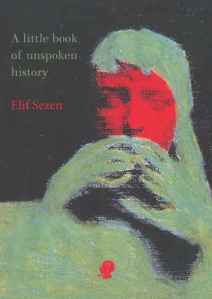
A little book of unspoken history
by Elif Sezen
Puncher & Wattmann, 2018
Where do footsteps lead, these frustrated blind hunters
In these times many of us from all corners of the globe have more than one place we call home. Concepts of nationality, attachment to place, a sudden annunciation of enlightened belonging or steadfast refusal of it can be dissociative, painful and conversely full of artistic promise. The very notion of home may be welcome or fraught with regret. It may involve mixed emotions or at worst, trauma.
Elif Sezen, a Turkish-Australian multidisciplinary artist currently living in Melbourne, has developed a sophisticated methodology to work across media and to explore these themes. By foregrounding a personal inner life within the rigours of artistic and spiritual practice, she eschews narcissism through a focus on the transformative image. As a poet, translator, and as an artist Sezen has access to a world of imagery which appears to float in an imagined but deliberately structured dimension. Through deft selection, her practice of writing does not overwork its own tropes, which centre on childhood, trauma, displacement, the politics of migration and the metaphysical ambiguities integral to journeys real and imagined. Sezen’s images of trauma carry with them an apparent resonance, tantalisingly suggesting an overcoming, but also simultaneously suggesting the indelible trace of that trauma.
An example of this effect can be seen in the epigram ‘Slap of the morning’:
Slammed doors are still being heard
Who are they?
Coming after two poems focusing on childhood, ‘On the topic of first parents’ and ‘Childhood’, the poem resonates as a deep early memory suggesting violence with the sonorous slap and slammed, and fear through the final line Who are they?. The poem, employing Sezen’s regular trope, the door, appears to echo through space in a similar way to a masterly haiku.
Speaking generally of her artistic practice, Sezen has written: ‘I suggest the continual expansion of a poetic persona as a methodology of surrendering to the infinite’. Her poetry renounces the world’s ability to deliver infinity; instead its imagery emerges in devotional splendour or in political anger at the cruelties inflicted on refugees, especially those in long term detention.
When I first encountered Sezen’s work several years ago, I was attracted by what I saw as the European texture of the work, with its philosophical emphasis and often-romantic interiority. This connection has been astutely observed by Nadia Niaz, in a review in this publication of Sezen’s first English collection Universal Mother. Niaz focuses on the influence of Rilke (and importantly, his use of Sufi imagery), but also stresses Sezen’s access to diverse traditions, including Ottoman and Persian poetics, and to modern protagonists such as Forugh Farrokhzad. Several poems in A little book of unspoken history are dedicated to what can be seen as a constellation of artists, images of whom form something of an interior gallery, a feature many of us share, functioning as icons of our very existence. Sezen’s gallery includes Holderlin, Kahlo, Camille Claudel, and significantly in ‘Our celestial doorway’, a moving tribute to Farrokhzad:
Let’s meet up in your
imaginary Esfahan
in a city where women glow in green, head to toe
when we bend down from
the Khaju bridge, our reflections
on the water turn into non-poisonous ivies,
a city of secret sovereignty
where bombs won’t explode
A significant poem included in A little book of unspoken history is ‘Chronic Fatigue Syndrome’. The open, sequenced structure of the poem allows the key state of the suffering of the body to move effortlessly through themes of spiritual renunciation, the trauma of non-belonging and the vicissitudes of migration doubly effected and politicised. In an artist talk at her recent exhibition The Second Homecoming at Counihan Gallery, Sezen mentioned how moving back and forth between Izmir and Melbourne had left her without a sense of home. In this poem, fatigue enforces a focus back upon the self. In 1. Awareness, Sezen writes:
Now that I am tired
I must open up inwardly, like a lotus blossom
yes, I must open my paper-like lids
towards the benign feature of absence
for I will encounter her, in the very bottom:
that archetypal mystic, resembling my mother
by her glance perforating the silvered smoke
my small self will pass away
because I am tired
because fatigue is a lovely trap made to
save my body from its old cage
I get rid of the worldly clock
losing beguiling sleep
This sequence leads to a surge of empathy, where like an ascetic removed from the fray, the poet releases the possibility of benevolent compassion:
become a voluntary mute
so I can speak for them
They surrender their souls
wrapped with flesh and blood and breath
back to where they came from
As the poem continues, it develops a floating sense, the pinning of an elusive image, the transformative power of angels, and the devastating liberation of surrendering to pain:
La Minor impatience
Do black humour
CRESCENDO the pain
Is so glorious here
In 8. Homecoming the preoccupation with health, the body and inner awareness moves outwardly to expand upon themes of connection and conversely, the dissociative experience of migrations between two homes, and to embrace a conscious and deliberate act of site-specific remembering and forgetting:
Istanbul Airport is the doorway of my
time tunnel. No talking!
Act like nothing happened
hereby I discovered the reason
for the lack of bird-chirp
that others dismiss
because I am a bird too
I too forget the necessity of flight
in all directions of the
forbidden atmosphere of mystery,
simultaneously
‘We must declare our indestructible
innocence’, grumbles my mum
her eyes staring towards the
beyond-horizons
The birds pollute the new President’s sky.
A deaf child disappears from sight
in the alley, after listening to the song
which only he can hear
I call him from behind, with no luck
and find myself
in Melbourne again, inevitably
I chop and add mangos into
my meals again
I forget the malevolence of a
suppressed father figure image again
I forget my most favourite scent,
jasmine
how holy this forgetting is, I know
for it will pull me back to that doorway
for I’ll want to go back home again,
home without geography
without footsteps
how sweet is my abyss.
No memory of fatigue
I’ll again make merry.
Because of Sezen’s productive impetus, it is difficult (and I would argue unnecessary) to separate the impact of a book of poetry from that of an art exhibition. In The Second Homecoming a series of brilliantly coloured ‘Door’ paintings reminded me of how artists such as Rothko and Kandinsky transformed colour and form to suggest an inner subjectivity or a spiritual connection between self and the world. The majority of the paintings presented at the exhibition represent a series of caves, rendered in swirling black paint, each canvas with a view rendered in different shapes of an idealised and distant landscape, evoking a sense of something longed for, attainability uncertain. In the exhibition notes, Sezen writes, ‘Initially, I was thinking of refugees, the Indigenous peoples and others displaced, but obviously the work could refer far more broadly, physically or spiritually.’ Of the Door series, she says that they ‘rather represent an elusive notion of a gateway, where everything is possible and homecoming can be dreamt into reality’. In thinking of First Nations peoples moved from or barred from their traditional Country, or of refugees in indefinite detention on Nauru we can imagine how unattainable that ideal may be. In the poem ‘Dear Immigrants’, the poet demonstrates how the withdrawal of compassion, the very notion of being comfortable with the imagined necessity of locking someone up, turns upon the populace:
And just about to say Well Come, we
rather remain silent
as if ripping out the tree roots from its soil
or sending the raindrops back where they came from
locking up our dear immigrants, outside
till we lock ourselves into cells,
shrinking more and more.
The theme of compassion is something that Sezen expands upon throughout the collection, perhaps representing this most expansively in ‘A thousand petal woman’, where a meditative practice reveals the strength and frailty of the practitioner:
I am gifted to see this
and yet I forget it again
I meditate upon the deceased again
I inhale Nagasaki,
exhale Hiroshima
you think that I am purified
that’s why you call me a Sufi
Whereas I am a confused woman
I have a growing homeless kid within me
she is not me, she is me,
I am.
By situating the political in an expansive consideration of the body and the spirit, in centring personal experience within rich philosophical and poetic traditions, Sezen’s oeuvre offers a fresh and original mapping of the question of home. In ‘A meditation on timelessness’ she writes:
Writing writing writing is such a deprivation from which I build
up an invisible reign on an earth where my footstep doesn’t
belong to the spot it steps upon …
Yes, my dear friends
every poet is responsible
for their own timelessness.
Earlier in this review, I referred to my initial sense of a European context to Sezen’s poetics. This certainly holds true as I gain greater familiarity with her work. Aside from Rilke, there are resonances of French poets such as René Char and André de Bouchet in the work. The above quotation from ‘A meditation on timelessness’ for example is something that Char himself may have written. However, with more recent reading of writers from Turkey and Iran, it is clear to me that although a European connection is certainly there, Ottoman and Persian exemplars, particularly in relation to Sufism, are more crucial. Writers such as Bejan Matur, Sholeh Wolpe, and fellow Melbourne writer Shokoofeh Azar engage with classical texts of Rumi, Attar and Hafiz, as well as with the innovative work of Farrokhzad and the contemporary writer, Shahrnush Parsipur, and it is with these practitioners that Sezen’s developing work may be more fruitfully approached.
*Jennifer Mackenzie is the author of Borobudur (Transit Lounge, 2009), republished in Indonesia as Borobudur and Other Poems (Lontar, 2012) and has been busy promoting it at festivals and conferences in Asia. She is now working on a number of projects, including an exploration of poetry and dance, ‘Map/Feet’. Her participation in the Irrawaddy Festival was supported by a writer’s travel grant from the Australia Council for the Arts.
**Τaken from Cordite Poetry Review at http://cordite.org.au/reviews/mackenzie-sezen/

 To Koskino