Michael Aiken reviews Ouyang Yu

yu-fwf

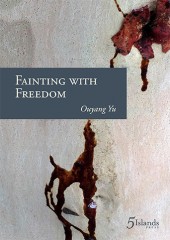
Fainting with Freedom
by Ouyang Yu

Five Islands Press, 2015

Ouyang Yu is a prolific writer whose combination of occupations – poet, novelist, translator, academic – gives some context to this book’s obsessive engagement with word, language and meaning. His biographical note mentions that he came to Australia at the age of 35, and there’s a pervasive trope in Fainting with Freedom of a stranger-in-a-strange-land’s curiosity for the materiality of language and its malleability: something akin to what Kerouac once alluded to when he described his relationship to English – a language he didn’t learn until he was eight – as a tool he could very consciously manipulate as necessary for effect and meaning. For Yu, this fascination is not limited to the experiences of a foreigner acculturating to a new socio-linguistic circumstance, but goes much further and deeper (presumably due in part to or concomitant with his work as a translator and teacher), investigating and playing with the complexes that emerge from the interaction back and forth between languages and his own movements across them. What emerges is a burgeoning sense of a meta-culture, not merely a bigger, hybrid, Chinese-Australian context, but a richer, more meaningful bilingual world available to those with the knowledge and awareness to perceive it.

For the rest of us, the contents of Yu’s poems offer tantalising windows into that world, especially in combination with his formal versatility. In form and style his poems are typically full of disruptive, unexpected lines, deploying enjambment, malapropism, skilful grammar (as well as wilful disregard for grammar) in service of profundity, humour, and intellectual interrogation. Moments emerge from Yu’s work as a translator and as a language teacher, and his fascinations capture not only an other’s perception of his second language and culture, but also a revision of his first language, and glimpses into parallels (as well as enormous divergences) between the two. There’s something enormously heartening about reading such a living, adventurous book published in English in Australia that can nonchalantly presume the relevance of a treatise on individual Chinese words or characters, or their relationship with English. Poems like ‘Talking about ’ and ‘Round’, with their matter of fact use and discussion of non-Latin characters, as well as non-European cultural referents, expand the palette of the possible for contemporary Australian poetry.

Perhaps the poem most emblematic of the book as a whole, ‘Round’ in particular wrestles with the inexactitude of translation, the ‘primitiveness’ of English and its inability to capture the nuance of a two-character Chinese word. The opening and closing stanzas summarise much of the story:

One student stood up and said,
“the subtle factor that makes live endurable” is not right
as the word “endurable” is not a correct
translation of the Chinese characters yuanhua

(…)

on his way home, the teacher was defeated again
when he thought of the impossibility of match
making the two languages in this single expression
that describes a person’s unctuousness, like oil or an eel

or that denotes life’s smoothness
in a round manner
as round
as a ball

Ostensibly about translation but produced for an English (only) speaking audience, this poem is as much about the futility of trying to express anything in any language, the flawed nature of language as a system, the unbridgeable difference between the uniqueness of individual aesthetic perception and the conventionality of language.

Elsewhere, at first encounter ‘Serendipity’ (particularly located as it is in a section called ‘Mathematics and Fog’) looks wilfully difficult, like a puzzle of typography as much as one of language:

it’s not that i don’t like it i actually do i mean the film that i saw tonight
it was actually a quite funny word when i first heard it
i thought it had something to do with being senile like senile dementia

It proves, however, to be quite a straight narrative about a night out at the cinema, a condensed memoir, meditating on this one word (and film of the same name) to explore the speaker’s relationship with life, work, marriage, friendship, and transnationalism. At its heart is the single brief line, ‘did you see it just for her?’, a question posed by the speaker’s wife that betrays a glimmer of tension in their marriage, a conceit that alters the light cast on every other part of the poem, demonstrating a deftness with narrative detail, just the right amount, that belies a novelist’s feel for drama. Such careful and attentive use of story, particularly in those poems in the book that are so strongly located in modern urban settings, combines with the linguistic play evident throughout the book, to offer a tangible sense of the here and now in which these works were created and exist.
Opening with ‘Manufactured by no one but this/Is a morning that harks back to 1787’, the poem ‘A cloud’ similarly manages to invoke multitudes from small, precise detail (in this case, mention of the year prior to British invasion invokes the Australia of pre-European colonisation and pre-industrialisation, in part as a proxy for pre-pollution). This starts a riff that culminates half way through the poem with: ‘The city that is changing rolling into/a nation that soon disintegrates and fragments/in multiple communities of digital photographs.’ Such striking power to sketch an entire national history from colonial pre-nationhood, through to the contemporary era of multiculturalism and social media, and tell it without dull prosaics, is one of the key powers of this book. Moments like these emerge continuously, seemingly effortlessly. Later in this same poem Yu flexes his talent for Steinian word play and linguistic interrogation, an awareness of the language as a toolbox or machine that can be repurposed through close and careful modification: ‘cloud and rain, cloud into rain/clout encapsulated in the rain’.

At times Yu’s urban lyric pieces recall Lorca with the quiet intensity of their observation, and the modest yet clever use of metaphor and simile. Such pieces also demonstrate an appreciation for one of the fundamental purposes of artistic experimentation: application. Where elsewhere in the book sentiment and content are overtaken by grammatical and linguistic play, in a poem like ‘The evening walk’, Yu’s awareness of the power to disrupt or extenuate meaning by manipulating word order, line breaks and voice, enables the poem to more deeply evoke experience in the reader. Line combinations like ‘the air is strong with horse/shit’ capture brilliantly the slow-seeping disruption of an idyllic rural moment by the dawning awareness at first of something bestial, and then more precisely of just which aspect of the beast is present. The delicate play and balance between humour and earnest quietude in this poem suggests the author is closely familiar with needing time for reflection in order to make art, while still living in the contemporary world. Similarly, ‘I’m feeling sad tonight’ manages to create a simultaneously earnest, deeply felt confessional moment, and a parodic critique of the same:

“I’m feeling sad tonight”
I turn around but see no-one saying that

“I must admit I have not felt this way for quite some time
As night is gathering its dark colours

The earth is taut and loud
With crickets like someone has switched a symphony on

Two died in the same year
Closest to my skin

I’m going somewhere else alone
To celebrate my 50th

Birth day
As he said he would do his 21st

A family of loners
In a rootless

Country
Loud again

Before death”
My heart lowers its head to listen.

It’s a quite extraordinary poem. The apparently arbitrary form – a blank line after every couplet – seems to contribute little until the final couplet, where two lines separated grammatically by the end of the quotation are brought together. That pairing drives home an intense profundity, the sort of brief, dashed-off moment of deep clarity characteristic of a lone poet like James Wright: “Before death’/My heart lowers its head to listen.” In turn, the use of the long-running quotation as a framing device emphasises the self-mockery of the opening lines, but particularly through that final coupling – half within the quote, half without – the same device also serves to intricately explicate the dichotomy a fearless experimentalist must feel when confronted with a desire to express earnest confession in verse. Yu’s slightly odd word manipulation – the synaesthetic ‘see no-one saying that’, or ‘Birth day’ as two words – recall once more his obsession with language play, but also evoke that ‘family of loners/In a rootless//Country’ and the cross-cultural uprooting (and perhaps attendant isolation) this poet has gone through. The use of ‘rootless’ in particular is strikingly clever, at once a near-cliché in keeping with the running parody of the confessional, but also so evocative of Australia and the strangeness of its vernacular – what does it mean in this particular culture to be alone and ‘rootless’ on a night of celebration? Indeed, to follow that word with the single-word line ‘Country’ approaches the Shakespearian in both bawdiness and skilful wordplay.
This book contains microcosms of alertness to the oddity of language as language, the arbitrary way meaning is distorted or inflected by unfamiliar acts of repetition, the use of phrases grammatically correct but somehow socially bizarre/inept, or the inappropriate use of passive or active voice. The actual subject of many of the poems is books and writing, literature or art as convention, with a particular concern for the non-creative aspects of the creative arts as an industry. In ‘Paintings’ for example, Yu calls out the exclusionary nature of acquired taste in a single line: ‘the eyes have to be trained but the names are more important’.

The second section of the book, titled ‘Leaf or fallen bank’, is preoccupied with questions of authorship and authenticity, while also making fun of arguing for a final position on these:
books, according to him, are not worth writing, having written one book that went back many centuries examining a time similar to ours in every aspect of time except the sound of their voices, which, unfortunately, have not been recorded, and the details that could not have been noticed by themselves or filed away (‘Books’)

As is so often the case in this book, here Yu seems to be revealing an endless fixation with investigating the absolute truth of things that are fascinating because they have no absolute truth.
The playful self-deprecation in this book feels honest without being earnest, self-critical without being self-effacing; subtle but showy. ‘Banality’ for example, makes art of email spam with a flight of fancy into the repercussions of seriously considering an unsolicited offer of marriage: ‘If I were to marry you I would have had to divorce (…) if I were to re-marry I’d have to bear/with all this day after day after night after night’, and ‘what is this based on except I stayed up late or went to the (online) market’, end the prevarications through banal email interactions with the closer, ‘I want to disappear into creative/banality just gauge how close the bin is to my brain’. Yu’s is an honesty that couldn’t be otherwise; the whole value of his investigations seems to be in getting to the truth, not of objective ‘fact’, but of subjective perception and reception. The minutiae of the everyday (and the timeless) are fair game in this endless, unending quest to expose the fact that the referent is always ultimately deferred. Life is in the living – or in the becoming, might be another way to put it.

The subjects in this book are unrepentantly contemporary, with references (and hyperlinks) to Wikipedia, current politics, and matters of popular culture like the SBS-syndicated Chinese dating show Feicheng Wurao. Amongst such material, the natural world also makes appearances, yet in characteristically unique ways. Yu’s ecopoetics is one of problematics, and both the inevitable collisions between human culture and nature, as well as the timeless disregard the former has for the latter, inform his investigations of each domain. In ‘Self publishing’, for example, he critiques our arbitrarily gate-keeping literary culture by noting that, ‘birds never remain quiet because they don’t get paid for calling’. After admonishing at length the ridiculousness of worrying about the legitimacy of self-publishing, and citing numerous canonical authors who are guilty of that very crime, he closes summarily with, ‘Now listen, to the rain self publishing again as it did 3000 million years ago,/on the page that is my roof’. Meanwhile in ‘Installation 001’ he indicts both our artificial sanctions on what is aesthetically valuable as well as our concomitant ignorant misuse of the natural world:
you want to cut this roadside slope with wild grass and a few trees and relocate
them into the national gallery

you want to cut that sky where a cloud is so big it bursts the car window and
install it inside the brain of the country

you want to pull the lone tree by the root and stand it in the middle of all galleries,
blocking the view

At once wholly contemporary and somehow timeless, Yu’s approach doesn’t interrogate the interactions between the human and ‘natural’ so much as expose the hierarchy: that is, the artificial and therefore apparently subordinate human world, subordinate to (or just a pale shadow of) the totalising essentialness of all-that-is-not-human. We might debate amongst ourselves whether self-publishing our art removes its value, but in the meantime the fundamental beauties of reality – rain, birdsong – don’t have time (or need) for such crises of worth; they simply are, they exist and they act because they must. Yu seems to be telling us: if your art is not a function of your essential self, if you need ponder whether you should be doing it, you probably shouldn’t.

This book as a whole zooms from the macro to the micro, the personal to the national, in a way that feels frantic, encyclopaedic, and entirely subjective. Reasserting the value of the subject in the living world seems to be a driving mission of the verse. Whether or not we can describe the ineffable, or comprehend it, to exist is to know the ineffable exists. This book is a celebration, a condemnation, and a defiant incitement to go with boldness, to be amongst it.

*Michael Aiken is a writer living and working in Sydney. His first book, A Vicious Example: Sydney 1934 1392k1-1811 1682k2 and other poems, was shortlisted for the NSW Premier’s Kenneth Slessor Prize for poetry.

**From Cordite Poetry Review at http://www.cordite.org.au
Αλέξης Αντωνόπουλος, Προλαβαίνεις

626time

Να προλαβαίνεις.
Ούτε ένα να μη σου ξεφεύγει.

Δεν υπάρχουν σωστές λέξεις
γιατί οι λέξεις δεν είναι σωστές.

26 χρόνια (και κάτι)
μου πήρε να το μάθω.

Βιβλία με τεράστιες γραμματοσειρές
παρουσιαστές με γαλάζια ρούχα
δόντια βαμμένα

μιλάνε για σωστές λέξεις
αφού από τις λέξεις ζούνε.

Άσε τις λέξεις, δεν υπάρχει χρόνος.
Τόσα πολλά σού ξέφυγαν
ενώ της έγραφες πορτρέτα.

26 χρόνια (και κάτι)
αλλά επιτέλους ξέρω.

Να φιλάς κάθε της δάκρυ.
Ούτε ένα να μη σου ξεφεύγει.

*Για περισσότερα κείμενα του Αλέξη Αντωνόπουλου, μπορείτε να επισκεφτείτε τον ιστότοπο http://www.alexantonopoulos.com

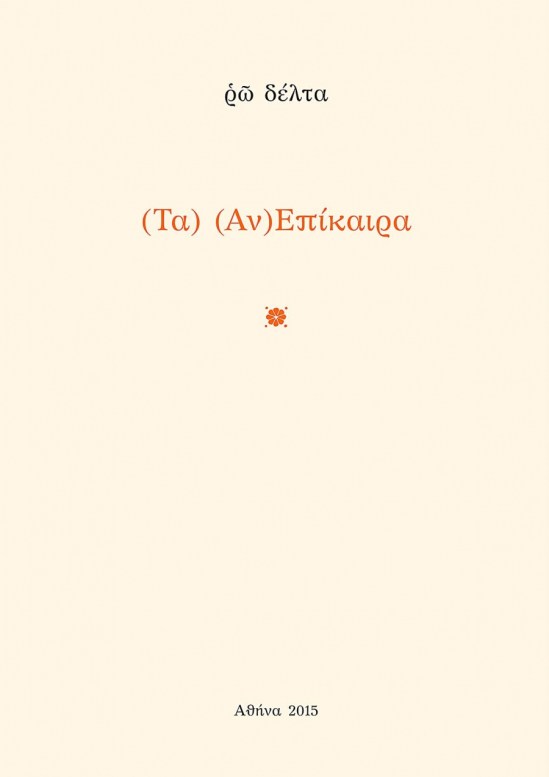
Ρω Δέλτα, (Τα) (Αν)Επίκαιρα, Εκδόσεις Ωκεανίδα

a05812a6ea54f32db80b865f7cd66f25_XL

ΤΟΥ ΘΕΟΧΑΡΗ ΠΑΠΑΔΟΠΟΥΛΟΥ

Έχουν περάσει αρκετά χρόνια από τότε, που η Κατερίνα Γώγου εμφανίστηκε στα γράμματα. Τότε, η οργισμένη ποιήτρια των Εξαρχείων παρουσίαζε κάτι το καινούργιο και πρωτόγνωρο για τα ελληνικά ποιητικά δεδομένα της εποχής. Από τότε έχουν ακολουθήσει αρκετές επίδοξες μιμήτριες, όμως, οι περισσότερες απλά μιμούνται χωρίς ταλέντο καταλήγοντας τις περισσότερες φορές σε μια απλή διαμαρτυρία χωρίς να έχουν να μας πουν κάτι το ιδιαίτερο.

Εξαίρεση στα παραπάνω είναι το βιβλίο της Ρω Δέλτα «(Τα) (Αν)Επίκαιρα», που κυκλοφορεί από τις εκδόσεις: «Ωκεανίδα». Πρόκειται για μια ποιητική συλλογή, που αν δεν κινδυνεύαμε να κατηγορηθούμε για ιεροσυλία θα τη χαρακτηρίζαμε εφάμιλλη αν όχι καλύτερη των ποιητικών συλλογών της Κατερίνας Γώγου και αυτό γιατί η Ρω Δέλτα δεν στέκεται σε μια απλή μίμηση, αλλά καταφέρνει να προσαρμόσει την οργισμένη ποίηση στην σύγχρονη εποχή της κρίσης και της παρακμής.

«(Τα) (Αν)Επίκαιρα» περιλαμβάνουν ποιήματα άλλοτε πολύστιχα και άλλοτε ολιγόστιχα, άλλοτε σε ελεύθερο και άλλοτε σε παραδοσιακό στίχο με μέτρο και ομοιοκαταληξία, άλλοτε σαν πεζά και άλλοτε σχηματικά, δείχνοντάς μας πως η ποιήτρια γνωρίζει καλά όλους τους τρόπους και όλες τις τεχνικές της ποίησης, και τις προσαρμόζει ανάλογα με τις απαιτήσεις του νοήματος, που θέλει να δώσει.

Η ποίηση της Ρω Δέλτα είναι χειμαρρώδης. Ακόμα και στα πιο πολύστιχα ποιήματά της δεν πλατειάζει, αλλά σα φουσκωμένο ποτάμι παρασέρνει τον αναγνώστη. Σαν την οργή, που θα ανατρέψει και θα πνίξει τους εκμεταλλευτές: «Η όξυνση των πεινασμένων / κορμιών / σαν θεριέψει / να δεις, ποιος σας σώζει…» Για την υποκατάσταση των αγώνων και τις υποσχέσεις του στυλ: Κάντε υπομονή και όλα θα αλλάξουν, θα ειρωνευτεί τραγικά: «Μη φοβάσαι, Το καλύτερο δεν έχει φτάσει / Ακόμα Υπομονή / Εν ευθέτω χρόνω η ανταμοιβή / Υπομονή ως τη δευτέρα παρουσία / Ως τότε, απουσία».

Ένα άλλο κοινωνικό ζήτημα, που απασχολεί την ποιήτρια είναι η μοναξιά του σύγχρονου ανθρώπου, που νιώθει απομονωμένος μέσα στο πλήθος, στη ζούγκλα της σύγχρονης πόλης και του κυβερνοχώρου. «Ξέρω τι συμβαίνει τα Σάββατα στους απομονωμένους», γράφει στο ποίημα «Εϊμυ», ενώ στο ποίημα «το εφάπαξ» θα γράψει: «5.000 διαδικτυακοί φίλοι – μα πούν ‘ν ‘τοι;;………», για να καταλήξει στο συμπέρασμα ότι: «είν’ η αναπηρία, που σου αφήνει κατάκοιτο το εγώ της προηγούμενης ζωής σου, κι ο εαυτός, που ξερίζωσες, για να επιβιώσει εκείνη…»

Το ερωτικό στοιχείο δεν θα μπορούσε να λείπει από την ποίηση της Ρω Δέλτα. Με πιο χαρακτηριστικό το ποίημα «Γυμνοί στα Βράχια», η ποιήτρια γράφει για έρωτα, που δεν γνωρίζει απαγορεύσεις και ψευτοηθικά διλήμματα. Η γυναίκα ορίζει το κορμί της κατά πως το θέλει η ίδια και όχι όπως το επιβάλλουν όσοι θέλουν να πνίξουν την ελευθερία.

Θα κλείσουμε εδώ, αυτή τη μικρή προσέγγιση στην ποιητική συλλογή της Ρω Δέλτα «(Τα) (Αν)Επίκαιρα» διαπιστώνοντας ότι η ποιήτρια καταφέρνει να συνδυάσει το επίκαιρο με το διαχρονικό και περιμένουμε να συνεχίσει να γράφει και άλλα ποιήματα γιατί όπως χαρακτηριστικά αναφέρει η ίδια στο ποίημα της: «Επίλογος»: «Η Ζωή είναι Πάλη Όχι παραίτηση».

Alexandra Bakonika’s Poems in Greek and English

Mayanaam's avatarManolis

2Alex_andra
FROM THE BEGINNING

We met after some time
and it was as if we started from the beginning.
I surveyed your face
and didn’t manage to restrain
the desire which blazed
because it awaited your body,
the harmonic junctions and its lines.
I sought its weight,
I sought its rage.

ΑΠ’ ΤΗΝ ΑΡΧΗ

Ύστερα από καιρό συναντηθήκαμε
κι ήταν σαν να ξεκινούσαμε
απ’ την αρχή.
Ανέτρεξα τη μορφή σου
και δεν πρόλαβα ν’ αναχαιτίσω
τον πόθο που φούντωσε,
γιατί περίμενε το σώμα σου,
τ’ αρμονικά δεσίματα και οι γραμμές του.
Γύρεψα το βάρος του,
γύρεψα τη λύσσα του.

PERFORMANCES

He impudently said to me:
“Your poems are flooded with sensuality and passion
and something related,
something exquisite
I expected from you
the few times we made love-
but I can’t conceal from you
that you have disappointed me”
For his own performance
in bed
and my appraisal of it,
he…

View original post 936 more words

Δημήτρης Α. Δημητριάδης, Στον εκτός μέτρησης χρόνο

GW352H265

Η ζωή μου επιτοίχια κραυγή
με τρεμάμενα γράμματα
και κόκκινο χρώμα

σκαρφαλωμένη σε πολυκατοικίες
σε μάντρες
στο αβυσσαλέο κενό

σινιάλο
μήνυμα
σε άλλη γλώσσα
στον εκτός μέτρησης χρόνο.

Αργύρης Μαρνέρος, Πέντε ποιήματα

elpida35

ΠΡΩΤΕΣ ΒΟΗΘΕΙΕΣ

ΓλυστράμεΠάνω στο δρόμο
Πατώντας τα λίπη
Που στάζουν
Από τα κρόσια
Της βελούδινης κουρτίνας
Πέφτουμε
Ουρλιάζουμε από πόνο
Ζητάμε βοήθεια
Και τότε μας ρίχνουν
Λάδι καυτό
Μέσα στο ανοιχτό μας
Στόμα.

***

ΖΑΧΑΡΟΠΛΑΣΤΕΙΟΝ

Κάθησε και παράγγειλε

Τον καφέ του
Την πάστα του
Τα τσιγάρα του
Τις πυτζάμες του
Τον ύπνο του
Το θάνατο του.

***

ΚΟΡΟΪΔΙΑ

Τα λουλούδια

Που φέρνουν
Στο μνήμα σου
Είναι 

Για να σε κοροϊδεύουν
Αφού η μύτη σου
Δε μυρίζει Πιά.

***

ΕΠΙΚΗΔΕΙΟΣ

Την ώρα
Που έβγαζε τον επικήδειο
Ο πεθαμένος σηκώθηκε
Και τούκλεισε
Το στόμα.

***

ΕΠΙΣΗΜΗ ΑΡΓΙΑ

Τη μέρα της μοιρασιάς
Βρήκαν χίλιες δυό προφάσεις
Για να κρατήσουν κλειστό
Το μαγαζί
Τη μέρα της μοιρασιάς
Μας δώσαν άδεια υποχρεωτική
“Μετ’ αποδοχών”
Οδέποτε τις εισπράξαμε
Τη μέρα της μοιρασιάς
Την κάνανε γιά μας
Επίσημη αργία.

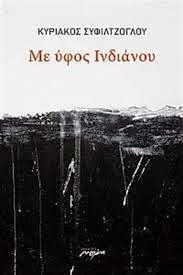
Κυριάκος Συφιλτζόγλου, Με ύφος Ινδιάνου, Εκδόσεις Μελάνι, Αθήνα 2014

ceb9cebdceb4ceb9ceb1cebdcebfcf85


-Ζαφείρης Νικήτας­-

ΠΡΟΛΟΓΙΚΑ
O Emile Cioran υποστήριζε, μάλλον προκλητικά, πως ο ιστορικός κάνει δημοσιογραφία σε άλλο αιώνα. Αν κάποιος θελήσει να αποκαταστήσει την μη αλήθεια στην μη τάξη της μη Ιστορίας, ιστορίας με γιώτα μικρό, τότε καθόλου δεν αποκλείεται να βρίσκεται ήδη στα περίχωρα της ποιητικής συλλογής «Με ύφος ινδιάνου» του Κυριάκου Συφιλτζόγλου. Σε κάθε ποίημα της νέας του, τρίτης συλλογής, ο δραμινός ποιητής επανδρώνει μία αποεγγραφή της εγγεγραμμένης ιστορίας, μια απογραφή ερωτηματικών.

ΣΥΝΟΡΙΑΚΟ ΚΟΙΜΗΤΗΡΙΟ

Με ύφος Ινδιάνου
Το πλεονέκτημα κάθε συλλογής που υπάρχει πλήρης διακειμενικού πληρώματος, εμπρόθετης οπτικής και λογοτεχνικού vibrato, είναι ακριβώς αυτό: ευφραίνει καρδία αναγνώστη (αφενός) και λύνει τα χέρια της κριτικής σκέψης (αφετέρου). Έτσι η αμήχανη θεωρία, η δεξαμενή της ορολογίας της, ενεργοποιείται, και συμβαίνει να γίνεται πράγματι η θεωρία, όπως σημειώνει ο αποφθεγματικός Καππαδόκης Γρηγόριος Νανζιανζινός, «πράξεως επίβασις».
Από τις δυνατότητες δόμησης και αποδόμησης λοιπόν, τις οποίες όπως έθιξα προλογικά, ανοίγει εν μια ριπή το «Με ύφος Ινδιάνου», θα εστιάσω σε μία. Θα κάνω λόγο για την παράμετρο της τελετουργίας και ειδικότερα τα ζητήματα μεταιχμιακότητας ή μεθοριακότητας (liminality κατά Arnold Van Gennep και Victor Turner) τα οποία διανοίγει η συλλογή, με εναρκτήριο λάκτισμα το ποίημα με τίτλο Συνοριακό κοιμητήριο.

Το ποίημα αυτό ξεκινά απροσδόκητα, κι ακόμη θα έλεγα παράλογα σχεδόν – κι όπου παράλογα το μυαλό να πάει στο καθ’ όλα ενσυνείδητο, το φλέγμα συγγραφέων που ξέρουν να ξαφνιάζουν στην μετα-Ολοκαυτώματος εποχή, στη γενιά, δυο γενιές μετά από κείνη που κλήθηκε να απαντήσει, αν υπάρχει ποίηση μετά το Άουσβιτς (θυμίζω το ερώτημα / αρνητική θέση ανήκει στον Αντόρνο, 1949), ερώτημα στο οποίο μπορώ προληπτικά να απαντήσω πως ο Συφιλτζόγλου απαντά καταφάσκοντας, προτείνοντας ύφος και τρόπο, κωπηλατώντας προς την diem futurum, την μέλλουσα μέρα της εγχώριας ποίησης.

Πίσω στο ποίημα. Το Συνοριακό κοιμητήριο ξεκινά με ένα κοίλο σημείο στίξης, μια παρένθεση κι εντός της μια λέξη: (ενταφιασμός). Η λέξη, σαν μια απροσδόκητη σκηνική οδηγία, επαναλαμβάνεται στο μέσο του ποιήματος, με την επαναληπτική αίσθηση της πένθιμης κωδωνοκρουσίας. Κι ενδιάμεσα, ανάμεσα στον ήχο και τον απόηχο του κοιμητηρίου ξεδιπλώνεται η τελετή. Γράφει ο Συφιλτζόγλου:

Οι άνθρωποι καμήλες/διασχίζουν τον ορίζοντα των σιταγρών/αποθηκάριοι και σακιά μαζί/δίχως ψαλμούς δίχως δαχτυλίδια/αποθηκάριοι μα πιο πολύ/ένα δελτίο παράδοσης παραλαβής/μέσα στο χρόνο
Και δω η δεύτερη χαμηλόφωνη τυμπανοκρουσία: (επαναενταφιασμός).

Μια πένθιμη πομπή λοιπόν διασχίζει το ορίζοντα, εργατική και συνεπής στον κλειστό της κύκλο, στον ανοιχτό της ορίζοντα. Ο δραμινός ποιητής τραβά το χαλί κάτω από θρησκευτική και πολιτική βακτηρία, με έναν στίχο τόσο ήπιο και πυκνό όπως: «δίχως ψαλμούς δίχως δαχτυλίδια». Περαιτέρω, ο στίχος αυτός από-πλαισιώνει την τελετή από το τελετουργικό της έρεισμα. Ο άνθρωπος καλείται να τελετουργήσει δίχως άμφια, κι όχι πλέον στη σιωπή, αλλά εντός λόγου (σημείωση: παράφραση του στίχου του Ν. Καρούζου «τελετουργώ στη σιωπή δίχως άμφια»).

Η τελετή στην επόμενη ενότητα συνεχίζεται. Αυτή τη φορά δεν είναι «εκείνοι», αλλά «εμείς». Γράφει ο δραμινός ποιητής:

Είμαστε οστά/γερασμένα οστά/τα ίδια που άνθησαν και μαράθηκαν/ σε κρεμαστούς κήπους/είμαστε τα οστά/της ίδιας μας της ανασκαφής/η σκονισμένη στάση είμαστε/μια οποιαδήποτε στάση
Διαβατήρια τελετή λοιπόν χωρίς απέναντι όχθη. Περίπατος χωρίς επέκεινα. Το «Με ύφος Ινδιάνου» θέτει επί τάπητος την παροντική εκκρεμότητα των μεγάλων αφηγήσεων.

ΔΙΑΒΑΤΗΡΙΕΣ ΤΕΛΕΤΕΣ

Οι διαβατήριες τελετές, όπως μια τελετή ενηλικίωσης, περιλαμβάνουν (κατά Gennep και Turner) τρία στάδια. Πρώτη φάση είναι αυτή του χωρισμού από την κοινωνική δομή (preliminal), δεύτερη φάση είναι η μετάβαση ή μεταιχμιακότητα (liminal) και τρίτη η ενσωμάτωση σε μια νέα δομή (postliminal).

Κατά τη διάρκεια της μεταβατικής φάσης, της μεταιχμιακής περιόδου, οι πάγιες δομές καταργούνται ή αποδυναμώνονται, και το άτομο ή η ομάδα (ή η ποίηση π.χ. η ελληνική θα προσέθετα εγώ) βρίσκονται σε ένα μετέωρο, οριακό σημείο. Το παλιό status έχει κρημνιστεί, το νέο όμως δεν έχει ακόμη παγιωθεί. Κατά τη διάρκεια αυτής της περιόδου-αιώρας, όπως θα την ονόμαζα, o Victor Turner υποστηρίζει πως στη θέση της παρελθούσας δομής και πριν την επόμενη, σχηματίζεται μια ενδιάμεση communitas, μία κοινότητα ανθρωπισμού που δεν βασίζεται στην εξουσιαστική ιεραρχία. Σε αυτή την αισιόδοξη πλευρά, έχει αντιταχθεί εξίσου βάσιμα, η άποψη που υποστηρίζει πως η μεταίχμια εποχή είναι λιγότερο μια εποχή μιας αυτοφυούς ισονομίας και περισσότερο μια εποχή τριγμών και ανισότητας.

Η ποιητική συλλογή «Με ύφος Ινδιάνου» του Κυριάκου Συφιλτζόγλου βρίθει από αυτή την αίσθηση του αναπάντητα μεταιχμιακού. Ενδεικτικά μόνο αναφέρω τα ποιήματα Υπεραστικά λεωφορεία, Μεταναστευτικά πουλιά, Συνοριακή γραμμή, και διαβάζω από το τελευταίο:

Κανείς δεν έφτανε/στην εξώπορτα/κανείς/μόνο στα υπεραστικά λεωφορεία/ομοιοκαταληκτούσαν οι άλλοι/στα σημεία αφίξεων/αναχωρήσεων/στα σημεία που η γεωγραφία/σήκωνε τα χέρια ψηλά/εκεί/άλλαζαν δέρμα/οι άλλοι/εκεί/από σημεία γίνονταν/σήματα/της πιο αδειανής μας/ζωής

Η ανθρώπινη ταυτότητα, όπως την σκιαγραφεί ο Συφιλτζόγλου, είναι μια ταυτότητα ασύνορη και συνοριακή. Ο άνθρωπος, όπως κι ο λογοτέχνης, δεν είναι πλέον κεντρώος της μεθορίου, ούτε μεθόριος του κέντρου αλλά παγοδρομεί σε μια έκταση τόσο ανταρκτική, όσο η άγραφη σελίδα. Η ποίηση του Συφιλτζόγλου είναι γεμάτη από αυτόν τον οριακό κλυδωνισμό, τις βέβαιες αβεβαιότητες, αφού τα ποιήματά του είναι κι αυτά αυτό: in limbo τελετές.

Σημειολογικά και μόνο σημειώνω, πως το ποίημα της συλλογής με τίτλο Αλληλογραφία εξωτερικού που απευθύνεται στον ζωγράφο και εικαστικό Jasper Johns, θα μπορούσε να απευθύνεται εξίσου στον φιλόσοφο και ψυχίατρο Karls Jaspers, του οποίου το προτεινόμενο «άλμα πίστης», δυσκολεύεται σήμερα να ευδοκιμήσει, στη συγχρονική εποχή, μια εποχή τρύπας του μεταφυσικού όζοντος και κλίματος εύφορα αντι-παραδείσιου (: ένα κλίμα που αιτεί οβιδιακή ή άλλη μεταμόρφωση, αυτό όμως δεν είναι της στιγμής).

Χρειάζεται ένα έμπειρο μάτι για να δει μέσα από την καθεστηκυία δομή, τον ησυχαστικό λόγο, την κινδυνολόγο fabula. Κι ο Συφιλτζόγλου διαθέτει αυτό ακριβώς το βλέμμα: υποψιασμένο, όχι καχύποπτο. Η ποίησή του κοφτερή και εγερτήρια. Το βιβλίο του Συφιλτζόγλου συνιστά ένα πόνημα, μία όχι εξ απαλών εργασία. Κι όσο αμφισβητεί τη γλώσσα, άλλο τόσο την ασπάζεται, άλλο τόσο εξελίσσει το προσωπικό του ιδίωμα. Η εμπιστοσύνη του στην τέχνη δεν εκδηλώνεται με όρους καταφυγής αλλά συναγερμού. Και κάθε νέα του συλλογή το αποδεικνύει με τον τρόπο της ars poetica: ως έπος ειπείν, άπταιστα.

ΒΙΒΛΙΟΓΡΑΦΙΑ
Turner Victor, The Ritual Process: Structure and Anti-Structure, Aldine de Gruyter, New York 1969.
Van Gennep Arnold, Rites of Passage, Routledge, London 1960.
Συφιλτζόγλου Κυριάκος, Με ύφος ινδιάνου, Μελάνι, Αθήνα 2014.

*Από το http://tapoiitika.wordpress.com/κριτικές/κυριάκος-συφιλτζόγλου-με-ύφος-ινδιάν/

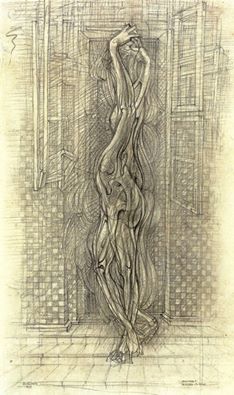
Antonin Artaud, Κάνει πολλή παγωνιά

Φωτογραφία¨Hans Bellmer / Hommage a Antonin Artaud

Φωτογραφία¨Hans Bellmer / Hommage a Antonin Artaud

Κάνει πολλή παγωνιά
όπως όταν
είναι ο
Αρτώ ο νεκρός
που φυσάει.

*Μετάφραση: Τάκης Σινόπουλος. Από τη σελίδα του ή της σιεΝ ανταλΟυ στο facebok.

Μαρία Θεοφυλάκου, Αιχμή

ilias3

Οι αργοτέλευτοι, του Αυγούστου,
οι φρουροί
πλωτοί κι ολόφωτοι
-σα να πηγαίνουν σε γιορτή-
με μπαϊράκια, και κάποτε έναν
κόμπο γόρδιο γερά απ’ το κατάρτι,
μας προσδοκούν
στο τέλειωμα μιας εποχής,
βρεμένη που ανταριάζεται
από παντού με κύμα.

Μας αναμένουν
τα στερνά του τηλαυγούς καράβια
με κάλεσμα δριμύ,
που αναρριχάται
ως αψηλά στη Χώρα επάνω
των έμπλωρων ερώτων μας
και των ανθών μας όλων.

Μες στην αγρύπνια μας
μοσχοβολούν
αυτά τα νυχτοξάρτια,
με πόσα ανεπιτήρητα
λυχνάρια αμποδεμένα,
και αναδεύουν τους καημούς
που είναι να μας έρθουν,
κι αυτοί αφρόδαρτοι
μα από άλλη θάλασσα,
κι αυτή αλμυρή εξίσου.

Θαλασσογραφία
Αν έμοιαζα λιγάκι του πελάγου
τι όμορφα που θα ‘πλεε η ζωή μου!

Θα χόρευα πίσω και μπρος,
εμπρός και πίσω
κι ίσως με σταματούσε μοναχά
το σήμαντρο κάποιου απάτητου καμπαναριού

Θα ‘κανα φίλους καρδιακούς
και κοσμογυρισμένους
όσο μαζί, τόσο και λεύτεροι
να πεταρίζουμε το δείλι

Αν έμοιαζα λιγάκι του πελάγου
τι γρήγορα θα έγειανε η πληγή μου!

Θ’ αποξεχνιόμουν στων ψαράδων τις κουβέντες,
κείνων που ξέρουν να διηγούνται ιστορίες
Χιλιάδες δίχτυα, παφλασμούς
ν’ αφήνω να μου παίρνουν

Θα ’χα ζωή και στο σκοτάδι ακόμα,
μυστήρια θα βύθιζα εντός μου μύρια
κάθε λογής κοράλλια μου
να σου χάριζα κι εσένα

Αν έμοιαζα λιγάκι του πελάγου,
πως δε θα μ’ έσκιαζαν πια και οι φουρτούνες!

Θα ‘κρυβα στο μανίκι μου ένα καντάρι ήλιο
Πότε ψηλά του γαλανού και πότε της αλμύρας
μαζί να κλέβουμε θωριές
με τ’ ακροδάκτυλα μας

Αν έμοιαζα λιγάκι του πελάγου
τι όμορφα που θα ‘πλεε η ζωή μου!

Μα εγώ φέρνω στο βότσαλο
που σέρνεται πίσω και μπρος,
μπρος πίσω
από του κύματος τον τελευταίο αφρό
στην άκρη αυτού του τόπου
Κι είμαι μικρός,
είμαι ανήμπορος το πέλαγο να φτάσω

Θάνος Γώγος, Πόλυ Ντεκόρ Χέδερς

dscf6706-2

iii)
Όπως τα ψάρια συνωστίζονται στην βαλίτσα μου
Και διάγουν την ανθρωπολογία σε κάτι ασήμαντο
Γελά κι εκείνη μαζί τους
Γνέφοντας η στιγμή για τη γη έχει έρθει
Και οι άνθρωποι δεν επιτρέπεται να μιλούν άλλο πια

iv)
Από τον ουρανό που φλέγεται
Μέχρι τη γη που κοιμάται
Ένας κόσμος δεν θα είναι ποτέ αρκετός
Κι αφήνει την φωτιά
Να προσαρμόσει πάνω μας
Όπως μια έρημος
Αγκαλιάζει δυο λουλούδια και τα πνίγει

*Από τη συλλογή ‘Μεταιχμιακή χαρά”, εκδόσεις Φαρφουλάς, 2013 (σελ. 29-30)