Και ο ήλιος τώρα που λάμποντας καθώς που το θέρος
και το σύννεφο ένα ξάφνου που γίνεται το σκοτάδι
και το στίλβος έρεβος ένα τους πόλους που ανατέμνοντας
που πολεμώντας τον υετό και βυθίζοντας η βροχή
στάλα τη στάλα που το νερό να σταλάζει την οροφή
καταποντισμένη οι τοίχοι πιο βαθιά μες τη γη
και μες το ναό των πεθαμένων θεών
μονάχα ο ερημίτης τώρα κοιμάται στις σαρκοφάγους γυμνός
μέρα τη μέρα να πολεμώντας τη σάρκα πληγή
και που ακινησία εκτείνονται όλα τα κύτταρα μες το κορμί
που να τρίζει ο άνεμος τη σιωπή απειλή
κι όταν ήλιος σκουριάζοντας τα μούσκλα το πράσινο
στο λυκόφως μουγκό φεγγάρι πορφυρό που να καίγοντας
στις κατακόμβες κεριά που να τρίζοντας η φωτιά
νύχτα τη νύχτα να πολεμώντας τα πνεύματα των πεθαμένων θεών
που να του ξεσκίζουν τα σωθικά μεγάλα αρπακτικά
βράχοι το κύμα που γλείφοντας χαμηλά
γυναίκες κόκκινες χαλκάς τα αιδοία χείλια γυμνά
που ασθμαίνοντας μεγάλα στήθια βαριά
κι ολολύζοντας αλυσοδεμένα τα τσακάλια παιδιά
κόκκινα μάτια μεγάλα στα σκοτάδια σκυλιά
μαύροι που άντρες υπάρχοντας τιτανικοί
και στην εστία ειδώλια μικρά προγονικά
κινήσεις ανύπαρχτες χέρια που να σέρνονται τα φίδια στη γη
κι οι λύκοι μεγάλοι να τρέχουν μαραμένοι ανθοί
από μέσα ν’ ανατινάζεται η σάρκα ναπάλμ
βαλκυρίες ν’ αποτεφρώνουν τη ζούγκλα ελικόπτερα πυρκαγιά
και μες στις σαρκοφάγους ο ερημίτης που τώρα γυμνός
ιδρώτας το σπέρμα που στις παλάμες καυτό
απ’ τις χαραμάδες που να κοιτώντας τα μεταλλαγμένα κορμιά
ως τα χαράματα τα τσακάλια ουρλιαχτά
θύελλα ενοχή τ’ αναφιλητά
σαν το σκυλί γαβγίζοντας τη νύχτα τη φωνή του
μέσα στη γη θα σπείρω το κορμί μου
η βροχή, ένα φοιτητικό ημιυπόγειο
με έπιπλα που έτριζαν από αρθριτικά,
κι ένα ασταθές φουρνάκι,
η βροχή, ένα ποτάμι από μελάνι,
και η πηγές του,
-η παλιά Ολιβέττι-
σαν συνέρχονται οι λέξεις,
ντροπιασμένες από την ευεργετική οξείδωση
– άγριοι φίλοι που μας αγαπούν μέσα από την πάρτη τους,
κι η αγνή αδιαφορία μας
για το χρόνο γενικά,
κυριαρχεί –
η βροχή, ο Ρασκόλνικοφ,
κι όλες οι καιόμενες σπονδές της αφελούς νεότητας,
με καφέ και – παλαιότερα – τσιγάρα,
νωπές εφημερίδες,
και μια μακάβρια κουβέντα για τον Ντιντερό,
υποσκάπτουν την ανάγκη μας
σαν δάκρυα μετάνοιας δίχως αντικείμενο,
μια ζωή που μας διαφεύγει και τη νοσταλγούμε,
μια ζωή που βιώθηκε και πάει/
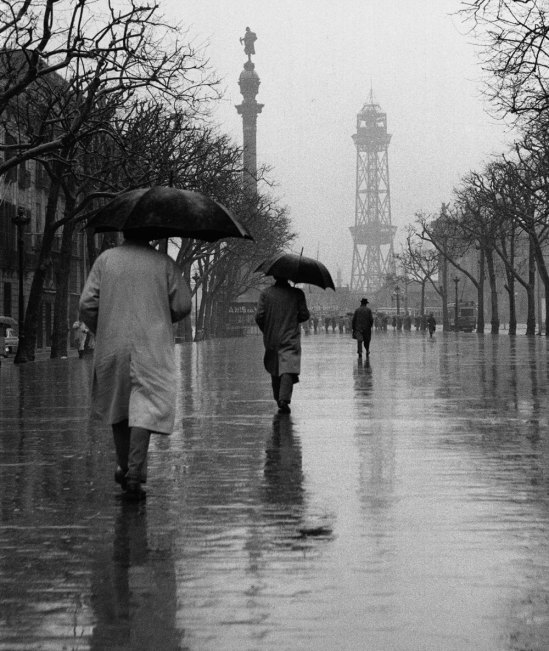
photo: Francesc Català-Roca (Valls, Tarragona, Spain, 1922 – Barcelona, Spain, 1998) Las Ramblas con lluvia (The Ramblas in the Rain) 1950 (circa) / Posthumous print, 2003 Selenium-toned gelatin silver print on paper 47.7 x 37.5 cm
Μίκης Θεοδωράκης & Ιάκωβος Καμπανέλλης, Ο εχθρός λαός
(τραγούδι: Βασίλης Παπακωνταντίνου / δίσκος: Ο εχθρός λαός (1975))
Ξέρω το λαό
Ξέρω το λαό αυτό
τον καυχησιάρη και τον ευκολόπιστο
που όλα τα φτιάχνει με τα χέρια του
και το καρβέλι και τα στέμματα
και το βιολί και τα ντουφέκια
και το αλφαβητάρι και τις χειροπέδες.
Ό,τι ελπίζει κάποτε θα γίνει
ό,τι έχει λειψό θα συμπληρωθεί
και τη σαπίλα ο ίδιος ο λαός
με τον καιρό από πάνω του θα καθαρίσει.
Από τη συλλογή Το πανηγύρι της φωτιάς (Αναστενάρια) [1959] του Γιώργου Καφταντζή
Perhaps surprisingly, the United States has been the home of a number of poets who have expressed anarchist ideas in their works. But then again, there are strong traditions of immigrant anarchism among Jews, Italians, Spaniards and Russians. There is the radical workers organisation, the Industrial Workers of the World.
There is the libertarian tradition among intellectuals, dating back to Thoreau. And there is a ?bohemian? tradition, often interconnected with these other movements which above all had its home in San Francisco and Greenwich Village in New York.
Kenneth Rexroth
Labor power on the market,
Firepower on the battlefield,
It is all one merely two
Aspects of the same monster.
The Dragon and the Unicorn
Kenneth Rexroth was born in 1905 in Indiana, into a family that had a long line of freethinkers, feminists, abolitionists, socialists and anarchists. His father used to drink whisky with Eugene Debs, the socialist leader. He had an enlightened upbringing but then had the misfortune of being orphaned at the age of 12. Most of his adolescence was spent in Chicago, where he worked as a newspaper reporter and was involved in running a jazz tea shop. Here he came in contact with the bohemian world of musicians, poets, writers, artists, hobos, revolutionaries and outsiders.
He was almost completely self-educated, with only five years of formal schooling. He read avidly, began to write poetry, paint abstract paintings, worked in avant-garde theatre and taught himself several languages. Like the European writer Malaquais, he took to the road in his late teens, He ranged, he roamed, he rambled. He worked at all sorts of jobs, sometimes as a cowboy cook, sometimes as a wrangler, and in farm and forestry jobs. He worked as a toothbrush maker and as a peddler of pamphlets on diet. He even managed to make it to Paris and back as a stowaway. There he met many important radical artists, including many surrealists.
The anarchist Alexander Berkman told him whilst he was in France not to become another expatriate and he returned. Becoming an anarchist at an early range, he saw through the Bolshevik myth as soon as 1921 when the Kronstadt sailors uprising was crushed by Lenin and co.
In 1927 he joined the Industrial Workers of the World working for a while on its newspaper. In Chicago he set up a Dadaist group. He carried on independent activity in the thirties. Settling in San Francisco he was involved in the newssheet the Waterfront Worker which exhorted dockers to organise. (In later life he entertained his friends with renditions of IWW and Spanish anarchist songs and sometimes used the IWW address “Dear Fellow Worker” in letters). With the collapse of the revolutionary wave he began to dig in, maintaining and seeking out contact with those who had preserved their radicalism, looking for reassessment and reappraisal. Where possible he spoke out against the established order. We have to remember that in this most grievous period, it was an extraordinary achievement to maintain revolutionary optimism. The perversions of Bolshevism had meant that as Kenneth said
There was no one left who was not completely centred on the Kremlin, either as a mindless Stalinist hatchet man or a psychopathic anti-Bolshevik?. He was also able to make the acute observation that: the socialist and trade union movements in the West have functioned in reality- not just as governors to insure that steam is let off when the pressure gets too high, not just as what are now called ? fail safe? devices, though they certainly are that- but as essential parts of the motive organisation of capitalism, more, in other words, like carburettors that insure there will be just the right mixture of fuel and air for each new demand on the engine.
In World War II he refused to take part in the clash of opposing capitalist states and was a conscientious objector. He did alternative service working in a psychiatric ward. During the war he formed the antimilitarist Randolph Bourne Council (named after the libertarian writer who had coined the phrase ?War is the Health of the State?). He helped Japanese-Americans who were being interned by the thousands in concentration camps, devising ways by which many were able to avoid internment.
Down in Berkeley from 1944 to 1948 the magazine Circle which united local ?Berkeley Renaissance? writers and exiled European Surrealist poets expressed anarchist and anti-authoritarian views (Rexroth contributed to it). In their last issue an ad for a New Writers Group stated that ? We believe in the possibility of a culture which fights for its freedom, which protects the economic interests of its workers in all fields including the arts, and which can create for itself new forms and new voices, against reaction and the threat of war.
After the war Rexroth was involved in the setting up of the San Francisco Anarchist Circle. (later the Libertarian Circle). Anarchists like David Koven, surviving old Italian and Spanish anarchists, and conscientious objectors returning from the Waldorf detention camp took part. Lively weekly meetings discussed all sorts of subjects from the Spanish revolution, Kronstadt and Makhno, to the ideas of anarchists like Goldman, Berkman , Voltairine de Cleyre , Kropotkin, the Anarchist Womens Movement, Sex and Anarchy.
The sessions at Rexroth’s house were enriched by his food (he was a superb cook) and his huge and encyclopaedic knowledge. Rexroth?s actions were designed to trigger what he felt was needed for a successful transition to an anarchist society- the development of a new consciousness. The little magazine Ark that was set up (printed on a small hand press from 1947) was more militant than its forebear to the south, Circle. It proclaimed: Today, at this catastrophic point in time, the validity if not the future of the anarchist position is more than ever established. It has become a polished mirror in which the falsehoods of political modes stand naked.
When all the other social commentators were bluntly asserting that all revolt and dissidence had ended he was able to say The youngest generation is in a state of revolt so absolute that its elders cannot even recognise it??. Members of the Libertarian Circle were to be key players in the radical upsurge that became known as the San Francisco Renaissance, as poets and artists, in free radio, in experimental theatre and in the little magazine movement. Rexroth was to be the midwife of the Beat movement that emerged that succeeded in uniting the dissident poets and writers of both the East and West Coasts. Kenneth hated being called the Father of the Beats- a movement of which he had many criticisms- but he was able to see that he and they were united in their mutual antagonism to the ruling ? convergence of interest- the business community, military imperialism, political reaction, the hysterical, tear and mud drenched guilt of the ex-Stalinist, ex-Trotskyist American intellectuals?. Rexroth was to preside at the birth pains of the San Francisco Renaissance, which led directly on to the emergence of the Beat movement, at the Six Gallery event in San Francisco where Allen Ginsburg?s powerful anti-authoritarian poem Howl was read out to a eager and excited audience of several hundreds in an electric, drunken atmosphere, where Jack Kerouac was cheerleader and rhythm-maker.
William Everson says what I feel about Rexroth better than I could so let?s hear him speak: ?He is a powerful spokesman for any cause he espouses. A born journalist, he has a flair for vigorous public speech and the guts to speak out in unequivocal terms. He has fantastic intellectual and moral courage, taking on the establishment and throwing it on the defensive through the sheer force of his invective. His rhetoric is savage, sometimes shockingly so, but it is never ineffectual?His faults are the excesses of his virtues and he quarrels with his friends as readily as he clobbers his enemies?He tends to drop the movement he has fostered as soon as it shows signs of fragmenting. But his constitutional restlessness could not jeopardise the work he actually accomplished. He touched the nerve of the future and more than any other voice in the movement called it into being. Though others picked up his mantle and received the plaudits, it remains true that today we enjoy the freedom of expression and lifestyle we actually possess largely because he convinced us that it was not only desirable but possible, and inspired us to make it be.
Rexroth placed too much stress on the development of a radical lifestyle as a fortress against capitalism to the detriment of struggle. His increasingly religious turn in the last years of his life are jarring for many atheists and agnostics. Nevertheless, both his prose and his poems are deeply anarchist and deeply combative. In the long poem The Phoenix and the Tortoise he wrote: The State is the organization Of the evil instincts of mankind. In For Eli Jacobson, one of his most moving poems, Rexroth remembers a dead friend:
?.We were comrades
Together, we believed we
Would see with our own eyes the new
World where man was no longer
Wolf to man, but men and women
Were all brothers and lovers
Together. We will not see it.
We will not see it, none of us.
It is farther off than we thought
We will be remembered, all
Of us, always, by all men,
In the good days now so far away.
If the good days never come,
We will not know.
We will not care.
Our lives were the best.
We were the Happiest men alive in our day.
In one of his angriest poems Thou Shalt Not Kill Rexroth talks of the toll that the collapse of the revolutionary wave had on so many writers, artists and intellectuals.
How many stopped writing at thirty?
How many died of prefrontal
Lobotomies in the Communist Party?
How many are lost in the back wards Of provincial madhouses?
How many on the advice of
Their psychoanalysts, decided
A business career was best after all?
How many are hopeless alcoholics?
One critic snidely called Rexroth (and Gary Snyder and Philip Whalen) ?members of the bear-shit-on-the-trail school of poetry.?. Rexroth did indeed spend a lot of time in mountain and wilderness, thought that this time was a splendid antidote to the scourges of urban capitalist life, and wrote beautifully about these experiences. But often, in the middle of such a poem, we are pulled back to ideas of struggle, just as I myself, walking in the mountains, have turned to thoughts of revolution.
Here Rexroth thinks about the Italian-American anarchist Bartomeleo Vanzetti and his comrade Nicola Sacco, murdered by the State ( He had visited them both in prison).
I saw you both marching in an army
You with the red and black flag, Sacco with the rattlesnake banner.
I kicked steps up the last snow bank and came To the indescribably blue and fragrant Polemonium and the dead sky and the sterile Crystalline granite and final monolith of the summit. These are the things that will last a long time, Vanzetti, I am glad that once on your day I have stood among them.
Some day mountains will be named after you and Sacco.
They will be here and your name with them,
?When these days are but a dim remembering of the time When man was wolf to man?.
I think men will be remembering you a long time Standing on the mountains Many men, a long time, comrade.
>From Climbing Milestone Mountain August 22,1937.
***
Philip Levine
Philip Levine was born in the industrial city of Detroit to parents of Russian Jewish origin in 1928. Detroit was the home of Father Coughlin, a notorious anti-Semitic Catholic priest who broadcast on the radio every Sunday. He spent most of his childhood and adolescence fighting people who wanted to beat him up because he was Jewish. Identifying with anti-fascism, he progressed to a discovery of anarchism, and in particular Spanish anarchism. Spanish anarchism and anarchists are a recurring theme in Levine?s poems.
He was educated in the state schools and at an early age had to take jobs in the factories of Detroit. Many of these were badly paid, unhealthy and unsafe. The conditions of working life and the way people survive them, and are effected by them is another recurring theme in his poetry. Levine has been called the poet of the proletariat by one critic, and indeed there are few others who deal with factory life and can replicate the experience of it as Levine does. He began to write poetry while he was going to night school at Wayne State University and working days in the car plants. Levine has written 16 books of poetry. In the first two On the Edge (1963) and Not This Pig (1968) Levine deals with those caught up in situations not of their own making. In Animals Are Passing From Our Lives the pig about to be sent to the abattoir intends to keep its dignity, no matter what, as if that was some sort of victory. Wage labour turns everything human into a commodity, the poems illustrate, and they are often harrowing in their depiction of working misery.
This is further expanded upon in Levine?s third book They Feed, They Lion (not a spelling mistake). Levine picked this phrase up from a black workmate in Detroit and in the title poem- his most fiery-he deals with the seething anger and foul conditions and racism that led to the Detroit riots of 1967.
A subsequent book of poems The Names of the Lost is dedicated to the Spanish anarchist Durruti ?and the world he said is growing here in my heart this moment?. One of the poems Gift for a Believer is for the Anarchist artist Flavio Costantini and deals with the lives of many fallen anarchists which have been used by Costantini as subject material for his paintings. Another, For the Fallen talks about a visit to the Montjuich cemetery in Barcelona where Durruti, his comrade Ascaso and the libertarian educationalist Ferrer are buried.
Levine returns to this theme in his 7 Years from Somewhere. The book’s cover is illustrated with a photo of the graves of Durruti and Ferrer but the greatest poem in it
Francisco, I’ll Bring You Red
Carnations deals with Francisco Ascaso
For two there are floral
Displays, but Ascaso faces
Eternity with only a stone.
Maybe as it should be. He was
A stone, a stone and a blade,
The first grinding and sharpening
The other.
And below in the city Levine describes
Industrial filth and
the burning mists of gasoline
Levine ends with the hope
We have it here
Growing in our hearts, as
Your comrade said, and when
We give it up with our last
Breaths someone will gasp it home to their lives.
*Read The Relevance of Rexroth, a pamphlet written by the Situationist Ken Knabb for a passionate appreciation of what Rexroth was about. Published by the Bureau of Public Secrets PO Box 1044, Berkeley, California 94701 And In Search of a New World: The Anarchist Dream in the Poetry of Philip Levine, by Robert Hedin in American Poetry (1986).
**From the pages of Organise!, thrice yearly bulletin of the Anarchist Federation (Britain and Ireland).
Φίδι με σώμα Πύθωνα
και Έχιδνας φαρμάκι
τυλίχτηκε στο στέρνο μου
κι άρχιζε να με σφίγγει
Το δηλητήριο του προσδοκώ
γρήγορα να πεθάνω
κι όμως δεν με τελείωσε
δαγκώνοντας τον λαιμό μου
στο στήθος πίεζε αργά
και μ’ έκανε να ξεράσω
Ό,τι καλό είχα το ‘φτυσα
και στέγνωσα την καρδιά μου
μόνο χολή απέμεινε
την πίκρα μου να δείχνει
Φλέμα γίναν τα όνειρα
που έχτισα με σένα
με κείνη με τους φίλους μου
που μου ‘δωσαν ως δώρο
τριάντα αργύρια πλαστά
αντάλλαγμα αγάπης
Κι όσο με σφίγγει ο Πύθωνας
σαν κόμπος στο στομάχι
θηλιά αγκαθωτή
στεφάνι στους κροτάφους
Έχιδνα σε παρακαλώ
την μνήμη μου να νεκρώσεις
συνείδηση φιλότιμο
αυτά με καταστρέψαν
***
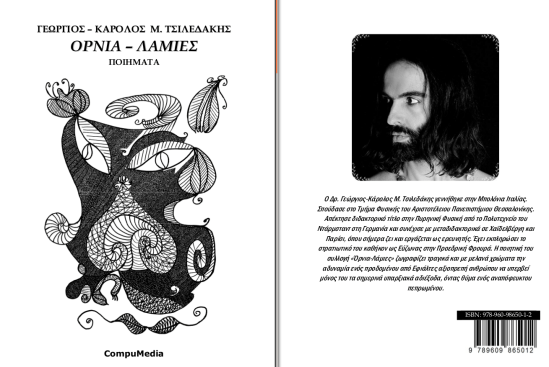
ΟΡΝΙΑ-ΛΑΜΙΕΣ
Όρνια-Λάμιες γδέρνανε
και σκίζανε το κουφάρι
δεν θέλανε την σάρκα
το δέρμα κατατρώγανε
που έλαμπε ακόμη
Μια πανοπλία αστραφτερή
που έκρυβε απ’ όλους
μια μάζα σάπια σκουληκιών
που τρώγονταν μεταξύ τους
Όρνια-Λάμιες σας καλώ
νύχια της Νέμεσις ελάτε
ξεσκίστε με το ράμφος σας
τούτο το δέρμα τ’ όμορφο
κι αφήστε ν’ αγναντεύσω
Βλέπω λουλούδια εκεί μακριά;
Όχι, σκουλήκια είναι
και νύμφες πεταλούδες
μέχρι κι αυτές ντυθήκανε
Μάη να θυμίζουν
Το γέλιο τους το περιπαικτικό
που δεν μπορώ ν’ αντέξω
καθάριο γάργαρο νερό
ακούγεται απ’ έξω
Όμορφο δέρμα σκουληκιών
με κόπρανα γεμάτο
τις φλύκταινες σου έκρυψες
μάταια να γελάσεις
τα Όρνια-Λάμιες που ‘ρχονται
το δίκιο να ορίσουν
Και ξαφνικά σκιά παντού
κάτι σαν να ζυγώνει
χαστούκια από φτερά
με πούπουλα ξυράφια
σε τάφρο με πετάνε
με την κοιλιά ανοιγμένη
Θεέ μου είναι πάνω μου
τις πέτσες μου τραβάνε
κι απ’ των νυχιών τις χαρακιές
οι κάμπιες ξεπροβάλλουν
Εντόσθια και έντερα
το φόρεμα τους χάνουν
κι ο Χάρος σαδιστής
καθώς αργά ψυχορραγώ
γελά
Τα Όρνια-Λάμιες
Θεέ μου
Μηηη…
***
ΠΡΟΤΟΜΗ ΑΠΟ ΧΑΡΤΙ
Εις ανάμνησιν της Marie, της συντρόφου…
Απ’ το χώμα ξεριζώθηκε
για μακρινό ταξίδι
μια προτομή από χαρτί
στην ωρυγή του ανέμου
Από της πόρτας την σχισμή
στην κάμαρα μου μπαίνει
πνοή αγέρα σύμμαχου
την φέρνει έμπροσθεν μου
Βλέφαρα θρηνητικές
στα μάτια μου ασπίδες
στα όνειρα είστε τρωτά
με θύμισες σας μεθάει
Μα σαν ανοίξετε δειλά
θα έχει μαρμαρώσει
οι χωματένιες ρίζες της
την έχουν φυλακίσει
Ώσπου το βράδυ ο άνεμος
να σπάσει τα δεσμά της
κι η πέτρα που ‘γινε χαρτί
μαζί μου ξανασμίξει
***
ΣΚΥΛΑΝΘΡΩΠΟΙ
Συρμάτινο το πλέγμα
μου σκίαζε τον ήλιο
τ’ αγκίστρια του βεντούζες
ξεπέτσωναν την σάρκα
αίμα και πόνος νάνοι
στην δίψα μου να φύγω
από κελί τσιμέντο
σε όνειρα κι ελπίδες
Και τώρα που ‘μαι ελεύθερος
ξέρω που να πάω
το μνήμα της μνηστής μου
με δάκρυα να ποτίσω
και μία ντάλια που ‘κλεψα
στο μάρμαρο ν’ αφήσω
μ’ έναν λυγμό που άργησα
να πω το σ’ αγαπάω
Με μαύρο φεγγάρι σύμμαχο
δεν θα με δει κανένας
σαν φίδι σέρνομαι κρυφά
ένα με το χώμα
με τα χαλίκια κόκκινα
απ’ των πληγών το αίμα
χρώμα της ντάλιας φλογερό
που κράταγα στο στόμα
Ξάφνου η νύχτα μέρα
αμάξια σταματάνε
άνθρωποι με μαύρα
αρχίζουν να γελάνε
με τσάπες και με φτυάρια
τα μάρμαρα σηκώνουν
τους τάφους μαγαρίζουν
τα κόκαλα ξεθάβουν
Τις μάσκες τους πετάνε
ζώα ντυμένα άνθρωποι
μισάνθρωποι απάνθρωποι
υπάνθρωποι σκυλάνθρωποι
βέβηλοι σιχαμένοι
στα απομεινάρια φτύνουνε
ξεκοκαλίζουν λείψανα
και Θεία βλαστημάνε
Στα πόδια το βάζω τρέχοντας
γυρνώντας προς τα πίσω
άντρα του νόμου συναντώ
βοήθεια του φωνάζω
χαμογελάει λύνοντας
τον κόμπο της γραβάτας
μα η προβιά του μαρτυρά
σκυλάνθρωπος πως είναι
Τρέχω πανικόβλητος
κοιτώντας προς τα κάτω
τα κόκκινα χαλίκια
την έξοδο μου δείχνουν
της φυλακής που ήμουνα
στον φράχτη σκαρφαλώνω
Ήχος υπόκωφος
σκίζει τον αέρα
σουβλιά στο στέρνο
μια σφαίρα για μένα
δραπέτης ελεύθερος
μαζί και δυστυχής
σάρκα μου απ’ τα δόντια τους
σαν μακελευτείς
Άρα
υ π ά ρ χ ω
σ’ αυτήν εδώ την κάμαρα
ένα αχαμνό τρεμάμενο φως
σ’ αυτήν την πόλη
σ’ αυτό τ’ αστέρι
σ’ αυτό τον έναστρο ουρανό
σ’ αυτό το σύμπαν το άπειρο
που ολοένα διαστέλλεται και διαστέλλεται
μες στο προαιώνιο τίποτα
και δεκάρα δεν δίνει αν υπάρχω / και σε σκέφτομαι
και δεκάρα δεν δίνει για την υπαρξιακή μου ανατριχίλα
απόψε
(χίλια τόσα κοσμοτέρμινα μετά το ξακουστό BIG BANG
άλλα τόσα πάνω-κάτω πριν το big buff).
*Από τα “Αγγούρια και μαργαρίτες”.
***
Ένας ποιητής
(Με τον τρόπο του Ν. Σφαμένου)
Αυτός ο ποιητής είναι
άγνωστος
ντιπ στους κύκλους του κέντρου
τις εκδόσεις τα περιοδικά τα φιλολογικά καφέ,
τον ξέρουν όμως καλά κάτι ξεχασμένοι καφενέδες
και τα ταβερνάκια όπου τα τσούζει
με παρέες ωραίες
τον ξέρουν καλά επίσης όλες οι γάτες που συναπαντά
στους βραδυνούς περιπάτους του
οι στίχοι του
κυκλοφορούν από χέρι σε χέρι
σε φωτοτυπίες
φτηνά πλην όμως σπάνια, πολύτιμα αυτοσχέδια φυλλάδια
τραγούδια γι’ αγίους που δεν έχουν
θέση στον κόσμο αυτό των επιτυχημένων κ.ά. τέτοια –
για τον φίλο μου τον Σφαμένο λέω:
πολύ μούτρο ο Σφαμένος! λεβεντιά ο Σφαμένος! δικός μας!
*Το άσμα είναι βεβαίως παρωδία ενός παλιού κομματιού του Νίκ
Οι Άγιοι, που λέμε, περιλαμβάνονται στο πρόσφατο φυλλάδιό του,
το “Αντιηρωϊκό”, Ιανουάριος 2016 – άντε βρέστε το, αξίζει.
***
(Η μ ε ρ ο λ ό γ ι ο ).
Κυττάζω στην αυλή το σκοτάδι.
Στρίβω τσιγαράκι.
Οι τσέπες άδειες – σάλιο δεν υπάρχει, έλεος, μία!
Στη δουλειά, θα μας πλερώσουν λέει στις 23 του μηνός. 450, συν 150 ευρά, χρωστούμενα. Σωθήκαμε!
Οι λογαριασμοί μαζεύονται στο μεταξύ, χέσ’ τους, δεν καταδέχομαι καν ν’ ανοίξω τους φακέλους. Τους αφίνω να χάνονται ανάμεσα στα σκόρπια χαρτιά μου…
Υπάρχει λίγη ρετσίνα κι’ ελιές, αγαπούλα, ας τα τιμήσουμε.
Γράψε: υπάρχουν και χειρότερα… Αύριο-μεθαύριο ποιος ξέρει πού μπορεί
να βρισκόμαστε;
Ας χαρούμε την ήσυχη βραδυά. Δεν το ξέρουμε, αλλ’ αυτή είναι η δική μας
“εποχή της αθωότητος”.







 To Koskino