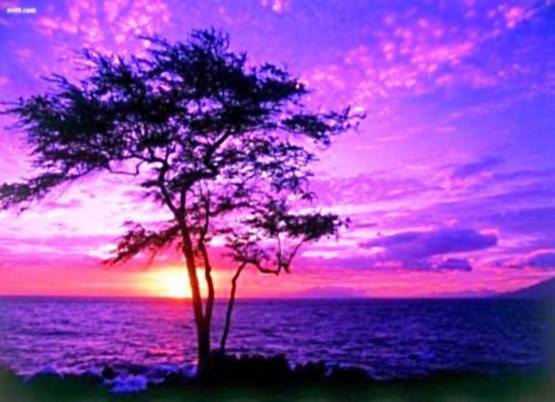
[ … ]
το μαύρο, νύχτα
και φιλί που δεν μου ’δωσες˙
… το γαλάζιο, πουλί σπάνιο
και το κόκκινο, από μακριά.
[ … ]
(Όλο το ποίημα, διαβασμένο σε 1 λεπτό και 26 δεύτερα)
Χρώματα: http://soundcloud.com/nana-t/colours-poem
[ … ]
το μαύρο, νύχτα
και φιλί που δεν μου ’δωσες˙
… το γαλάζιο, πουλί σπάνιο
και το κόκκινο, από μακριά.
[ … ]
(Όλο το ποίημα, διαβασμένο σε 1 λεπτό και 26 δεύτερα)
Χρώματα: http://soundcloud.com/nana-t/colours-poem
Εγώ, η Κατερίνα…
Κόρη του πατέρα μου Θάνατου – Ουρανού…
Και της γυναίκας του, μητέρας μου Ζωής – Γης…
Λιπόταχτη, ομογάλακτη αδελφή, της αδελφής μου Σελήνης…
Και με άνομο ζωοποιό έρωτα για τον υπέρλαμπρο αδελφό μου Ήλιο…
Χωρίς φόβο, γράφω αυτά…
Γιατί τον πατέρα μου Θάνατο, πιο πολύ από τη μητέρα μου ζωή
αγάπησα…
Και εκ φύσεως αιρετική, τη λογική αντέστρεψα…
Και με πίστη βαθιά πίστεψα, πως από τον πατέρα μου Θάνατο – Ουρανό αρχίζει
η Ζωή…
Και πως τελειώνοντας, τότε μόνο θ’ αρχίσω…
Γι’ αυτό ο πατέρας μου, το πέρασμα με τους
εφτά αγγέλους της μέρας και τους εφτά αγγέλους της νύχτας μου έδειξε…
Πως από την ερημιά του πλήθους να βγαίνω…
Και στον ουρανό ξανά κάνοντας κίνηση κυκλικά ανοδικά πάντα να μπαίνω…
Εγώ, η Κατερίνα…
Χωρίς ιδιοτέλεια γράφω αυτά…
Έτσι τη δοκιμασία της δόξας και της ταπείνωσης τα λιμνάζοντα νερά πέρασα…
Χωρίς να μ’΄ακουμπήσουνε, χωρίς να τ’ ακουμπήσω…
*Από τη συλλογή “Νόστος”.

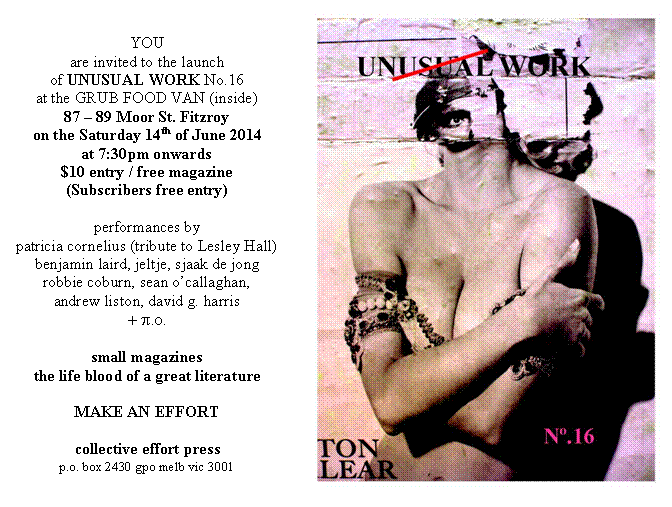
Poetry@fedsquare – Saturday, 21 June 2014 – 2-4pm
The Atrium Federation Square, Melbourne
Featuring Western Union Writers
Dear fellow poets and poetry lovers.
We are coming once again to our monthly appointment with you this time bringing WUW or Western Union Writers.
WUW have been meeting as a writing group in the western suburbs, mainly in Werribee for more than 25 years; one of the longest running groups with continuous members in Victoria, if not Australia. They have published several anthologies and have been featured in various reading events and literary festivals around Melbourne.
WUW’s aim is to support local writers and writing in the western suburbs, facilitate creative writing events and stimulate creative written and literary expression in the City of Wyndham community. Inclusive, they are a multicultural group, open to all fiction and non-fiction writers–poets, prose writers, novelists, historians, biographers, published, new and young writers.
Founders of the group, Kip Singh Chauli, Bronwen Hickman and Helen Cerne are still active as Secretary, Treasurer and Coordinator. Margaret Campbell facilitates the young writers group called Imagination Creation which continues to organise a writing competition for young writers throughout Australia and a published book with the winning entries annually.
We have the pleasure to feature three poets from WUW:
Helen Cerne, Margaret Campbell and Chris Ringrose
HELEN CERNE is a Melbourne writer whose stories and poems have appeared in Meanjin, Overland, The Age, the ABC, Hecate and other lit mags. A coordinator of Western Union Writers, a Werribee writers group, active in the local arts community and tutor at Victoria University, she has co-written and published a local history, a poetry collection Just Heart Work and a novel Those who Can’t. In 2007 she established Vanark Press for new local novelists. Her recent work explores women’s creativity, relationships and heterosexual artistic collaborations. Last year she completed a PhD writing a novel about Melbourne artists of 1940-50s
MARGARET CAMPBELL’s poetry and short stories have been published in literary magazines and newspapers in Australia and NZ. Her books include poetry, a young adult novel, a verse novel, a collection of stories and poetry and several oral histories including a volume of first person accounts recording migration to Werribee/Wyndham. She has won many writing awards and was a co-editor of Poetrix for its twenty years of publication.
CHRIS RINGROSE is a writer of fiction and poetry. He was born in East Yorkshire and is a graduate of the University of Cambridge. He has taught literature at Dalhousie University in Nova Scotia, and at Monash University in Melbourne. Chris has lived in Williamstown since 2012, and is a member of Western Union Writers. He was the winner of the “People’s Choice” competition at the Williamstown Literary Festival in 2013.
Open mic readers from WUW will include, Bronwen Hickman, Richard Dove, Bernadette Smallwoood, Bridh Hancock, Janet Howie, Angela Murnane and Jonathan Griffiths.
Poetry@fedsquare is coming to you the third Saturday of every month (except December and January) under the Federation Square and the auspices of Multicultural Arts Victoria.
Contact details
Dimitris Troaditis
poetryfedsquare@gmail.com
troaditisdimitris@gmail.com
http://www.facebook.com/PoetryAtFedSquare
http://twitter.com/poetryfedsquare



στα παγκάκια
της γκρίζας αγωνίας
μνήμες τρέχουν
πάνω-κάτω
με γκάζια ανάπλερα
περιμένουν τη βροχή
όπως άλλοι
τους προϋπολογισμούς
της υστεροφημίας τους

The eleventh issue of A Hundred Gourds, a quarterly journal of haiku, haibun, haiga, tanka and renku poetry is now online for your reading pleasure.
As well as our regular Haiku, Tanka, Renku, Haiga, Haibun and Expositions sections, AHG 3.3 features:
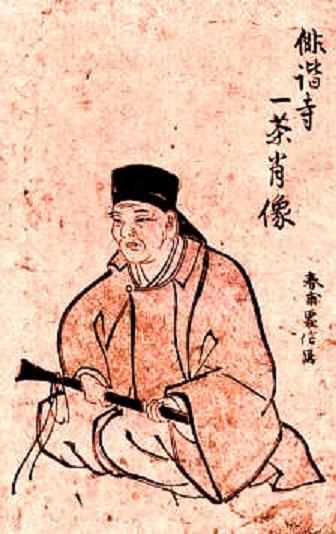
Issa’s Humanity and Humour: A Haibun Passage from His Travel Journal Oraga Haru
Everyone loves Issa’s haiku for their immediacy and evidence of his seemingly simple humanity, yet we don’t always pause long enough to study the context that might expand our appreciation. Ray Rasmussen, one of the four founders of A Hundred Gourds, returns as guest author of this issue’s feature, an in-depth study of one of Issa’s haibun passages. Ray demonstrates that the time taken to read and reflect more thoroughly brings great rewards.
Submissions Deadline
The deadline for all submissions to AHG 3.4 (the September 2014 issue) is June 15th. AHG has an open submissions policy: any submissions received after the deadline will be filed for consideration for the December 2014 issue. Please check our submissions page for details and editors’ guidelines.
Lorin Ford – Haiku Editor, Managing Editor,
for the Editorial Team, A Hundred Gourds

Vagabond AP SeriesVagabond AP SeriesVagabond AP SeriesVagabond AP Series
Poems of Masayo Koike, Shuntaro Tanikawa & Rin Ishigaki, Leith Morton, trans.

Poems of Rolando S. Tinio, Jose F. Lacaba & Rio Alma, Robert Nery, trans.

Poems of Yi Sha, Shu Cai & Yang Xie, Ouyang Yu, trans.
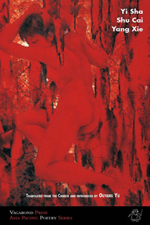
Poems of Lưu Diệu Vân, Lưu Mêlan & Nhã Thuyên, Nguyễn Tiên Hoàng, ed.
Vagabond Press, 2013
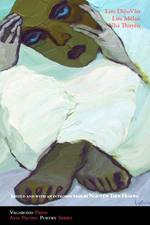
Vagabond Press has recently issued four attractively presented volumes of poetry from the Asia Pacific region. Each contains the work of three poets and represents China, Japan, Vietnam and the Philippines, respectively.
In the selection from China, Ouyang Yu provides an introduction which is concise, forthright and irreverent, so it should come as no surprise that the three poets he has chosen, Yi Sha (b.1966), Shu Cai (b.1965) and Yang Xie (b.1972) share these characteristics. There is a cool muscularity about these poems. For instance, Shu Cai ‘favours the cleanness of words and images’, Yu writes, ‘a poetry with contemporary rhythms that resonate with his themes of absurdity, of death and of memory.’ His poetry exemplifies the connection between source and form, what Yu calls ‘the centrality of solitary insight’. In ‘Ocean Sea’, the sound from the ocean’s depths and from those of the soul, present a language both perceived and created:
All we can ever do is listen to the sound from the depth
Of our selves
All that can be forgotten needs to be forgotten
As the stars and the earth refuse to be forgotten
At the seaside where I sit and watch
I seem to see life right through to its other end
In ‘Sunday Free’ there is a transposition of self into nature, as the speaker is ‘full of wings/Inside my house, flying inside the bus.’ Once at the beach:
Over my head, a huge bird is
Flying, and I am sitting
A bird whose wings have grown
Thoughts
Στα γενέθλια της Κατερίνας Γώγου (1η Ιούνη 1940-1η Ιούνη 2014)
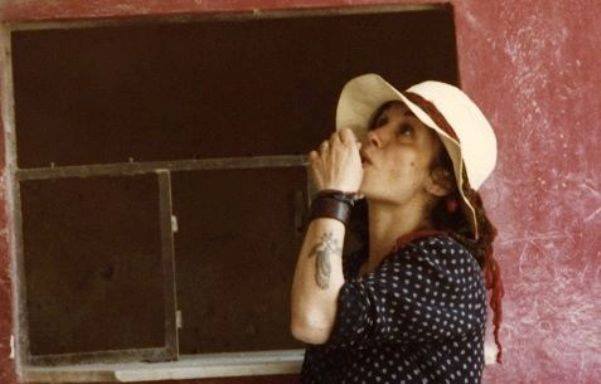
TΗΣ ΕΥΤΥΧΙΑΣ ΠΑΝΑΓΙΩΤΟΥ
Διαβάζοντας τα ποιήματα της Κατερίνας Γώγου, θέτω στον εαυτό μου την ίδια πάντα ερώτηση: Τι κάνει ένα ποίημα ποίημα; Οι περισσότεροι γραμματολόγοι αγνόησαν την ποίησή της1 την ίδια στιγμή που οι πωλήσεις των βιβλίων της έφταναν, και πριν από το θάνατό της, στα ύψη του νομπελίστα Ελύτη2. Ενώ η Γώγου ανήκε χρονολογικά στη λεγόμενη «γενιά του ’70», εφόσον γεννήθηκε το 1940 και εξέδωσε το πρώτο της βιβλίο το 1978, δεν συμπεριλήφθηκε όμως επισήμως σε αυτήν.
Ενώ οι ειδικοί επιδόθηκαν σε μια προσπάθεια σωστής ονομάτισης αυτής της γενιάς (με τους όρους «γενιά της αμφισβήτησης», «γενιά της άρνησης», «γενιά των γερανών και των φλίπερ», «τρίτη μεταπολεμική γενιά»3), ο ανένταχτος αντικομφορμισμός που πρωτοσυνέδεσε τους εν λόγω ποιητές άρχιζε, με το τέλος της δεκαετίας, να υποχωρεί. Όταν δηλαδή η Γώγου εξέδιδε το δεύτερο βιβλίο της, που έφερε τον προκλητικό πολιτικό τίτλο Ιδιώνυμο (1980)4, υψώνοντας ακόμη παραπάνω τους τόνους της πολιτικής αμφισβήτησης του Τρία κλικ αριστερά, το μεγαλύτερο μέρος της «γενιάς του ’70» προσχωρούσε σε έναν προσωπικό, υπαινικτικό και γλωσσοκεντρικό ποιητικό δρόμο. Τη δεκαετία του ’80 ανέτελλε για την ιστορία της νεοελληνικής ποίησης η επόμενη γενιά, του «ιδιωτικού οράματος»5, με κύριο χαρακτηριστικό της τη σταδιακή, και συχνά ηθελημένη, αποϊδεολογικοποίηση.
Ο κριτικός Αλέξης Ζήρας κάνει λόγο για ένα πολιτικό όραμα εξαρχής αδρανοποιημένο, εφόσον «σε κανέναν από τους επιμέρους ποιητές δεν συναντάμε με ρητό και άμεσο τρόπο την υπαγωγή της τέχνης σε ιδέες και πολιτικοκοινωνικά σχήματα»6. Ο Βαγγέλης Χατζηβασιλείου, από την άλλη, υποστηρίζει ότι, ενώ κάποιοι πρόλαβαν «να προβούν σε μια υπερβατική σάρωση του διεθνούς διπολισμού», άλλοι αισθάνονταν ότι «δεν μπορού[σαν] να κλείσουν την πόρτα σε όσα εξακολουθού[σαν] να συμβαίνουν γύρω τους»7. Αυτοί οι άλλοι δεν κατονομάζονται, δεν είναι όμως δύσκολο να καταλάβουμε σε ποια από τις δύο κατηγορίες ανήκε η Γώγου, λαμβάνοντας υπόψη μας τους στίχους ποιητικής της: «Εκείνο που φοβάμαι πιο πολύ / είναι μη γίνω “ποιητής”. / Μην κλειστώ στο δωμάτιο / ν’ αγναντεύω τη θάλασσα / κι απολησμονήσω»8.
Η χαρά είναι μια άπιαστη θλίψη
Η θλίψη σπάει με θόρυβο, θρυμματίζεται
σαν τζάμι
Κάθε νύχτα που ξημέρωσε
νίκη
επί θανάτου, ένα ξενύχτισμα για τα νεκρά
όνειρα
της ενηλικίωσης
Κάθε νύχτα έρωτα
νίκη
για την άχαρη τελετουργία της μέρας
Καλύτερα μισός, από νεκρός
καλύτερα ο πόνος από το τίποτα
Η χαρά δεν είναι επίφαση,
είναι μια άπιαστη θλίψη
Οι νεκροί δεν υποφέρουν
Ηταν νεκρός, κι οι νεκροί δεν υποφέρουν
ανοίγουν μόνο τα βράδια τις βρύσες
και πλυμμηρίζουν το υπόγειο δάκρυα
Περίμενε σκυφτός το τραμ
Οπως κάθε μέρα, κάθε πρωί
από τότε που θυμόταν τον εαυτό του
Κάθε μέρα στη στάση, φορώντας το καπέλο του
κρατώντας την ομπρέλα
χειμώνα-καλοκαίρι
με ήλιο με βροχή με αέρα
Περίμενε το τραμ
Όπως άλλοι περιμένουν τον θάνατο.
Τα ραδιόφωνα
Τα ραδιόφωνα στη διαπασών
κι η μάνα μου να σιδερώνει στο μπαλκόνι
Υποβρύχιο και τα τζιτζίκια να σκάνε
Ιδρωμένες σκέψεις, ανοιχτοί δρόμοι
ξεχειλωμένα κοντομάνικα μπλουζάκια
Και το μπλουζ του χαμού που σφυρίζει αμέριμνα
πάνω από τα κεφάλια μας.
Θα κάνουμε έρωτα, θα μαλώσουμε, θα χαθούμε
θα ξαναβρεθούμε, θα ζήσουμε
Θα χαθούμε
*Αποσπάσματα από την ανέκδοτη ποιητική ενότητα “Η χαρά είναι μια άπιαστη θλίψη”
Αναδημοσίευση από το http://www.poema.gr/poem.php?id=535&pid
 To Koskino