Render it barely

9781742585352

By Jeff Sparrow*

Collected Poems: Lesbia Harford
by Oliver Dennis (editor)
UWA Publishing
152pp
$29.99AU
Published September, 2014
ISBN 9781742585352

When Lesbia Harford died in 1927, she left behind three thick and neatly-lined exercise books full of handwritten poetry. These, now housed in the Mitchell Library, provided the basis for Nettie Palmer’s The Poems of Lesbia Harford (1941) and, in 1985, Drusilla Modjeska and Marjorie Pizer’s expanded collection, published under the same title.

Now we have a new and even more comprehensive edition, courtesy of Oliver Dennis and UWA Press. In his introduction to Collected Poems, Dennis writes:

Of the nearly four hundred poems in manuscript, just over half that number are reproduced here; of these, a third or so … have not, to my knowledge appeared in print previously.

Bringing so much writing by an important but under-appreciated Australian poet into the public arena is a major achievement, for which both editor and publisher should be congratulated. It is, however, regrettable that the new volume diminishes Harford’s work with an editorial framing that feels unpleasantly gendered.
Much of what we know about Harford’s life comes from research conducted by Pizer, a former Communist Party member personally acquainted with some of Harford’s circle. Dennis bases his introduction almost exclusively upon this material, ignoring, for instance, Ann Vickery’s recent study in Stressing the Modern (2007). Perhaps lacking Pizer and Modjeska’s political sympathies, he interprets it in ways that are frustrating and tendentious. For example, he writes:

Whereas many poets of the time – Mary Gilmore or Banjo Paterson, for example – wrote with an eye to establishing an Australian literature, Harford clearly never gave a moment’s thought to abstract notions of culture or nationhood … She instead found her place out of view, where she was free to articulate a distinctive brand of pure, incidental song.

Continue reading

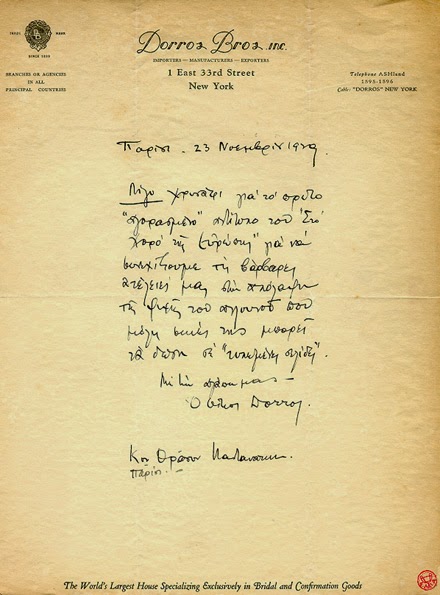
Θεόδωρος Ντόρρος ο αγνοημένος

NtorrosUeodvros.JPG

Ελάχιστοι θυμούνται σήμερον τον Θεόδωρον Ντόρρον, τον πρώτον υπερρεαλιστήν Έλληνα ποιητήν, ο οποίος με την μοναδική του ποιητικήν συλλογή “Στου γλυτωμού το χάζι” τάραξε τα λιμνάζοντα ποιητικά ύδατα της πατρίδος μας. Η συλλογή αυτή του Θεοδώρου Ντόρρου εξεδόθη εις το Παρίσι και διανέμετο δωρεάν εις τας Αθήνας.

ΙΙ. Πολλαί εικασίαι εγένοντο αναφορικώς προς το όνομα του ποιητού. Ο Γιάννης Κορδάτος δεν γνωρίζει αν το Θεόδωρος Ντόρρος είναι ψευδώνυμον ή το πραγματικόν όνομά του. Ο Μάρκος Αυγέρης το θεωρεί ως ψευδώνυμον ανθρώπου ο οποίος θέλει να δημιουργήσει θόρυβον, “να κάνει ντόρο” και ο οποίος δεν επίστευεν αρκετά εις την σοβαρότητα του εγχειρήματός του. Ωστόσον ο Θεόδωρος Ντόρρος ήτο υπαρκτόν πρόσωπον. Επρόκειτο περί Ελληνοαμερικανού εγκατεστημένου εις το Παρίσι τα στοιχεία του οποίου ευρέθησαν εις τα κατάλοιπα του Θράσου Καστανάκη και είναι σήμερον κατατεθειμένα στο ΕΛΙΑ. Πέραν πάντως όλων αυτών ο Ντόρρος δεν ενεφανίσθη ξανά εις τα γράμματα.
Continue reading

Jessica L. Wilkinson 
reviews Luke Beesley’s New Works on Paper

new-works-paper

New Works on Paper
by Luke Beesley

Giramondo Publishing, 2013

I’ve been meaning to write this review for a year – in fact, there’s a wine stain on my copy and I can pinpoint the exact date that I first put it on my to-do list (i.e. engaged in other work → frustration → tipped glass). Despite all of my sideways swerving, a year is a good amount of time to let Beesley’s recurring bees swirl around the head; a year helps one to figure out their tune. Or, as the poet writes, ‘It’s not about bees. There are no bees.’ Have I tipped the wine glass again?

New Works on Paper reminds me of Stein’s Tender Buttons: windows open out to an ‘other’ view, wholly within our grasp but difficult to articulate; a sensual vision can feed the poet as well as food (‘You wear your aubergine swimmers that answer to no one. I peel you’ (24); ‘You caught the asparagus-green, oiled and wok-fired lights’ (25)); philosophical sketches on modern living are passed through a (green) prism: ‘After taking pencil shavings (green) out of the sharper than the air’ (15); ‘The green light inside/ a canary’ (54). Indeed, the following poem suggests the poet’s nearness to Stein, as he quotes her in the epigraph (‘all is as all as, is yet or as yet’):

Funny, to be in nature might be like

what? It is surprisingly icy, the sky.
Is it something within, or without?

I see as much from a window, hear.

I collect twigs. Fantastic. It’s a word
I’ve been meaning to use it
won’t take
isn’t necessary, or this evening – sky.

Near is nature might be like. As in it is.

(‘In Nature,’ 7)
Continue reading

Sam Moginie Reviews Breaking New Sky: Contemporary Poetry from China

breaking-new-sky

Breaking New Sky: Contemporary Poetry from China

edited by Ouyang Yu

Five Islands Press, 2013

Breaking New Sky is a happily variegated collection of work by contemporary Chinese poets, edited and translated by Chinese-Australian poet, novelist and translator Ouyang Yu. Strangeness produced by means of a ‘neutral’ or ‘plain’ English (a ‘Yu signature tone’) gives the poems and their objects a riddle-like quality whose pleasures and dramas implicate food, sex, work, river systems, animals, domestic space, relationships, the medical system, nostalgia, death, farming and sleep. This plainness is put to work as the material of an aphoristic narrative mode that defines this anthology; making small claims continuously and thereby amassing charm.

Yu’s introduction begins with an account of a ‘new taste’ he has experienced while running Chinese-to-English translation workshops for Chinese students in Melbourne: a preference for ‘down-to-earth’, ‘subtle and plain speaking’ poems. His anecdote serves to place the translations in Breaking New Sky under the sign of plainness, a category that introduces prose, ‘heart to heart’ communication, the familiar and normal (I’m thinking of ‘plain food’), ease of access, assimilation, the unremarkable, blending in and plainclothes policing as modalities for the poems. There’s also a plainness to Yu’s ‘direct translation’: lines like Zhou Suotong’s ‘I saw the back of a grass-hoeing person’ or He Xiaozu’s ‘even the mah-jong players don’t get in touch / making you feel a bit odd’. Yu’s direct translation method aims to render the original language ‘literally’, to produce ‘poetry that fills the lacuna of a target language … with something so quotidian in the source language, that one’s sense is numbed’. Another result is a highly productive, stretched or slow English.

Continue reading

Shale Preston 
reviews Collected Poems: Lesbia Harford, edited by Oliver Dennis

9781742585352

Collected Poems: Lesbia Harford
edited by Oliver Dennis

UWA Publishing, 2014

In the foreword of this long overdue volume, Les Murray writes that he considers Lesbia Harford to be ‘one of the two finest female poets so far seen in Australia; the other has to be Judith Wright’ (xviii). This is an extravagant contention, but it is not without foundation. Further, Murray’s claim warrants being extended beyond the confines of gender for, to my mind, Harford should be just as readily compared to some of Australia’s finest male poets including Les Murray, Kenneth Slessor, A. D. Hope, Bruce Dawe, Douglas Stewart, David Malouf and David Brooks (albeit that the tenor of Harford’s poetry is decidedly less conservative than some of these poets). Accordingly, it is quite tragic that Harford has, up until now, occupied such a minor place in Australian literary history for, as this volume amply attests, she produced what can only be described as some of Australia’s most evocative poetry.

Born in 1891 and dying in 1927 at the age of only thirty-six from the combined effects of pulmonary tuberculosis and a bacterial infection of the heart, Harford published very little in her lifetime and held so strongly to her uncompromisingly modern and free-spirited vision that she turned down opportunities for publication. Indeed, she refused to give Percival Serle, renowned Australian biographer, permission to publish one of her poems because her need to live an authentic life took precedence over concerns about her artistic after-life: ‘Your anthology will be read in many places for many years. I would not care to be recalled to the memory of distant friends by the poem you have chosen … You see, I take my poetry seriously and I am in no hurry to be read’ (xx). It is fortunate that Harford took this approach because the fluid nature of her sexual identity and her unselfconscious ability to express this within her poetry would, no doubt, have met with rejection and/or hostility at the time that she was writing. Being in no hurry to publish thereby gave her the freedom to commit wholeheartedly to her unflinchingly honest and searingly personal poetic vision. Moreover, it ultimately worked to preserve the wonderfully uninhibited nature of her poetry for posterity. During the years that she was writing, it is highly unlikely, for instance, that the following words from her poem ‘I can’t feel the sunshine’ would have been published:

Would that I were Sappho,
Greece my land, not this!
There the noblest women,
When they loved, would kiss.

Continue reading

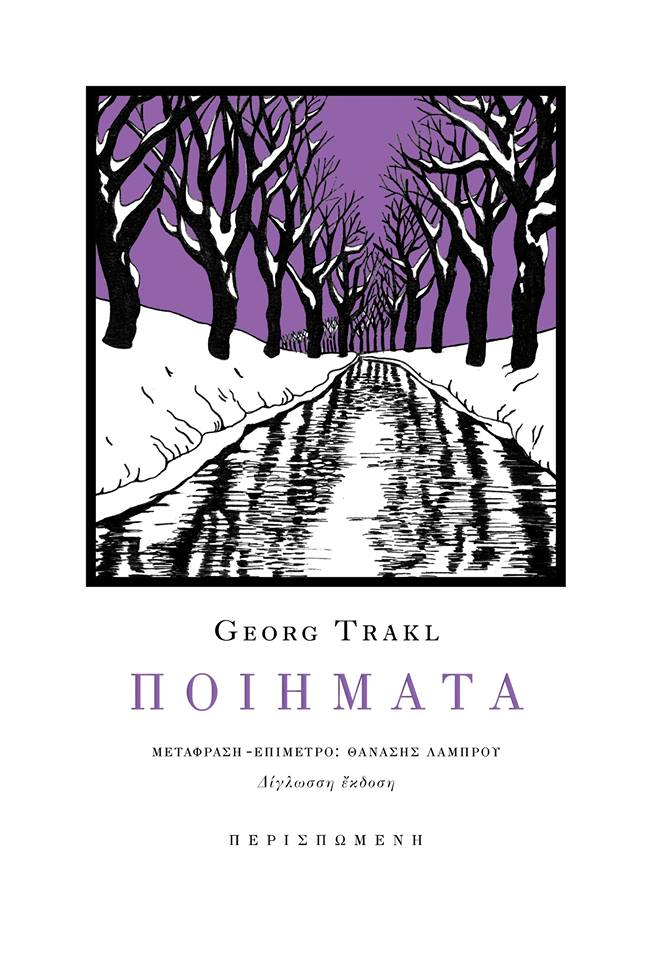
Georg Trakl (3/2/1887–3/11/1914) In Memoriam

10485831_891288077561518_8338044769177571332_n

Σαν προχθές, 3 Νοέμβρη, πριν από εκατό χρόνια, τη νύχτα, ο Αυστριακός ποιητής Γκέορκ Τρακλ, ψυχικά διαλυμένος, σίγησε για πάντα στο στρατιωτικό νοσοκομείο της Κρακοβίας, Έτσι, ο 20ός αιώνας έχασε, στην αυγή του κιόλας, μια από τις αυθεντικότερες ποιητικές φωνές του.

Με την έναρξη του Α’ Παγκοσμίου Πολέμου ο υπερευαίσθητος ποιητής, τον οποίο χαιρέτισε με θαυμασμό ο Ρίλκε, επιστρατεύτηκε σε μονάδα του Υγειονομικού και στάλθηκε στο μέτωπο. Μετά τη μάχη του Grodek (στη σημερινή Ουκρανία) υποχρεώθηκε να αναλάβει ολομόναχος την περίθαλψη ενενήντα βαριά τραυματισμένων, αρκετοί από τους οποίους αυτοκτόνησαν μπροστά στα μάτια του. Απελπισμένος από την αδυναμία του να βοηθήσει, αποπειράθηκε να αυτοκτονήσει, όμως τον πρόλαβαν οι σύντροφοί του την τελευταία στιγμή. Μεταφέρθηκε στην ψυχιατρική πτέρυγα του νοσοκομείου. Λίγες ημέρες αργότερα πέθενε από ισχυρή δόση ναρκωτικών.

Οι εκδόσεις Περισπωμένη βλέπουν την επικείμενη έκδοση της ποίησης του Τρακλ (μετάφραση-σημειώσεις-επίμετρο: Θανάσης Λάμπρου) ως αφορμή να θυμηθούν, δηλαδή να βάλουν στην καρδιά και να σκεφτεί τους νεκρούς του Α΄ Παγκοσμίου Πολέμου, ένα από τα θύματα του οποίου ήταν και ο 27χρονος ποιητής.

The poetry and brief life of a Foxconn worker: Xu Lizhi (1990-2014)

xu lizhi

Translations of poems by Xu Lizhi (许立志), the Foxconn worker who committed suicide on 30 September 2014, at the age of 24, in Shenzhen, China. Also includes an obituary with some explanatory notes. Note: Below are translations by friends of the Nao project, starting with Xu’s departing poem and an obituary, followed by other poems from 2011 to 2014. By translating these poems, we aim to memorialize Xu, share some of his excellent literary work, and spread awareness that the harsh conditions, struggles and aspirations of Chinese migrant workers (including but not limited to Foxconn) have not diminished since the more widely-publicized spate of 18 attempted Foxconn suicides in 2010, resulting in 14 deaths.

Insiders report that thereafter, although the frequency of suicides decreased (mainly due to Foxconn’s installation of nets making it more difficult for workers to jump from their dormitories, along with the development of workers’ collective resistance), such suicides have continued to the present. Including Xu Lizhi, at least 8 cases have been reported in the media since 2010, but insiders say that many other cases go unreported. We hope that in the future, workers in Foxconn and elsewhere manage to find ways around such companies’ military-style discipline and surveillance, come together, and forge collective paths out of this capitalist world of death, into a world worth living in. Don’t give up! Feel free to repost these translations anywhere.

Continue reading

Ζαχαρίας Στουφής, Η Ταξιθέτρια του Χάους, εκδόσεις «Κάποτε»

stoyfis


ΤΟΥ ΘΕΟΧΑΡΗ ΠΑΠΑΔΟΠΟΥΛΟΥ

Στις μέρες μας κυκλοφορούν πολλά βιβλία και ορισμένα από αυτά είναι πρωτότυπα γραμμένα, όπως το καινούργιο βιβλίο του Ζαχαρία Στουφή «Η ταξιθέτρια του χάους», που κυκλοφορεί από τις εκδόσεις «Κάποτε».

Όπως, μας πληροφορεί ο ίδιος ο ποιητής, το συγκεκριμένο βιβλίο, αν και περιλαμβάνει ποιήματα δεν χαρακτηρίζεται ποιητική συλλογή, αλλά ποιητική βιογραφία χωρισμένη σε τρεις ενότητες. Όμως, διαβάζοντας την «Ταξιθέτρια του Χάους» διαπιστώσαμε ότι το κάθε ποίημα θα μπορούσε να σταθεί και μόνο του και να δημοσιευτεί ξεχωριστά καθώς όλα διαθέτουν το δικό τους νόημα και την δική τους αυτοτέλεια.

Ολόκληρο το βιβλίο το διαπερνά ένας σαρκασμός και μια ειρωνεία, ενώ ο ανατρεπτικός στίχος του ποιητή ξαφνιάζει ευχάριστα τους αναγνώστες: «Τώρα όμως, στο νηπιακό μου γήρας – δυστυχώς – / δεν υπάρχουν οι μεγαλύτεροι για να τους μιμηθώ / και οι νεότεροι – ευτυχώς – / ούτε που θέλουν να με ακούσουν». Και αλλού: «Πραγματικά θέλω να με ευχαριστήσω που δεν με έκανα, έναν από τα εκατομμύρια σωτήρες του κόσμου».

Ακόμα και σε κάποια σημεία, όπου συναντάμε βωμολοχίες θα εκπλαγούμε γιατί πίσω από τις θεωρούμενες χυδαίες λέξεις δεν θα βρούμε τον εύκολο και φτηνό εντυπωσιασμό, αλλά την ουσιαστική αποδόμηση μιας υποκριτικής ηθικής, που διαπερνά τη σημερινή κοινωνία.

Σε ορισμένα ποιήματα της «Ταξιθέτρια του χάους» έχουμε την ανατροπή των ωραιοποιημένων εικόνων της σημερινής κοινωνίας: «Ετούτη η πατρίδα είναι ψέματα· ο μεγάλος της ήλιος είναι λιοπύρι που κατατρώει τους εργάτες».

Θα κλείσουμε εδώ την περιπλάνησή μας σε αυτή την ποιητική βιογραφία της «Ταξιθέτριας του χάους» από τον Ζαχαρία Στουφή, βγάζοντας το συμπέρασμα, ότι είναι μια έκδοση, που, όπως αναφέρει χαρακτηριστικά ο ίδιος στο ποίημα «Μέτρια έκδοση»: «Αν μείνει λίγο αδιάβαστη στον πόνο…/ αντιδρά· / τινάζοντας την πόλη στον αέρα».

Alice Allan Reviews Nola Firth, Richard James Allen, Liz McQuilkin, Sandra Thibodeaux, and Wendy Fleming

Even if the Sun
by Nola Firth
Melbourne Poets Union, 2013

Fixing the Broken Nightingale
by Richard James Allen
Flying Island Books, 2013

fixing-the-broken-nightingale

The Nonchalant Garden
by Liz McQuilkin
Walleah Press, 2014

nonchalant-garden

DIRTY H2O
by Sandra Thibodeaux
Mulla Mulla Press, 2014

DirtyH20

Backyard Lemon
by Wendy Fleming
Melbourne Poets Union, 2014

backyard-lemon

Whether new or established, it’s part of a poet’s work to ask: How far can my words go; how much can they capture; where are their limits? The five Australian poets reviewed here each have their own methods of asking these questions. As a reader and writer of poetry I’ve learned a lot from the sometimes quiet, sometimes bold and always courageous ways they’ve answered them.

Continue reading

Book launch: Alex Skovron, Towards the Equator – New & Selected Poems

Towards_the_equator_310_476_s

This New & Selected Poems is a substantial and long-awaited compilation from one of Australia’s most accomplished poets, a retrospective spanning more than thirty years.

The New Poems section, ‘Towards the Equator’, represents Alex Skovron’s sixth book-length collection and signals a return to the formal variety that has been a hallmark of his work. As always, a distinct Eurocentric sensibility sits alongside an engagement with Western art and culture. All six collections are characterized by close attention to craft, versatility of tone and technique, and a seriousness of intent seasoned at times with wry humour or playful wit. We encounter a rich assortment of voices, moods and scenarios as the landscapes of experience, the playgrounds of the mind and the theatres of the self are negotiated.

Music, memory, philosophy, the creative spirit and language itself are focal-points; the dimensions of faith and the quest for self-knowledge colour the shifting light; while Eros, in various guises, accompanies many of the poems across the plains and borderlands of the imagination. Recurring motifs in Skovron’s poetry include the perpetual tussle with history, the search for a clarity of vision, and our often ambiguous relationship with identity, with each other, and with the enigmas of time and remembrance.

The book will be launched

at Armadale Bowls Club, Princes Park

41 Sussex Rd, South Caulfield, Melbourne

on

Sunday, 30 November 2014 at 4.00 pm

Refreshments will be served