Ποιητική οφειλή στην Αναρχία

anarhia

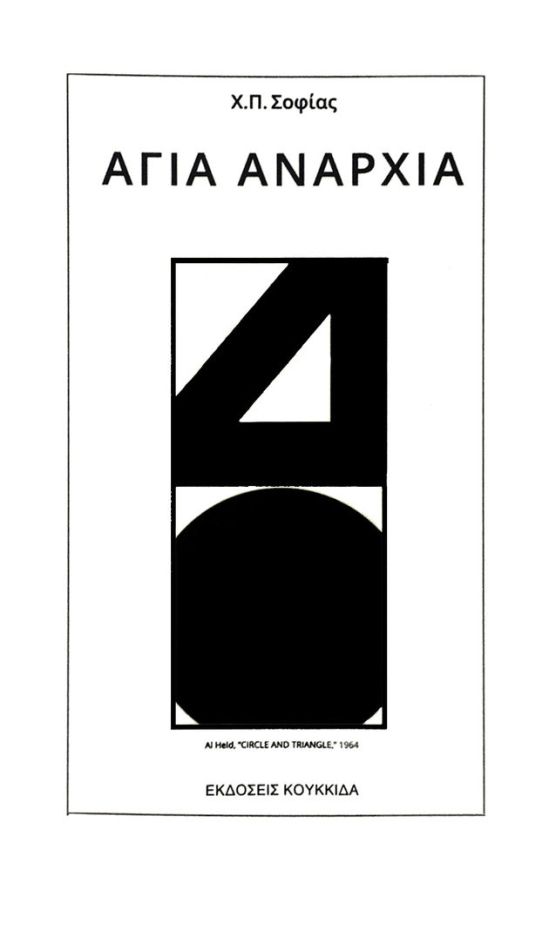
«Το ποιητικό μονόφυλλο με τίτλο “Αγία Αναρχία” εκδόθηκε τον Μάρτιο του 2016 και αποτελεί μια ποιητική οφειλή του συγγραφέα στην Αναρχία» διαβάζουμε στη λιτή ανακοίνωση. Δημιουργός ο Χαράλαμπος Π. Σοφίας (Εκδόσεις «Κουκκίδα»). Από τα περιεχόμενα (οκτώ ποιήματα) μπαίνουμε στο κλίμα του κειμένου: Αλφα, Αναρχικοί, Μαύρος Σπόρος, Μιχαήλ Αλεξάντροβιτς Μπακούνιν, Σεργκέι Γκενάτιεβιτς Νετσάγιεφ, Μαύρη Σημαία, Μητρόπολη, Αγία Αναρχία.

Ιδού η κατακλείς από το ποίημα για τους Μπακούνιν – Νετσάγιεφ:

Στης νύχτας τη χαρά, το χώμα από ενοχή απάντησε/περιμένοντας κι αυτό τον δαίμονα του ανθρώπου./Εκείνον που αγρυπνά στο πρόσωπό του η ομορφιά της ταραγμένης θάλασσας./Εκείνον που πολεμάει τις λέξεις εμπρός στον καθρέφτη μη αντέχοντας το μοιρολόγι του δούλου./Εκείνον που στο χείλος της αβύσσου συλλέγει κάθε νύχτα από τη σιωπή των άστρων την αστρόσκονη/χορεύοντας ξυπόλυτος/σκορπίζοντας την εξέγερση που γεννάει την επανάσταση.

Τα ποιήματα «υπακούουν» στο μότο που κραυγάζει, θα ‘λεγε κανείς: «Πυρπολήστε το παρόν αν θέλετε να έχετε μέλλον».

Πώς βλέπει τους αναρχικούς στο ομότιτλο ποίημα;
Είναι έτοιμοι να πυροδοτήσουν τα όνειρά τους/Σκιές με ασημένια φτερά στον αέναο κύκλο/ Ταξιδιώτες του μέλλοντος με το όπλο στο χέρι/Ετοιμοι να παγιδεύσουν τις ήρεμες νύχτες σας/Να διαταράξουν τη λογική της αρχής/Να επιτεθούν στη συνεχή ροή του χρόνου/Είναι ήδη έτοιμοι να κηρύξουν την κοινωνική επανάσταση.

Τι κάνει η Αγία Αναρχία;
Δαγκώνει τα χείλη της καθώς η αστροβροχή συνεχίζει να πέφτει/Αγκαλιάζει τα παιδιά της/Τους μιλά για την Αγία Αναρχία/Το οπλισμένο χέρι της/Τη νεανική της φλόγα/Την περπατησιά της/Το θάρρος της όταν πυροβολεί τον καθρέπτη και τις μισές λέξεις/Την ιερή οργή της για τους ανθρώπους που σιωπούν στο φως της ψυχής.

Μια πραγματικά αυστηρή ματιά μέσα από έναν εσωτερικό κόσμο που εκρήγνυται και φωτίζει τις νύχτες και τα «αγόρια και τα κορίτσια με μαύρα ρούχα, που μοιράζονται τη χαρά στους δρόμους καίγοντας είδωλα» (Μητρόπολη). Ασημοφέγγαρο, σύμβολο της αναρχίας το θέλει ο ποιητής: «Ανθίζουν μαύρα λουλούδια στον ουρανό/Ενα ασημένιο φεγγάρι ανατέλλει και μέσα του ένα Αλφα».

Μαύρη Σημαία:
Στου χρόνου τη λήθη δε λυγίσαμε, δεν σωπάσαμε/Παραμείναμε με τον άνεμο της πρώτης νιότης/Με τα φτερά του πετάξαμε στις πράξεις της φωτιάς/Στο τέλος του αγνώστου κλέψαμε τον ήχο του κύκλου/Και όλο χαρά τσακίσαμε τη φορά του βέλους/Σηκώσαμε ψηλά τη μαύρη σημαία/Ετσι φτάσαμε πολύ ψηλά ώς τα άστρα/Δεν αφανιστήκαμε μέσα στης νύχτας τη σκοτεινή βλάστηση.

(Ηλεκτρονική διεύθυνση: xpsofias@gmail.com).
Επιμέλεια: Γιώργος Σταματόπουλος
*Από το https://www.efsyn.gr/arthro/i-viosi-mias-xenitias

Simon Eales reviews On Violence in the Work of J.H. Prynne

unnamed

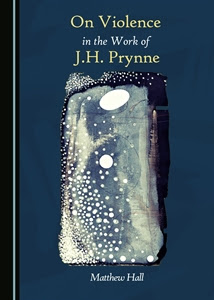
On Violence in the Work of J.H. Prynne
by Matthew Hall

Cambridge Scholars Publishing, 2015

Violence and poetics are the key poles in Canadian-Australian critic and poet Matthew Hall’s new scholarly release. Hall charts how the British late-modernist poet, Prynne, responds to violent events of the twentieth and early twenty-first centuries – from the Holocaust, through apartheid, Chernobyl, and Australian colonialism, to Abu Ghraib. These affective sites of violence are linguistic, too: chapter two takes its subject as the ‘the sociolinguistic war’ which takes place under ‘the strain of economic factions and the reach of the multinational resource sector’. In dealing with these events, which are all tied up in language whether they seem so or not, Hall argues that Prynne infects his work with that which cannot be reconciled; ‘pure violence’. He writes, ‘Prynne’s poetry problematises an experience of the world inextricably knotted with the manners in which it may be understood’. Violence, consisting of its ‘perpetration’ and its associations with ‘systematic and political constructs’ of power, frames this experience of the knotted world.
In considering these violent events, the book dedicates its five chapters to close readings of three of Prynne’s editions – News of Warring Clans (1977), Bands Around the Throat (1987) and Acrylic Tips (2002) – and two of his poems, ‘Es Lebe der König’ from Brass (1971) and ‘Refuse Collection,’ published in a special edition of Quid journal in 2004. As Hall argues, his readings, like Prynne’s poems, are ‘engrained with the history of the event’. Much of Hall’s argument around the significance of Prynne’s work hinges on Alain Badiou’s theory of the event, which, for Hall, consists of a ‘real rupture’ of an existent paradigm, in the wake of which forms a ‘new subject,’ which persists by ‘fidelity’: ‘the name of the continuation of the existence of the process of the new subject’. Similarly to John Kinsella’s argument that ecopoetics is largely an ‘egopoetics’ in that its placement of nature as a dialogic correspondent is ‘an act of convenience and not reality’, Hall emphasises the reality that the three elements of Prynne’s project – the historical event, its non-poetic (mythic or mediatised) representation, and the poem – sit together irregularly. Such an emphasis drives his attention to the fact that the poem is a ‘momentary clarity, easily soluble,’ or, in other words, that it holds its structure briefly before subsumption, and until further attestation.
Violence is articulated in various ways throughout the book. In chapter one, the Holocaust is the violent event and we track the aesthetic distension and incompleteness it causes – its ‘estrangement’, ‘displacement’, and ‘dissonance’ – through Prynne’s elegy (of sorts) to Paul Celan, ‘Es Lebe der Konig’. In chapter three, on Bands Around the Throat and looking at Chernobyl and South African apartheid’s ‘necklace killings,’ violence is experienced as a ‘“continuous formation, rupture and reformation” of sensation’. Chapter five deals with the embodiment and sexualisation of violence via Kafka, Judith Butler, Elizabeth Grosz, and Giorgio Agamben’s state of exception. But it is Hall’s identification of a public ‘coopt[ed]’ into the ‘democratic process of decision making’ that is most compelling here, and that indicates the most insidious violence, in a poem responding to the mainstream media-spread images of torture at Abu Ghraib. It reveals Prynne’s poetic function of critical resistance: America’s mediatised coercion – or Prynne’s great metonym, ‘call-sign Freedom’ – is interrupted by his use of its ‘public language’ against itself. Aporias double up and down, and the ouroboros is reinvited.
The way that Hall is able to be close to the linguistic ‘constriction’ and ‘censorship’ that Prynne represents is really the outstanding mark of this book. The concept of ‘survivors keeping watch over the annihilated’ expounded in the first chapter carries throughout. It is through this kind of attestation that language and, indeed, scholarship can do ethical work. (Ethics is broached fleetingly, but seems more of an implicit motivation of the study). It can symbolically, or, in the case of scholarship, analytically, admit its complicity in the violence (and there’s a substantial nod to Slavoj Žižek on this point) while concurrently bearing what Derrida calls ‘witness for the absence of attestation’. Long sections of glistening, close poetic analysis demonstrate how comfortable Hall is in this space.

An abstract conceptualisation of the usually lyric subject also occupies this closeness to Prynne’s poetic re-events. Violence is done to it, but it also attests to violence. Chapter Two draws us into tracking this almost paratactical progression of the lyric through Prynne: Hall shows that News of Warring Clans uses ‘the usurpation and subsumption of the lyric into the violence of exploitative and warmongering language’ as its material constraints. He elucidates Prynne’s precarious maintenance of the lyric in his analysis of the subject’s catharsis in Acrylic Tips. The book perhaps even shows symptoms of being over-invested in this maintenance of the lyric and its associated person-centered approach to violence response. When ‘Vocab[ility]’ is the position to which a child ‘graduat[es]’, we might be drawn to enquire after those who cannot lyricise their own experience. Or can everyone lyric? As Hall makes explicit, though, that we’re asking these questions are part of the point of Prynne’s affect: ‘The reader is left travelling into the heart of a contaminated country [both Ukraine and the lyric form] without the means of expressing the horror of bearing witness, and with the knowledge of the eradication of the account of the victims’.

The book’s attempt to negotiate the tensions between a dialectical procedure and a nomadic one is clearer and more critically generative. Fittingly, Hall seems to wrestle with the dialectical, and I think he lets it maintain its corner. He quotes the famously dialectical Clausewitz in the introduction to chapter five, and in chapter four proposes that the ‘occasion[ing]’ of a ‘cultural hybridity’ made of Indigenous and Western ‘values and traditions’ would be ‘the most providential conclusion’ possible for a nation built on colonial violence. Although the adjective, providential, seems to come out of nowhere, we might understand Hall’s expression in light of Dominique Schnapper’s notion of ‘providential democracy,’ a projected conclusion that orients practice (which, in regards to Schnapper’s term, privileges equanimity between individuals as an alternative to ‘civic transcendence’). Dialecticism in this case of Prynne’s is particularly challenging because it asks us to look at both sides, the violator and violated, fully in the face, up close and ugly, and accept that parts of each will constitute the new subject.

It is hard to discern from the book what should be done in response to violence; either what Prynne advocates doing, or whether the point of his work sits at a distance from the idea that something could or should be actively done at all. In the conclusion to his analysis of the title poem of Acrylic Tips, a short work dealing with ‘forced adaptation’ (‘language … under pressure’) in direct reference to British colonialism’s imposition on the indigenous people of this land, Hall writes, ‘The utilisation of a model of pastoral elegy aligns the poem’s narrative and Prynne’s poetic construction of colonial conditions to a movement from loss to possible consolation’. Consolation is a significant idea for Prynne via Hall in making sense of the after-realm of violence. It is central to the arch of this pastoral elegy form he uses and departs from, and is analogous to the subject’s return to a musical fugue’s tonic key, a form riffed on in Hall’s analysis of ‘Es Lebe der König’. Hall suggests that in the face of violence, Paul Celan in the poem ‘Todesfuge,’ and Prynne responding to ‘Todesfuge’ in ‘Es Lebe der König,’ use the fugal form and its boomerang-like fidelity to itself as a way of representing a remembrance of the pre-violated subject.

The book advances several distinct and significant contributions to Prynne scholarship. Being on a dramatically under-read poet, the book benefits from Hall’s deep historiographical research and its resultant new theoretical concepts. One can imagine that a few of these have initiated what will become further enquiry, perhaps beyond Prynne studies. The idea of public language as refuse, which underpins chapter five, for example, opens a field of enquiry into the power of the public reader. This is also the utility of ‘Refuse Collection’ as lyric poem, which ‘asks the reader to formulate her or his own judgements with regard to the experience of suffering, a judgement the reader must create and defend from her or his own position within the world’. Hall’s attitude towards discourse and its subject, here, is representatively and demonstrably non-violent. One might further identify the importance of thinking about dialecticism in relation to Prynne’s work, in that the reader is invited to form their own judgement in the face of Prynne actively subsuming meaning and obfuscating ‘expressive interpretation’ through devices like ‘glottal sonority’. Again, we’re called to fidelity. And then there are Hall’s many, many crystalline insights into the affect of Prynne’s poetic practice, such as his examination of ‘the function of the command, used in close proximity to alliterative, onomatopoeic word clusters’ in Prynne poetry since Brass.

Hall’s depth and rigour of analysis relating to single poems, concepts, or words is necessary with Prynne’s work, which deliberately charts its own various, thoroughly developed, and interweaved, ontologies. In chapter three, for example, Hall identifies in ‘Fool’s Bracelet’ that ‘specialised languages of economic theory and financial trading, biblical data, reports on psychoanalytic testing, and nursery rhymes all have contingent and mixed operations’. Hall doesn’t ease the complexity of these interweavings, rather he pin-points some of their affective capacities and suggests connections. On the poem ‘Ein Heldenleben,’ Hall states that ‘Leisurely movement and its pastoral associations are radically juxtaposed against the imposed restrictions on movement for the people living in the direct line of fallout of the Chernobyl reactor,’ incorporating a historiographical sense-making into Prynne’s deliberately jarring juxtapositions. Hall refuses to simplify Prynne’s interruption of these lines of movement, whether they chart the passage of thought, displaced persons, or lines of a poem (as in the poem ‘Write Out,’ in Bands).

Another key introduction to Prynne studies is the book’s focus on ‘experiential knowledge within the poem,’ as is the argument that the experiential is fundamental to Prynne’s work, ‘even if the manner in which experiential knowledge is utilised is not explicit’. The argument along this line is that, in response to extra-linguistic violence, as well as the violence of the speech act, both of which he would say he (as a representative of we) is complicit, Prynne ‘turns upon his own prior propositions and reinserts presence within the questioning framework of the poem’. An effect of this experiential approach is that Hall’s work is very much middle, and not so concerned with resounding conclusions. Linking the torturers’ craft in staging the Abu Ghraib atrocities for cameras with their self-protection against the recollection of childhood trauma in the last paragraph of the last chapter, for example, leaves a lot unexplained. It opens a psychoanalytic line we have not yet pursued, and will not. We are not left with the realisation of an argument Hall has been building, rather, a hypothetical question, and highly contingent strands of its constitution. The subject we began with, namely, the poem, has transformed into the subject we finish with, a polysemous one: ‘life,’ but in the tight framing of the function of sovereign power, ‘unreal suffering’ and the violence done to identities. I think this is testament to the kind of reading that Hall provides, which shares traits with the reading styles of his Australian poet-critic contemporaries, Michael Farrell (see a really nice section on constriction, bridging, camping, and puns on pages 158-9) and Astrid Lorange: precise and radically generative, theoretically accomplished, referential and witty, and less concerned with dictum than it is with the responsive stuff of the procedure.

Hall uses the word ‘the’ a lot, which might seem facile to note, but it indicates a few important things about this scholarly style. The’s effects is to encumber Hall with a mandate to prove existent knowledge. The ‘the’ sentence’s passivity indicates an objectivity conceit. Similarly to Prynne of his conceits, Hall seems acutely aware of the semi-permanence of his scholarly voice, only willing to lean truth-objects against each other in an almost deliberately awkward way, and not against anything more ecologically certain. As mentioned above, his close analysis feels palpable and counterposes any ‘innocuous tedium of the “slogan vestry”’ that might be represented by his ‘the’-full sentences. A further effect of Hall’s ‘the’ sentences is the feeling that these sections are collections of sense data. Their pieces are valuable in themselves – the book is highly quotable – but they sit together, I think deliberately, uneasily. It’s indicative of Hall’s internally cohesive argument concerning attention and responsive intertwinement that the ‘the’ sentence is endemic to Prynne’s own theoretical style. For example, charting a sentence like, ‘Through these experimental linguistic means, the conditions of labour and the relation to the sustentive are also problematised’, would involve the kind of minute deconstruction of the phrase that Hall conducts on sections of Acrylic Tips.

On Violence in the Work of J.H. Prynne is a valuable addition to what should be described as an invigorated moment in Australian poetic criticism. Taking on the transnational, decolonising, and ecopoetical sensitivities of this moment, Hall turns alertly to a powerful poetic, and perhaps pioneering, proponent of this mode.

*Simon Eales was born and lives in Melbourne. He recently completed a MA on Australian satirical poetics at the University of Melbourne.

**Taken from http://cordite.org.au/reviews/eales-hall/

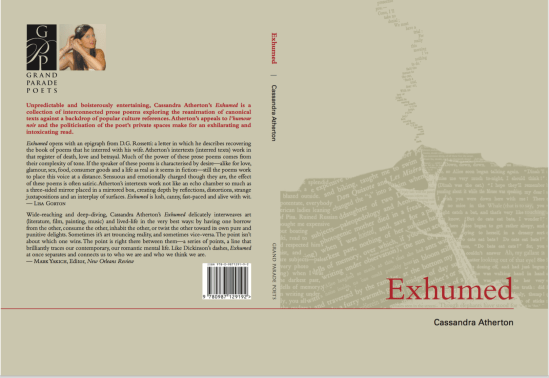
Ivy Ireland reviews Cassandra Atherton’s Exhumed

CAthertonExhumed

Exhumed
by Cassandra Atherton
Grand Parade Poets, 2015

Dazzling, vibrant and terribly witty, Cassandra Atherton’s Exhumed does not give itself over entirely to the horribly serious, gruesome images invoked by its title. Nor of course does it travel down to the desperate depths of its epigraph’s hero, Rosetti, who (in)famously ‘recovered’ the book of poems he had buried with his wife. Yet Atherton’s collection of prose poems is nonetheless morbidly fascinating and even darkly exhilarating, with some of the more raw, emotionally-fierce poems evoking similar queasy feelings in the twenty-first century reader, perhaps, as the nineteenth-century poet might have experienced recovering writings from the grave of a loved one. For loved ones haunt the pages of Exhumed in abundance, with all their conceits and betrayals on display, coupled seamlessly with high literature or popular TV, colour or sound, texture, taste and scent. These are embodied, visceral poems, alive with sticky sex, sugary gastronomy, grandiose and not so grandiose imbibing: ‘no gripe water. Maybe absinthe’ (‘Seed’ 22).

Picking up Exhumed, I confess I was daunted. Perhaps I was in a bad mood, perhaps glancing over the great chunks of text with their pages of intertext endnotes felt a little like facing the suggested reading list for an end of semester essay. This collection felt heavy, both in word length and subject matter. And yet within moments, the opening poem, ‘Bonds,’ sucked me in and under, even with its thirteen references in the back pages:

There can be no valedictions here./ So now our lives are cotton. And although cotton breathes, it is also the/sarcophagus of our relationship. Embalmed memories. But I promise to/ dig you up. Like Heathcliff. Or Rossetti. I promise to unbind you and gather you in my arms (11).

Exhumed contains a romantic, Romantic quest: to ‘write the space between / my heart and my pen’ (‘A Room of One’s Own’ 28) or perhaps to uncover what was lost (often before it becomes lost): ‘I worry every day that you will go to ‘Empty Trash’ and / I will disappear.’ (‘Rubbish’ 49). The quest of the reader, then, is to follow along, to become lost deep inside the narrative (and then of course endeavour to dig themselves back out). For this book of prose poems unfolds a love story, with its everyday ins and outs: ‘I want a red Smeg 473L fridge. I want my whole kitchen/ to be red. He draws the line at a red fridge.’ (‘Plum(b)’ 12), moments of exhilarated hope: ‘I belong / in Massachusetts twirling myself in his sheets. Rotation. Revolution. / Spinning ginny. Ginnie to his Riddell’ (‘Anonymous’ 15) and boldly confessed fears of the imminent end: ‘But you have never bought me flowers. / Or shown up unexpectedly. And you won’t stay for a lifetime. Because / neither of us has a lifetime left to spend. Together. Or apart.’ (‘Tsundoku, Neon Love’ 74). There is no small amount of sorrow at the inevitability of imperfection in relationship here, coupled with a maudlin yearning for perfection nonetheless; all cleverly drawn out with the grand device of allusion. A supermarket notebook in ‘More’ becomes a motif for all that cannot be gained: ‘You want to buy/ all the green notebooks at $1.99 each but know they will replenish the / stock when you leave. You can never have them all. Somewhere, someone / else will be using one of your green notebooks’ (34). Yet, in ‘Chigger’ there is still joy in what can be experienced, what may be grasped, albeit momentarily: ‘I fell in love with fireflies in Pennsylvania. / I remember trying to take photos of their luminous green abdomens as / they took of and landed in the long grass’ (60).

Exhumed contains far too much viscera to dissect in such a short review. For all their sparkling intelligence and playful satire, these poems, I believe, are profoundly embodied and emotive. There is a glorious layering here, and the themes flow on from each other through the interring process to the necessary disinterring to create what is an (albeit diverse) narrative whole. The ‘glue’ (‘Bonds’ 11) of childhood food such as a ‘McDonald’s Happy Meal’ (‘Alice’ 41) sticks literature giants like Nabokov (‘Lolita’ 23) to the ‘Hello Kitty love hotel’ (‘Shinjuku Morning’ 74) with seemingly little effort.

While there are some actual belly laughs to be had throughout, the vast blocks of text (and endless intertexts) do not make for easy reading. Sometimes it is difficult to determine who or what is hiding whom: does the sarcasm reveal a vast emotional void or does the almost gruesome body imagery and heavy reliance upon others serve to place a shield over what is perhaps a raw and unknowable human response to upheaval? Everything slightly mentioned on this expansive ground seems to open the way to something else entirely, and heaven forefend we should arrive at a conclusion concerning the speaker here, the quixotic voice is only too ready to set us off on yet another bisecting or bifurcating path. Perhaps, though, this obfuscation hardly matters, the pikes of prose alone are enough to ward off the queasy reader and the robust reader will devour it all, with vigour and a large dose of ‘Apple Pie Moonshine’ (‘Seed’ 22).

*Ivy Ireland is a writer who runs a bookstore café with her partner. She teaches Creative Writing at the University of Newcastle, where she completed her Ph.D in 2012. She has been awarded the Australian Young Poet Fellowship, the Harri Jones Memorial Prize for poetry, and has been commended in the Newcastle Poetry Prize and awarded the local section. Her poems have been published in various magazines and anthologies around the world. Ireland’s first book, Incidental Complications, was published in 2007 and her new collection, Porch Light, was published earlier this year with Puncher & Wattmann.

*Taken from http://cordite.org.au/reviews/ireland-atherton/

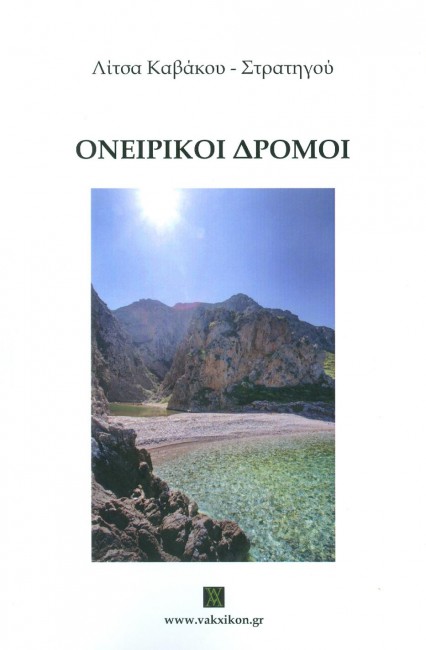
Λίτσα Καβάκου-Στρατηγού, Ονειρικοί δρόμοι, εκδόσεις Vakxikon.gr

c7acc3e7-d87e-4c67-9638-b2d37b524983_5

ΤΟΥ ΘΕΟΧΑΡΗ ΠΑΠΑΔΟΠΟΥΛΟΥ

«Ονειρικοί δρόμοι» ονομάζεται το νέο βιβλίο της Λίτσας Καβάκου-Στρατηγού, που κυκλοφόρησε πρόσφατα από τις εκδόσεις “Vakxikon.gr”. Πρόκειται για μια ποιητική συλλογή, που περιλαμβάνει ποιήματα σε ελεύθερο ή παραδοσιακό στίχο, ανάλογα με την έμπνευση της ποιήτριας και μας δείχνει τη δεινή στιχουργική της δυνατότητα, αφού στα παραδοσιακά της ποιήματα, χρησιμοποιεί ευρηματικές ομοιοκαταληξίες και τηρεί αυστηρά τα μέτρα της παραδοσιακής φόρμας, ενώ στον ελεύθερο στίχο μας δίνει άρτιες εικόνες με τις αδρές πινελιές της γραφίδας της.

Η ποιητική συλλογή της Λίτσας Καβάκου-Στρατηγού «Ονειρικοί δρόμοι» ξεκινά με το προσωπικό δράμα του ανθρώπου, όμως, όσο προχωράμε στο διάβασμα του βιβλίου, το προσωπικό γίνεται συλλογικό και καταλήγει πανανθρώπινο. Έτσι, ενώ στην αρχή διαβάζουμε για τον σύζυγο, που χάθηκε και για την απουσία, που η ποιήτρια δεν μπορεί να αντέξει, συναντάμε τη μάνα του σκοτωμένου επαναστάτη, όπου η Λίτσα Καβάκου-Στρατηγού στέκεται ως παρηγορήτρα στον πόνο της, τον ήρωα, που με το αίμα του χτίζει την ελευθερία και στον τυχερό πολεμιστή, που πέθανε πριν δει την ειρήνη να σέρνεται σαν σκλάβα.

Αρκετό ενδιαφέρον παρουσιάζει και η άποψη της ποιήτριας για το χρόνο και τη φθορά, που γίνεται όλο και πιο αντιληπτή με το πέρασμά του. Η Λίτσα Καβάκου-Στρατηγού διαπιστώνει με τραγική ειρωνεία: «Πάντα νόμιζα πως έχω / κι άλλο χρόνο, / μόνο που ο χρόνος / δεν νόμιζε το ίδιο.», για να καταλήξει: «Τώρα στυγνός κι απρόσωπος / συνοδοιπόρος μου ο χρόνος / συντροφεύει την πορεία μου».

Σε άλλο σημείο η ποιήτρια γράφει για την μοναξιά του σύγχρονου ανθρώπου. Την φοβίζει «η ερημιά των πόλεων». Ανησυχεί για «τ’ όνειρο που χαμήλωσε». Αλλά, αυτό, που φοβάται περισσότερο η Λίτσα Καβάκου-Στρατηγού είναι η αλλοτρίωση της συνείδησης του σύγχρονου ανθρώπου: «Μα πιότερο φοβάμαι την ανοχή / που μεγαλώνει την αδυναμία μας / και την συνείδησή μας που συνθηκολογεί».

Κλείνοντας, θα θέλαμε να συγχαρούμε την ποιήτρια για τους ονειρικούς δρόμους, που μας ταξίδεψε. Περιμένουμε καινούργια «ονειρικά ταξίδια» με την ποίησή της.

***

Μαχητής

Δεν έχω κάτι να σου δώσω
μαχητή του πολέμου.
Αφουγκράζομαι την περπατησιά σου
στα μονοπάτια της άρνησης.
Μαζί σου σέρνεις
της κάθε φυλακής τις αλυσίδες
του κάθε συμπολεμιστή σου
την απορία και το θυμό.
Κι εγώ δεν έχω μια γωνιά
για ν’ ακουμπήσεις την απόγνωση
του λαού σου.
Ήρθες και πέρασες σαν το οργισμένο κύμα του πελάγου
που λαβώνει την αμμουδιά.
Αγωνιστής μιας περασμένης γενιάς
που ξεχάστηκες στο δικό μου δρόμο
κι ο χρόνος σε γυρνά ξανά και ξανά
στους ίδιους χώρους που μάτωσες
για να μας θυμίζεις
πως υπάρχει κι από ένας ήρωας
στον καθένα από μας.
Φτάνει να μην αφήνουμε
να τον ακυρώνει
και να τον μηδενίζει
η ανοχή, ο συμβιβασμός και η αδιαφορία μας.

*Η Λίτσα Καβάκου-Στρατηγού γεννήθηκε στα Κύθηρα και ζει στον Πειραιά. Ο πατέρας της, Ιωάννης Τριφύλλης (Φώτης Κάβος), ποιητής και δημοσιογράφος, ήταν εκδότης της τοπικής εφημερίδας «Κυθηραϊκός Τύπος» (1954-1966). Έχει εκδώσει τρία βιβλία ποίησης, το πρώτο με τίτλο «Παλμοί», το δεύτερο με τον τίτλο «Ανηφοριές» και το τρίτο με τίτλο «Ονειρικοί Δρόμοι»

**Το ποίημα και το σύντομο βιογραφικό αναδημοσιεύονται από το http://fractalart.gr/litsa-kavakou-strathgou/

Βασίλης Κουντζάκης – Μια συνέντευξη και μια κριτική

kountzakissite

Βασίλης Κουντζάκης: “Το ζήτημα του ελεύθερου χρόνου είναι κρίσιμο”

Συνέντευξη στον Θεοχάρη Παπαδόπουλο

Συνομιλήσαμε με τον ποιητή Βασίλη Κουντζάκη με αφορμή την κυκλοφορία της ποιητικής του συλλογής “Δίχως όνομα” (Εκδόσεις Εκάτη 2015).

“Δίχως όνομα” είναι ο τίτλος της ποιητικής σας συλλογής και όλα τα ποιήματα, που περιλαμβάνει είναι άτιτλα. Το είχατε σκεφτεί από πριν να μη χρησιμοποιήσετε τίτλους ή σας βγήκε στην πορεία; Ο τίτλος δόθηκε, επειδή τα ποιήματα είναι άτιτλα;
Ο τίτλος της συλλογής και το γεγονός ότι τα όλα τα ποιήματα είναι άτιτλα αποτελούν μέρος της αρχικής σύλληψης και δεν προέκυψαν στην πορεία. Τα δύο αυτά σημεία σε συνδυασμό με τα χαρακτηριστικά των ποιημάτων επιχειρούν να συνθέσουν μια προσωπική προσέγγιση και αισθητική.

Πιστεύετε ότι οι ποιητές γράφουν κυρίως τις νύχτες; Εσείς πότε εμπνέεστε περισσότερο;
Δε γνωρίζω πότε ακριβώς εμπνέονται οι ποιητές. Σε προσωπικό επίπεδο, η νύχτα σηματοδοτεί το τέλος μιας εργάσιμης ημέρας. Συνεπώς υπάρχει το ελεύθερο εκείνο χρονικό πεδίο μέσα στο οποίο ζυμώνονται καλύτερα και με μεγαλύτερη άνεση σκέψεις και ιδέες. Το ζήτημα του ελεύθερου χρόνου θα έλεγα ότι είναι το κρίσιμο, ανεξάρτητα από τη χρονική του τοποθέτηση. Στην παρούσα δουλειά ωστόσο υπάρχει ένα προβάδισμα των βραδινών στιγμών.

Τι σημαίνει για σας η ήττα μιας έμπνευσης;
Η «ήττα μιας έμπνευσης» δεν είναι τίποτε άλλο παρά η μικρή ή μεγάλη φθορά που προκαλεί η πλήξη και η ροή της καθημερινότητας στο δημιουργικό κομμάτι του εαυτού μας.

Θα θέλατε να μας περιγράψετε τη χώρα του σχεδόν ποτέ;
Η «χώρα του σχεδόν ποτέ» είναι ο σχηματισμός ενός συνόλου ανθρώπων της λήθης ή μιας ελάχιστης, επιλεκτικής, κατευθυνόμενης μνήμης. Μια τέτοια χώρα, ένα τέτοιο σύνολο, που δεν προσπαθεί ή δεν μπορεί να διδαχθεί από προσωπικές και συλλογικές εμπειρίες δε νομίζω ότι έχει θετική προοπτική.

Με την πρώτη σας ποιητική συλλογή κάνατε ήδη το πρώτο βήμα. Έχετε σκεφτεί κάποια από τα επόμενα;
Επεξεργάζομαι αρκετές ιδέες σε μια προσπάθεια βελτίωσης των εκφραστικών μέσων και μεγαλύτερης στόχευσης των στίχων και κατ’ επέκταση των ποιημάτων που γράφω. Υπάρχει σκέψη για κάποια επόμενη έκδοση αλλά όχι το αντίστοιχο υλικό προς το παρόν.

*Αναδημοσίευση από το http://www.vakxikon.gr/βασίλης-κουντζάκης-2/

Χάνομαι ένα Σάββατο
στο κέντρο της πόλης
την ώρα που αφηρημένα κατεβαίνουν
τα ρολά των μαγαζιών
κι επικρατεί μια περίεργη βοή
την ώρα που τα παπούτσια σου
με χάρη ακουμπούν
τις πλάκες του πεζοδρομίου
στο γυρισμό για το σπίτι

******

9789604081950

«Δίχως όνομα» του Βασίλη Κουντζάκη

Το Εγώ και το Εσύ είναι οι δύο άξονες που οριοθετούν το σύνολο της συλλογής του Βασίλη Κουντζάκη Δίχως όνομα. Ένας διάλογος που πότε γίνεται εσωτερικός και πότε δίνει ήχο στις λέξεις του, που ακουμπάει σε σκέψεις που θα μπορούσαν να ειπωθούν αλλά τελικά δεν συμβαίνει, σε συναισθήματα που αποδεικνύονται εκτός χρόνου και παλιώνουν στο μυαλό χάνοντας έτσι την όποια τους επικαιρότητα.

Μου αρέσουν οι δομές και ο άμεσος χαρακτήρας της γραφής, τα ποιήματα είναι άρτια και δεν περιέχουν κομματιασμένες σκέψεις, από την άλλη όμως δεν έχουν ρυθμό, ούτε πυγμή, δεν έχουν άλλο νόημα εκτός από το καθαρά προσωπικό για τον δημιουργό τους. Δεν είναι κακή ποίηση, ούτε δήθεν, ούτε κατά διάνοια στημένη για τέρψη οφθαλμών, αλλά ταυτόχρονα η απουσία της πρωτοτυπίας είναι εκκωφαντική, οι λέξεις και οι έννοιες συνηθισμένες. Και το πρόβλημα είναι ότι συνηθισμένοι στίχοι προκαλούν αναμενόμενες σκέψεις. Ο ποιητής και κατ’ επέκταση ο αναγνώστης δεν διακρίνει κάτι που δεν θα έβλεπε ο οποιοσδήποτε, δεν μας προχωράει ένα βήμα πιο ‘κει.

Ο Βασίλης Κουντζάκης στο Δίχως όνομα δημιουργεί γοητευτικές, κλασικές εικόνες του έρωτα, και του αρέσουν οι όμορφες λέξεις που αρέσουν σε όλους μας:

Φώτα
πορτοκαλί
μελαγχολικά
πάνω από ένα δρόμο
-μια κεντρική λεωφόρο-
Χαζεύω την πόλη. 

Η πόλη άγνωστη

οι άνθρωποι ξένοι
αδιάφοροι
μια βραδιά που δεν βρίσκει
στίγμα
πορεία. 

Τι αν κρύβεται άραγε
μέσα σ’ ένα βλέμμα
της στιγμής
σ’ ένα άτολμο άγγιγμα;

Στης νύχτας το δύσκολο πλησίασμα
με παράθυρα κλειστά
έρχονται
απανωτά
να με βρουν οι λέξεις.

Κρις Λιβανίου

*Αναδημοσίευση από το Στίγμα Λόγου στο http://stigmalogou.blogspot.com/2016/02/blog-post_26.html

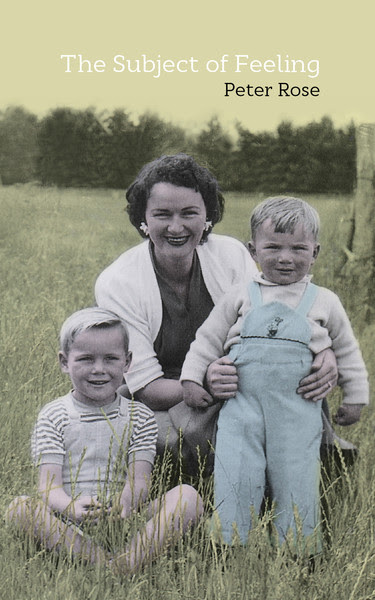
Nathanael Pree reviews Peter Rose’s, The Subject of Feeling

unnamed

The Subject of Feeling
by Peter Rose
UWA Publishing, 2015

From the beginning of the latest work by Peter Rose, the reader is given the impression of an unfolding tableau or score, the creases and outlines of which to be generously shared. A sense of intimacy is engendered from the outset: we are let in on the scales and arpeggios that a musician practises, as if each poem, or note that it reaches, ‘might lead somewhere / or fail to ascend.’ The seemingly off-hand candour of such admission serves as an indication that one is in for a special experience from a master of the craft.

Consistent with the presentation of layers of the self comes a confessional tone touching on the bittersweet recognition of stages of life that are passing or have passed. This is evinced by familiar tropes of hidden childhood treasure, gold and dirt comingled – but also a sense of bemusement, mystification of the ages, such as a ‘Plantagenet cut’ as an almost hallucinatory image in a suburban park. This quasi-historical hallucination is echoed by expression of bewilderment in an art gallery, experiencing ‘something like mystification’ in the flashbacks revealing intensely personal strands that compose the nets of everyday life.

The very elusiveness of inter-personal recognition, in ‘Late Autograph’ and ‘Dux’ indirectly introduce walk-on parts in the work – once again a sense of the intimate, but with a sense of darkening and unease. This sense distils into moments of quiet, reflective beauty in ‘Days and Distance,’ recalling: ‘So many years ago. / Cruel to dislodge them / like moss in a grotto.’ A plane journey works as a vector for an elegiac and concisely rendered return to the past, which evokes the best moments of Bruce Beaver: lives connected to one another by literal and metaphorical roots and threads, which form ‘the ramifications between us,’ inescapable and tropic in their impact. In another poem, with a cherry as aide-memoire, Elizabeth Bishop and ‘all those lines about loneliness,’ makes their appearance to the lost narrator, and culminate in ‘an unexpectedly quick twilight.’ Impermanence and sliding scales of reality mark the first section as the initial scores of a composition, where notes are left visible even if unplayed, and what is unsaid resonates with a force equivalent to the words left on the page.

The ghostly presence of precursors, familial and famous, and a premonition of the book’s central event, a death in the family in a car crash, as the children chant in memory of Marilyn Monroe, shows a certain menace, a darkness close to home: ‘The Hume relentlessly narrowing, / a blur.’ and his father’s ‘terrifying’, if ‘brilliant,’ way of handling the wheel. The ‘old ones,’ as the epigraph from Donald Justice to ‘The Elders’ makes clear, are not about to let go. They demand their space in the realm of the living, and the present is pushed out to its limits with the resultant psychic friction. As the deceptively simple ‘Dead’ reminds us – ‘you’re dead a long time,’ and this length becomes spatial as well as temporal when considering the dimensions that people share, whatever stage of life or death they are passing through. Where better to ponder this process but from the bed of a hospital ward, ‘with its new admission every day, / the latest freckled youth dragged / from some creek or car wreck.’ Pervasive reminders of mortality are commonplace, as ‘the salt music of insinuation,’ yet this does little to diminish their impact. Likewise, the human carapace extends into housing: from ‘semi-detached graves’ in ever-expanding settlements, to ‘the precipitous hilltop cemetery’ from where the dead appear to keep watch.

The nexus and titular poem reveals a fatal accident, with physical feeling of the dying person departing; nerve endings deadened in a mangled wreck of metal and flesh. This poem is an understated tour-de-force along the edges that divide sentience and nothingness; worth starting or finishing a reading session, and very much vindicating the decision made to come with the poet so far. That the death of an elderly person whose discomfort has been building up for years occurs with a crash, but also in familiar, compressed surrounds elicits a wry observation: ‘eschatology is a slow / remorseless science.’ A stranger is present, hearing last words, by listening, as if to heal:

heard about a new daughter.

And then the subject of feeling –
why you had none in your feet.
Men ground the car with steel
and flung it open
like a sack of wheat

These final lines of the poem recall Thom Gunn’s mourning of ‘The Man with Night Sweats,’ testament to their power and depth. The alignments of time and circumstance that some refer to as inevitability may not be anything we can understand, but their presence on such occasions creates the clarity that comes, satori-like, at the very edges of life. The poet finds himself in the public domain again, figuring out the revenant presence of a doppelgänger, from a time where: ‘in place of accidents / and crumpled youth there is / space and more space,’ yet which engenders the awareness that a seemingly untrammelled existence will eventually be brought into line. His life becomes text, so that with ‘Senza Rancor,’ no acrimony is needed (although its playful attributes form a delightful coda in the return of Catullus in the book’s final section), given all that has past:

So much happens to the living.
Call it a phenomenal dust storm
Visiting the land, shrouding
The children who set off hand in hand
Unable to read their siblings faces.
Cling though we do and stumble.

The presence of death and a lack of certitudes engender a hard-won sense of humour with which to temper the personal and affecting touches that refuse to relinquish their hold on an astonishing range of immanence. The past has never seemed quite so musical, or alive.

*Nathanael Pree is of Australian and German background, brought up and educated in the United Kingdom. He did undergraduate studies at University College London, before working in education in Russia, Vietnam, Cambodia and Australia, with additional work experience in India. His postgraduate studies were at The University of Sydney, specialising in the works of W.G Sebald (Masters’ Dissertation) and Charles Olson (PhD, ongoing).

**Taken from here: http://cordite.org.au/reviews/pree-rose/

In crisis-stricken Greece, one thing is in prosperity: poetry

CfQ39fGXEAAAGtS.jpg-large

By Nikos Fotakis*

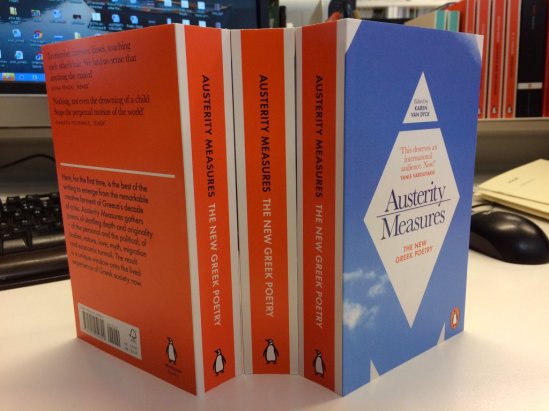
A collection of modern Greek poetry, aptly named Austerity Measures, proves a well-known truth: that great art can emerge from hard times. The book’s editor offers her insight on the anthology and recalls discovering the Greek language on the streets of Melbourne

It’s been six years since Greece got under the international spotlight, claiming centre stage as the worst possible example of a debt ridden country, brought to its knees by a combination of state corruption, overspending, neo-liberal dogmatism and the effects of the Global Financial Crisis. Struggling with high unemployment, harsh austerity, rising inequality and regressive taxation, the country has seen its middle class all but crushed and almost every sector gasping for air. One thing seems to be thriving, though.

After the initial shock, the Arts industry – the term becoming more and more ironic, as the sector has never been more deprived of funding – has been fighting back, responding to the ongoing crisis with creativity. Dissecting the greek psyche, the output of artists, writers, musicians and poets, offers valuable insight to the effect of the imposition of austerity on the social fabric, thus proving to be a much more useful tool of understanding what has been going on in Greece, than any analysis of a financial think tank could offer.

Karen Van Dyck seems to share this view. The Kimon A. Doukas Professor of Modern Greek Literature in the Classics Department at Columbia University where she directs the Program in Hellenic Studies and teaches courses on Modern Greek,Greek Diaspora literature, translation and gender, has recently edited a magnificent collection aptly named Austerity Measures: The New Greek Poetry (Penguin UK).

“When there is less to go around, people fight, grab, get tough. Lately, Greece and the Balkans have been living with more than their share of less”, she writes on the collection’s introduction, only to add: “Poetry, though, is one thing there is more of. Much more. Poets writing graffiti on walls, poets reading in public squares, theatres and empty lots, poets performing in slams, chanting slogans, and singing songs at rallies, poets blogging and posting on the internet, poets teaming up with artists and musicians, teaching workshops to school children and migrants. In all of the misery and mess, new poetry is everywhere, too large and various a body of writing to fit neatly on either side of any ideological rift”.

“GREECE EXCEEDS THE BOUNDARIES OF A NATION STATE”

It is this kind of poetry that she collected in the book. Poems that come from a whole range of different outlets and backgrounds; writings by established poets are presented next to the wordplay of rappers and non-Greek names are common fare in the book, in a striking display of heterogeneity one would normally not associate with Greece.

“I decided to organize the anthology around where poetry happens, rather than alphabetically, chronologically or thematically”, she says, explaining how the collection came to be. “This, I felt, would give the English-speaking reader a better sense of the poetry’s reach and diversity. It is happening everywhere; not just in literary magazines, but in DIY blogs, in theaters, abandoned lots, cafes, in villages on the borders, outside Greece… Also this approach allowed me to introduce poets who weren’t already known in the regular literary circles”, she adds.

How representative of modern Greek culture is the outcome, in her opinion? “Well, the answer to that is as varied as the poetry included”, she answers, giving some examples of the poets featured in the book. “Jazra Khaleed sees his poetry as a way of practicing politics. It’s not from the printers, he says, but from the mines. Doukas Kapandais thinks it has nothing at all to do with politics. Elena Penga is more East Greenwich Village than Salonican. The only thing they all agree on is that Greece exceeds the geographical and linguistic boundaries of a nation state. It is not representative in the traditional sense of political representation. And no, not really in the literary sense of mimesis either. To represent something, don’t you have to believe there is something fixed to represent? For these poets contemporary Greece, like the fox in Katerina Iliopoulou’s poem, is what exceeds definition. It’s what you chase after, not what you catch.”

“POETRY CAN TELL US SOMETHING THE NEWS CAN’T”

A philhellene in the truest sense of the word, Karen Van Dyck is one of the scholars who can claim to have a deep understanding of Greek poetry, as it evolved throughout the ages. Yet, she herself was surprised by some of the work she came across, while working on “Austerity Measures”, allowing her to draw some interesting conclusions on the state of Greek poetry.
“I was most surprised to find that many poets were bridging prose and poetry in their writing”, she says. “There was a new storytelling component that recalled the folk song tradition and ballads like “The Bridge of Arta,” but also spoke to contemporary international literary trends like flash fiction. I was also struck by the complete reinvention of the fifteen-syllable line, the political verse, as it is called. Yannis Efthymiades stretches it out to 27 syllables in his masterful meditation on a man falling from the World Trade Center. These poets seem fearless formally. Open to everything. Maybe it has to do with the fact that they feel there’s nothing to lose.”

The feeling of “nothing to lose” can be liberating, especially in times of oppression. Karen Van Dyck knows it all too well, being one of the world’s leading authorities of Greek poetry of the Dictatorship era, which she analyzed in her book Kassandra and the Censors: Greek Poetry since 1967 and collected in her anthology The Rehearsal of Misunderstanding Although she’s reluctant to compare the Crisis to the Junta (as many in Greece do), she can definitely see some similarities, at least in terms of the role of poetry as socio-political commentary. “”During the Dictatorship, poets, especially women, used the lessons of censorship to their own ends. Elliptical, parological, and full of ambiguity, their poetry told us that nothing can be taken at face value”, she explains. “Again, in recent years, poets, especially women, drawing on the work of poets from the generation of the ’70s such as Katerina Anghelaki-Rooke and Jenny Mastoraki, have turned to dreams and myth to rewrite the difficult times. This is particularly evident in the poets who write for Farmakon (ed. Note: “φρμκ” is a bi-annual literary magazine) such as Phoebe Giannisi, Anna Griva, Katerina Iliopoulou, and Eftychia Panayiotou, but also Yiannis Efthymiades and Yiannis Stiggas. The similarity between these two different historical moments lies in the sense that poetry can tell us something that the news and politicians can’t. The difference, I think, is what poets now take for granted: everything is at their fingertips through the internet; the Greek language includes so many hybrid forms – Gringlish, Gralbanian, Grurkish; Greekness is something borderless, nomadic, and the Greek literary tradition is not a necessary education for a Greek poet. Arabic feminism or Code Poetry might be equally useful.”

DISCOVERING GREEK IN AUSTRALIA

This approach should come as no surprise, given the way Karen Van Dyck’s ongoing interest in Greek language began. “From an early age I lived in cities with very strong Greek Diaspora communities – Melbourne, London, New York, and most recently Istanbul”, she says. “I was always fascinated by the Greek alphabet and language. In 1974, I remember travelling back and forth on the train from my home in South Melbourne, where my father had a parish, to PLC, the Presbyterian Ladies College. Going to an Australian private school rather than an American public school, wearing a uniform, even down to blue hair ribbons, eating pavlova and meat pies… Everything was new, but it was the anti-junta graffiti of the Greek immigrants that became my passion. I wanted to know what they were saying. It was a way of identifying with the foreignness I felt. A way of learning how to decipher it. At PLC I took Russian hoping that would help, but I didn’t find all the letters I was looking for. The ‘ξ’, for example, was missing. The long road to realizing the letters were Greek and then mastering this other language made it all the more rewarding. Only much later, writing my book on poetry under and after the Dictatorship, did I finally understand the urgency and politics I had sensed in the writing on the walls”. What kind of impact did these anti-junta scribblings on the walls of Melbourne would have on a young American expatriate?
“It made me want to know how words and politics were related”, she attests. “It made me cautious of generalizations. It taught me that if you want to understand the larger picture, you need to figure out the specifics. It also made me think from the position of the in-between, the translator. Though not officially a part of the Diaspora, not Greek by birth, I am Greek by work and experience. My constant struggle to think about Greek in the context of other cultures and languages, my decision to raise my three sons in Greek and to teach Greek literature and translation outside Greece have all meant that my take on the world is closer to that of a C. P. Cavafy, Olga Broumas or Antigone Kefala”.

This take on the world was influenced by much more than language, of course: “I remember wondering why each wave of migrants took out their frustrations on the next”, she says. “Fights would break out at the Foster’s brewery, where the parents of the kids in the South Melbourne parish worked. How to imagine forms of tolerance that don’t erase history? How to think through the eyes of the underdog even after one has achieved a middle-class status? Australia taught me that to be minor, and to stay minor, is a major accomplishment”.

*This article published in the English section of Neos Cosmos in Melbourne, Saturday, 11 June 2016.

Meet the Greek writers revolutionising poetry in the age of austerity

Clockwise from top left: Yiannis Efthymiades, Glykeria Basdeki, Eftychia Panayiotou, Yannis Stiggas, Danae Sioziou, Thomas Tsalapatis, Yiannis Doukas and Elena Penga.

Clockwise from top left: Yiannis Efthymiades, Glykeria Basdeki, Eftychia Panayiotou, Yannis Stiggas, Danae Sioziou, Thomas Tsalapatis, Yiannis Doukas and Elena Penga.

By Marta Bausells and Eleni Stefanou*

A new group of poets is changing the arts landscape in Greece. Fearless, global and with an artistic fervour unseen since the dictatorship, they tell us their hopes, the culture that excites them – and the Greek myths they’d like to debunk

A new kind of poetry is flourishing in Greece’s streets, bars and cafes. It is popping up not just on magazines, small presses and websites, but on graffiti walls, and in music, film, and art. Not since the dictatorship that shook the country in the 1970s has there been such an abundance being written. A new anthology in English translation, Austerity Measures, compiles some of the most revolutionary.

Former finance minister Yanis Varoufakis is a fan, calling it a “silver lining”, the one good upshot from austerity policies that have shattered the country. “Along with the mass unemployment and the rise of neo-Nazism that it engendered, austerity also occasioned a cultural renaissance,” he writes. “This volume is … living proof that the Greek crisis is of global significance.”

In a country where there is less to go around across the board – including fewer young people – poetry is “the one thing there is more of,” writes editor Karen Van Dyck. Despite the title, and the fact that many of the poems respond to the social and economic crisis, Van Dyck emphasises this is not a homogenous phenomenon. “A lot of these poets don’t even know the others exist. It’s a very disperse scene.” Nor are they really a generation. They are multicultural, multiethnic, multigenerational; some of them aren’t even Greek, just writing in it.

“They don’t even think they need to belong to Greek poetry. They have access to the whole world,” says Van Dyck. From the small pleasures of suburban gardens to the viciousness of streetfights, they use pop culture and post-capitalism, images of domestic machines and the internet and mix them all up with ancient myths. We talked to some of them about what drives them to create, and what hopes and fears they have for their country.

Eftychia Panayiotou, 36, Athens

An extract from The Outside of My Mind (translated by Karen Van Dyck):

I woke at sunrise to change

the window, warped from looking

across, slicing my view.

I open the shutters, wild

from the wind and misfortune.

What were you trying to convey with the poems in this collection?

Most of the poems in Austerity Measures were published nine years ago; they were my debut as a poet. They expose the suspicion that what we call “personal identity” is socially constructed. In these short poems the subject realises that pain and grief is part of the process of wanting to be free.

What has been your creative inspiration?

Entering a society that looked a lot like a bad movie and fear that I might end up playing a predetermined role in it.

What is the myth surrounding the Greek crisis you’d like to debunk?

I hear a lot of whispers that “the Greeks” have been really naughty and, most of all, very lazy. So they all have to be punished, like in Dante’s Purgatory.

What is giving you hope?
That we’ve managed so far to create a desirable life out of simplicity: love, friendship, knowledge, art. A bare life that is precarious, passionate, influential and rewarding.

How would you like your art to be remembered in a hundred years?

As poetry that isn’t just remembered, but also read and reread. As very much alive art with a positive impact on strangers.

Thomas Tsalapatis, 31, Athens

An extract from Word Monday [translated by Karen Van Dyck]:

Boiling water, always boiling water

Learning that what is scarce is what takes charge

Learning how Π and T lose their flat roofs

How ζ and ξ dry up at the roots

How vowels get murdered

How language bubbles up
An offering of the silent

For those who grew silent

How do you define your poetry?

An attempt to construct a personal modern poetical mythology, with sometimes non-poetical elements (borrowing from theatre, stand-up comedy, graphic novels, journalism or cinema) based in the absurd, slapstick of words, and expressed mainly in a prose poetry form, in dialogue with the rich Greek poetry tradition.

What were you trying to convey with the poems in Austerity Measures?

Word Monday is the first day of a journal. The poem speaks about the process of a boiling language, of losing words, letters and meanings in the steam, in grief and in silence. Regardless of that, the last word always belongs to the reader. I could be wrong about the meaning of my poems. He can’t. He is always right.

Which myth about the Greek crisis would you like to debunk?

I think that it is our duty to debunk the legions of stereotypes that fill newspapers every day (both Greek and European newspapers). The racist myth of the lazy Greek. The myth of the ouzo-drinking, opa-screaming Balkanian. The myth that the poor used to live above their means.

What is giving you hope?

The work of small groups, the creativity of small artistic cells. The never-ending conversations between a group of friends about art, politics or whatever. And of course the help given to refugees from volunteers (Greeks or non-Greeks) and common people every day in Athens and the islands.

How would you like your art to be remembered?

I hope to be remembered as a small handmade ark of a feeling and an era. Both old and (hopefully) new, open to new meanings.

Which other Greek poets and artists do you admire?

I strongly recommend George Prevedourakis. His book Kleftiko is a take on Allen Ginsberg’s Howl set in Greece amid the crisis; it’s a great book. In theatre, the director Theodoros Terzopoulos –he’s the most important Greek artist of our times. I would highly recommend younger directors like Savvas Stroubos and his Simeio Miden theatrical group; Aris Biniaris and his ‘holy goat’ performance; Stelios Faitakis’s mural paintings; Dimosthenis Papamarkos’s short stories; Mode Plagal’s blend of traditional music with jazz and funk elements; and the directors of the so-called ”weird wave’’ in cinema, which started with Giorgos Lanthimos’s Dogtooth in 2009.

Danae Sioziou, 29, Athens

An extract from Around the House (translated by Rachel Hadas):

imprisoned in a filthy cage

a ceiling without sunrise

little beetles on the floor

in the sink a dark lake

How would you like your art to be remembered
?
As heartfelt, I guess.

Which is the myth surrounding the Greek crisis you’d like to debunk?

That anything good can come out of such a crisis. Good things occur, but despite of it.

What is giving you hope?

Concerning the crisis? Lately, fewer and fewer things. People are being hunted, deprived, excluded. Walls, actual walls, as well as social and political ones are built upon. People who help bring them down give me hope.

What Greek cultural trends do you find most interesting?

The various voices emerging in poetry. The foundation of new publishing houses and literary journals. The experimentations of musicians and bands. The neighbourhood solidarity networks, which promote art among other things. The emergence of young artists who elaborate on the current condition in their own terms.

Which other Greek poets and artists do you admire?

Women poets of older generations who write and publish vivid poetry. There is a vast plurality trying to continue making art and survive. From opera and theatre to circus, music, poetry, filmmaking, photography, performance and more. Most of them collaborate with others. I especially admire those who reinvent themselves without betraying who they are.

Jazra Khaleed, 37, Athens

630

An extract from Words (translated by Peter Constantine):

My words are homeless

They sleep on the benches of Klafthmonos Square

covered in IKEA cartons

My words do not speak on the news

They’re out hustling every night

My words are proletarian, slaves like me

They work in sweatshops night and day

Can poetry be political?

Poetry can be part of the anti-fascist discourse and the working class discourse in Greece. There are autonomous anti-fascist groups and working class groups who publish magazines, do demonstrations, put posters on the walls.

What would you say to people who believe what is happening to Greece has been caused by external factors?

I blame the Greek middle class and the Greek capitalist system. I live in Greece so I don’t know what is going on in Germany or in England, I just know what’s going on in Greece. What’s called the crisis is used by the Greek state and the Greek middle class to push all the burden to the working class.

How is poetry perceived in Greece?

In Greece poetry is considered a high-class art. If you want to publish a poetry book, you have to pay a publishing house. So many publishing companies say that they are brands and they ask for £3,000 euros to publish your book. That means that most people who publish poetry in Greece belong to the middle class or are very rich. One important thing about Austerity Measures is that it includes poets that are not very well known in the poetry circles and who don’t have access to publishing houses.

What’s happening on the streets of Athens that you find exciting right now?

Many second-generation groups doing hip-hop and they’re really underground, doing self-organised free concerts. I can sense there are more people from a working class background that write poetry nowadays. There is a guy called Omega who writes about his experiences as working class or unemployed. His poetry is very direct, which is not very common in Greece.

Elena Penga, 50, Athens

An extract from Nightmare Pink (translated by Karen Van Dyck):

I open the balcony doors.

You’re singing.

But the rain is louder.

It comes into the house.

Hits the lampshades.

Knocks over the lights.

Collides with reality.

How would you define your poetry?

It uses fragments of personal memories to challenge our perception of what we are as a species and what we do here.

What were you trying to convey with the poems in Austerity Measures?

In this time of crisis what is the role of the personal, of the senses, of the body? Do people trust their body? Do they listen to it? How can they stop being just consumers, but active members of society who care about their environment? How do our senses and our body want us to live, work, relate, create?

How would you like your art to be remembered?

As meaningful and exciting and beautiful.

What is giving you hope?

In politics and society? Nothing. We are all shaken up and blinded by the shock. We have lost perspective and see no horizon.

Which Greek cultural trends do you find most interesting?

There is culture in Greece, but no money or real support for it. People worry about survival. This has killed all spirituality, inspiration, beauty. I find it remarkable that people want to work and do keep working in arts and culture, despite the hostile environment. All cultural trends in Greece are a kind of resistance to giving up.

Yiannis Doukas, 35, Galway (Ireland)

An extract from The Children of Abel (translated by Chloe Haralambous and Moira Egan):

The Danny F bound for Syria

Like an arc; for slaughterhouses

But it flounders with the waves

Of the sea that does not wash out

How do you define your art?

As bearing a sense of nostalgic irony towards the Greek and European cultural and political history.

What were you trying to convey with the poems in Austerity Measures?

They are attempting to encapsulate how my generation experiences reality and develops emotion in the digital age.

What has been your creative inspiration?

Interacting with memory, literature and the urban landscape. Also, trying to distil the times and the news.

Which myth of the Greek crisis would you like to debunk?

That the Greeks are a nation of lazies on a permanent vacation; that austerity measures, as they were implemented, were proportionally distributed or worth the sacrifice. But also, the over-simplistic populism that there was no need for reform in Greece; that we’d be better off outside the EU, trading in drachma. And, obviously, the neo-Nazi rhetoric that the foreigners – immigrants and refugees – are to blame for everything.

What is giving you hope?

Naïve as it may sound, the turning wheel of history: things are due to eventually get better. Also, whatever the disappointments and frustrations, the idea of a better world and a fairer society is still something worth fighting for.

What cultural trends in Greece do you find most interesting?

A hopeful moulding of community; people brought together around local and regional bookshops, publishing houses, galleries, concert venues; vibrant hubs and meeting points, new spaces and, hopefully, new ideas.

Which other current Greek poets and artists do you admire or recommend? 

For poets my age this anthology offers a balanced and representative specimen. From previous generations, I would have to single out Kiki Dimoula, Nasos Vayenas, Jenny Mastoraki, Christoforos Liontakis and Haris Vlavianos. In other fields: the films of Syllas Tzoumerkas, Yorgos Zois and Alexander Voulgaris (also the latter’s music, under the alias The Boy); the powerful photography of Enri Canaj and Myrto Papadopoulos, reinventing realism and reframing reality; finally, the marvellous theatrical work produced by the National Theatre of Greece, the Neos Kosmos Theatre and the Onassis Cultural Centre, featuring many young directors and thespians.

Glykeria Basdeki, 47, Ksanthi

An extract from Mama’s a Poet (translated by Karen Van Dyck):

Oh, yeah – Mama’s
an important poet
all day she cooks up commas

sweeps tenses under the rug

What were you trying to convey with the poems in Austerity Measures?

My poetry insists on being dark, ironic and sad. My poems are a kind of personal talisman that protects me from my evil self.

What has been your creative inspiration?

Family deaths, family births, sad sex memories. I turn the Greek folksongs into an autistic modern universe.

What is giving you hope?

My children, my friends, my faith in the revolution and life after death.

What Greek cultural trends do you find most interesting?

The dynamic Greek theatre groups (such as bijoux de kant, who I collaborate with) that survive without financial assistance. It’s a kind of miracle nowadays.

Which other current Greek poets and artists do you admire?

I love the post-Cavafian poetry of George Le Nonce, Stathi Tsagarousianos’s sad editorials in Lifo magazine, the wild romanticism of the bijoux de kant theatre group, Ersi Sotiropoulos, Maria Mitsora and Alexandro Kypriotis’s prose. And of course all of Jenny Mastoraki’s poetry, which is forever current.

Yannis Stiggas, 39, Athens

An extract from The Labrynth’s Perfect Acoustics (translated by Stephanos Papadopoulos):

Because

as much as I smoked

I never found my inner thread

so many loves

so many breathlessness
and the Minotaur,

my God, what a fiddler

If you had to define your poetry in one sentence, what would you say?

My poetry functions as a multitool: a pickaxe, a compass, a parachute, perhaps a first aid kit. Any of these is useful stuff for exploration. Poetry seems to involve all three dimensions of time: past, present and future. If someone is trying to comment only on current events, I suggest they would be better off using a polaroid camera.

What were you trying to convey with the poems in Austerity Measures?

They all bear the element of urgency and an agony for human destiny.

What is the myth surrounding the Greek crisis you’d like to debunk?

That Greeks are corrupted people. There are no corrupted nations, only corrupt power.
What cultural trends in Greece do you find most interesting?
After two decades of drought, poetry seems to blossom again, especially since 2004. It is very encouraging to see young people reading poetry, something which I regard as a political act.

Yiannis Efthymiades, 47, Athens

An extract from 9/11 or Falling Man (translated by Karen Van Dyck):

all of you think I was scared shitless that’s why I dove
head first into the abyss
god what idiots for once I took my life into my own hands
and let myself
drop provocative like in front of their eyes immense
ghoulish I stick my tongue out
then in that last moment I see a girl with a sad look in the
midst of the crowd

What has been your creative inspiration?

The thousands of people, my fellow citizens, who suffer from the austerity measures imposed on us, most of which threaten our dignity and our very existence. The source of my inspiration is the ominous future of young children, the frustrated life of older people and the puzzlement of us all against a ruthless technocratic monster that eats away our lives on a daily basis.

Which myth of the Greek crisis would you like to debunk?

That we are all to blame for the irregularities that have led us to this misery, that the Greeks do not work as hard as the rest of the Europeans and that all these austerity measures have been imposed with the sole purpose of purifying the economy and not to work as an experimental basis for undermining the institutions and manipulating the people.

Which other current Greek poets and artists do you admire or recommend?

The Greek poetic tradition happens to be one of the oldest and most important in Europe and the whole world. Great poems are still written today, poems that will define our future – poetic or not. I deeply admire Jenny Mastoraki, Christoforos Liontakis and many other younger poets of my generation, as I feel that my poetry interacts with theirs.
How would you like your art to be remembered in a hundred years?
As a testimony of truth and beauty.

• Austerity Measures: The New Greek Poetry is published by Penguin Books.

*http://www.theguardian.com/books/2016/may/11/meet-the-greek-writers-revolutionising-poetry-austerity
Φύλλα Τέχνης | Τεύχος #01

flyer-κυκλοφορίας-ΟΛΟ-1024x457

Κυκλοφορεί το Τεύχος #01 της νέας σειράς εκδόσεων «Φύλλα Τέχνης» του ανεξάρτητου περιοδικού Τέχνης & Γραμμάτων Παλινωδίαι/Palinodiae

|Δοκίμιο – Παρουσιάσεις – Νέοι Καλλιτέχνες – Μικρές Αναφορές|

σε 48σέλιδο έγχρωμο τεύχος |

Αυτοέκδοση Παλινωδίαι 2016

■ Xειμερινό Αστικό Τοπίο | Διαγωνισμός Φωτογραφίας

■ Το Γυμνό του Jules De Bruycker

■ Ο ζωγράφος Vaughn Beneteau

■ Nicolai Ivanovich Fechin

■ H Aurore Lephilipponnat και το Butoh

■ Oι Νόμοι της Ινδιάνικης Ζωγραφικής

■ Ο ωραίος Μοντιλιάνι

■ Η ζωγραφική της Στυλιάνας Κατσιάρης

■ Ο γλύπτης Kiko Urrusti, κ.ά.

___ ΠΡΟΛΟΓΟΣ

Αντί προλόγου το ποίημα «Όλο το 24ωρο» του Νάνου Βαλαωρίτη, από τη συλλογή «Εστίες Μικροβίων» που κυκλοφόρησε στο San Francisco το 1977:

Μισός αιώνας απογεύματα με τη γιαγιά μου
Σύννεφα σαύρες παρδαλές και άλλα τέρατα
Κορίτσια ελαφρόμυαλα σαν τα σπουργίτια
Με βάδισμα ενοχοποιητικό μες στα παλτά τους
Ένα σεντόνι ερημιάς πάνω στο πρόσωπό μου
Συναντήσεις καθημερινές σαν γκρεμισμένες εκκλησίες
Λιμουζίνες με περίεργες βλοσυρές εκφράσεις στο τιμόνι
Άγνωστοι στις γωνίες των δρόμων περιμένοντας
Άγνωστες που περνάνε στον πληθυντικό
Ζαχαροπλαστεία γεμάτα ερωτηματικές ματιές
Φάρμακα αντίδοτα για αισθήματα ασφυξίας
Ώρες που δεν ξανάρχονται και καφενεία φαντάσματα
Ξύπνημα πρωινό βαρύ ασήκωτο ή ευδιάθετο
Ξεκίνημα για μιας καρδιάς την πόρτα τη στενή
Αλλά κανείς στο σπίτι που είπανε πως έμενε
Τρελή Σουηδέζα με μάτια σα φανάρια
Αγώνες για τη Δημοκρατία αγώνες δρόμου και αγωνία
Μισός αιώνας παρά τέταρτο και κάτι ακόμα παραλίγο επάνω μου.

♠♠♠ Κείμενα: Αγγελική Λυδάκη | Μαρία Μ. | Γιάννης Καφούρος | Μιχάλης Μιλώνης Άλλων: Γιάννης Τσαρούχης

Σημεία διακίνησης

AΘΗΝΑ _______________________________________
Εξάρχεια • Κ*ΒΟΞ (Κατειλημμένο Κοινωνικό Κέντρο) Αραχώβης & Θεμιστοκλέους ______________________________________________
Δάφνη • ΦΥΣΙΚΟ ΚΙ ΕΠΟΜΕΝΟ (Καφενείο) Αντιόπης 43 & Λεωφόρος Αλ. Παπαναστασίου ______________________________________________
Ν. Σμύρνη • ΕΡΓΑΤΙΚΗ ΛΕΣΧΗ Ν. ΣΜΥΡΝΗΣ Ελευθερίου Βενιζέλου 12 & Αιγαίου ______________________________________________
Μπραχάμι • ΠΙΚΡΟΔΑΦΝΗ (Ελευθεριακό Στέκι) Αγ. Βασιλείου και Π.Π.Γερμανού 22
• ΓΑΙΑ (Καφεποτείον) Στρ. Αλ. Παπάγου & Ναυάρχου Νοταρά ______________________________________________
Άνω Ιλίσια • ΜΠΕΡΝΤΕΣ (Αυτοδιαχειριζόμενος Κοινωνικός Χώρος) Aράδου 55, πλατεία Κύπρου ______________________________________________
Περιστέρι • ΕΡΓΑΤΙΚΗ ΛΕΣΧΗ ΠΕΡΙΣΤΕΡΙΟΥ Θηβών 227 ______________________________________________
ΜΕΣΟΓΕΙΑ ΑΤΤΚΗΣ ______________________________________________
Κορωπί • ΟΠΤΙΚΑ ΒΑΣΙΛΙΚΗ ΣΑΚΚΟΥ Λ. Βασιλέως Κωνσταντίνου 134 ______________________________________________
ΘΕΣΣΑΛΟΝΙΚΗ _______________________________________ σύντομα ______________________________________________
ΠΡΟΣΟΧΗ: Οι χώροι διακίνησης μπορεί να αλλάξουν ανά πάσα στιγμή

∅ Contact: Info@Palinodiae[dot]com

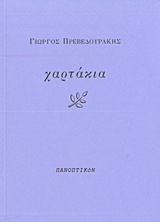
Η έκρηξη της μικρής φόρμας: Τα “χαρτάκια”, εκδ. Πανοπτικόν, 2016, του Γιώργου Πρεβεδουράκη

30088785

Γράφει η Κωνσταντίνα Γεωργαντά*

έχουμε χρόνο-
δεν έχουμε

αυτό κι αν είναι κέρμα
`
Χαρτάκια. Εναλλακτικά φέιγ-βολάν για πορείες. Πολεμοφόδια για εθισμένους. Εφημερίδες για φυλακισμένους. Τα κρατάς βαθιά μέσα στην τσέπη σου, τα κρεμάς στον τοίχο. Βγάλτε τα ρολόγια από το σπίτι∙ μετρήστε τον χρόνο με ‘χαρτάκια’.
`
περασμένα μεσάνυχτα
ψέλισσα «ελευθερία»
κι έβαλα το ξυπνητήρι στις 7
`
Αυτές θα μπορούσαν να είναι οι οδηγίες χρήσης της τρίτης ποιητικής συλλογής του Γιώργου Πρεβεδουράκη – μετά το Στιγμιόγραφο (Πλανόδιον, 2011) και το Κλέφτικο (Πανοπτικόν, 2013) – με τον τίτλο χαρτάκια (Πανοπτικόν, 2016), ένας όρος πυροτέχνημα που πυροδοτεί όλα τα σύντομα ποιήματα/επιγραμματικές φράσεις/μοντέρνα γνωμικά/αφορισμούς που βρίσκουμε στις σελίδες του.
`
με κίνδυνο να εξαϋλωθώ
κοιτάζω την ώρα
`
Η ποίηση δίνει νέο σκοπό στη γλώσσα που χρησιμοποιεί.
`
τι κι αν οι λίμνες αποξηράνθηκαν
εμείς συνεχίζουμε το κουπί μας
`
Η επιλογή της γλώσσας αυτής – λέξεων, ρυθμού, ήχων, κενών διαστημάτων, ορολογίας, αποσπασμάτων από άλλα κείμενα – γίνεται τόσο πιο συνειδητή για τον αναγνώστη εξαιτίας της συμπύκνωσης του λόγου σε μια μικρογραφία κειμένου, που είναι συχνά το ποιητικό κείμενο.`
[ένας μετρ του είδους του, δίχως αντικείμενο πια]
`
Η παράθεση αυτού του μείγματος λόγου στο ποίημα κάνει τον αναγνώστη να αναγνωρίσει, να ανακαλύψει ή να εφεύρει νέους τρόπους με τους οποίους τα στοιχεία του λόγου αυτού συνομιλούν μεταξύ τους και έτσι να διευρύνει ένα βήμα ακόμη τη φαντασία του αλλά και τον τρόπο που η λογική συνυπάρχει δημιουργικά με τη φαντασία.
στο δάσος είμαστε
οι λύκοι είναι σαφείς
και τα ζαρκάδια συγκεκριμένα
`
Η ποίηση, θα λέγαμε, μας κάνει να συνειδητοποιήσουμε περισσότερα πράγματα για εμάς, τους γύρω μας και την πραγματικότητά μας, όλα εξαιτίας του συνειδητού τρόπου με τον οποίο προσφέρει ένα μείγμα προσεκτικά διαλεγμένων στοιχείων από αυτά που, συγκεντρωμένα, δημιουργούν τον κόσμο μας.
`
μήπως το μόνο που κατορθώσαμε
ήταν ν’ αποστηθίσουμε την ενέδρα;
`
Η ποίηση έχει μια ιδιαίτερη ενέργεια αφού καταφέρνει να τροποποιεί το γύρω μας και το πέρα και, εάν προσθέσουμε σε αυτό τη διαπραγμάτευση που πάντα υπάρχει ανάμεσα στην ποιητική δημιουργία και τους περιορισμούς που εκείνη αντιμετωπίζει – είτε αυτό είναι κανόνες είτε τυχόν υλικοί περιορισμοί – τότε μπορούμε να κατανοήσουμε γιατί όλα αυτά που μπορεί να επιτύχει το ποιητικό κείμενο λαμβάνει νέες διαστάσεις όταν το κείμενο αυτό δείχνει να παραδίνεται σε κάποιο άλλο είδος γραφής, σε κάποιο άλλο ύφος, σε κάποιον άλλο μηχανισμό.
`
κατάθλιψη τύπου «λίμνη της Βουλιαγμένης»
(με παπάκια μέσα)
`
Όταν το ποίημα μοιάζει με απόκομμα εφημερίδας, παρουσιάζεται σαν άλλο γνωμικό, καθρεφτίζει την πραγματικότητά μας μέσω των πιο καθημερινών υλικών, τότε όλα όσα μπορεί να καταφέρει εκρήγνυνται.
`
τα τριζόνια δεν μεταπείθονται
αμέτρητα χρόνια εξέλιξης
ένα το πλήκτρο τους
και το πατούν
`
Α, και όλα αυτά με πολύ χιούμορ.
`
σκέψου τι σόι συμπλέγματα
θα κουβαλάνε οι στιγμές
που προηγούνται
της μεγάλης.
`
*Η Κωνσταντίνα Γεωργαντά είναι συγγραφέας του βιβλίου Conversing Identities: Encounters Between British, Irish and Greek Poetry, 1922-1952 (Rodopi, 2012). Εργάζεται ως καθηγήτρια Αγγλικής φιλολογίας και είναι επιστημονική συνεργάτης του τμήματος Αγγλικής Λογοτεχνίας του Πανεπιστημίου Αθηνών όπου διδάσκει Αγγλόφωνη Ποίηση του 20ού αιώνα και Λογοτεχνική Μετάφραση. Η πρώτη της ποιητική συλλογή με τον τίτλο “Ρακοσυλλέκτης χρόνος” κυκλοφόρησε από τις εκδόσεις Πανοπτικόν τον Ιούνιο 2015. Από το Μάιο 2014 λειτουργεί μαζί με την αρχιτέκτωνα Κανελία Κουτσανδρέα τη σελίδα http://www.athensinapoem.com αφιερωμένη στη συλλογή υλικού πάνω στην ποίηση της αστικής εμπειρίας με κέντρο την Αθήνα.

**Αναδημοσίευση από το Ποιείν http://www.poiein.gr/archives/33461/index.html#more-33461