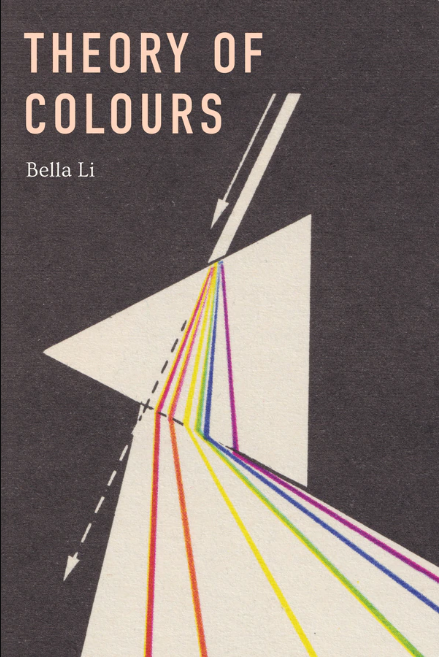
Theory of Colours by Bella Li
Vagabond Press, 2021
Bella Li’s hybrid poetics of text and image are instantly recognisable. Her third collection Theory of Colours follows on structurally and stylistically from her well-received earlier works: Argosy (2017, Vagabond Books) and Lost Lake (2018, Vagabond Books). Here, as with her previous collections, alchemical concoctions of form and genre blend source materials into sequences with a commitment to the surreal and uncanny. Theory of Colours extends this eclectic approach into what is arguably the most thematically cohesive collection Li has published thus far, delicately threading abstraction and narrative immersion. It is a meticulous book-object, with her attention to detail extending even to the design of the cover and internal typesetting.
The collection’s title is borrowed from poet and polymath Johann Wolfgang von Goethe’s 1810 treatise. Goethe’s Theory of Colours is a renowned historical oddity: part challenge of Isaac Newton’s physical theory of light and colour, part catalogue of colour experiments, and part philosophical reflection on the experience of colour. Goethe’s ‘theory’ is less scientific and more perceptual – his colour wheel contains a subsection for allegorical, symbolical, and mystical applications of colour. In contrast to the Newtonian view of colour as a subset of white light, Goethe argues that colour is the result of interactions between dark and light, and that ‘colour itself is a degree of darkness’.
Just as Goethe sees colour as emergent from the mixing of light and dark, Li’s readers find meaning and appreciation in the recomposition of contrasting elements and forms. Absence, and what we piece together in its stead, runs as an underlying theme across the book’s three sections. In the first and titular section, Li relates Goethe’s perceptual colour theory to photography and ghost stories. ‘Coloured Objects’, the entirely visual opening poem, consists of nine image collages in sequence. Each image juxtaposes colour theory diagrams and block colour swatches with black and white photos of drawn from a historical overview of New Zealand photography: sweeping natural vistas and portraits of well-dressed people sitting for the emerging technology are subsumed by the schematics of colour, obscuring faces and bodies and sometimes whole landscapes. One double-fold shows men in suits pose for a group portrait, their faces almost entirely obscured by coloured index tabs. In a later spread, women in light full-length dresses stand in a field of daisies, their bodies all but obliterated by a triptych diagram visualising the phenomena of refraction, where light through a prism splits into its composite colour frequencies.
In this quietly striking poem Li deploys several inversions that grapple with absence. Most prominent is the striking contrast between the black and white photographs and the bright yet constrained colour palette of the interpolated images – the subjects drained of colour by the technology of the early camera are refracted back into colour, but illegibly so. The title too suggests an inversion of the ‘subject’ nominally linked to the portraiture style dominant in the late 1800s; in this visual bricolage they are now objects, mere embodiments of colour phenomena in a scientific positivist lens.
Considering the Aotearoan context of the source images, a colonial spectre pervades this inversion. The early history of photography is interwoven with that of the racial sciences that pervaded the colonial empires of Europe in the late 19th and early 20th centuries. As advances in physiology challenged the reliability of human visual perception, photographs were purported to depict an empirical truth that was frequently used to justify notions of racial superiority and the wider colonial apparatus. When ethnic or Indigenous minorities were represented on film, it was typically either as evidence for racial science purposes or as an idealised exotic figure to export back to the white motherland. This exclusion has been continually baked into the technology of photography itself, from the ‘Shirley card’ swatch of a white woman which was for decades the sole measurement for colour photo processing to the computer vision algorithms which misidentify non-white faces due to their omission from data sets used to train these algorithms. Placed in this context, ‘Coloured Objects’ emphasises photography as a vehicle for the erasure of Indigenous culture by forming an erasure of the idyllic colonial vision itself. The well-to-do European subjects of this poem are engulfed in colour theory, transformed into objects of pseudoscientific obsession. This anticolonial reading is no doubt shaped by Li’s renowned poem ‘Pérouse, ou, Une semaine de disparitions’ in her first collection Argosy, which Aden Rolfe suggested ‘can be read as a kind of Pacific revenge against Europe, the natural world reclaiming the civilised, the colony subsuming the coloniser’.
Later in this first section, Li explores colour through a gothic bent with ‘Chroma’, a story in which colour is presented as a supernatural force. In this piece, describing an abandoned mansion which is ‘set back a safe distance’ from a ‘ruined and populous village’ and the wealthy family that once lived there, Li pushes her visual practice to new levels of experimental abstraction, with a sequence of pages consisting only of a hollow rectangle against a bright yet monochrome background. Li’s notes cite Edgar Allen Poe’s ‘The Masque of the Red Death’ here, but while the coloured rooms in Poe’s plague tale are sequential, the speaker in Li’s poem describes the rooms as part of a clockwise, circular sequence. The reframing of this textual allusion gives a sense of inevitability to the demise of the wealthy family to ‘chroma’, which ‘starts in the blood’ and ‘macerates the vein’. Reading between Poe’s and Li’s texts, I can’t help but think of the Silicon Valley billionaires buying up New Zealand land and building bunkers to wait out the climate apocalypse. At a time when it appears the rich might escape the worst of impending global catastrophe, there’s a slightly mean thrill in this dark story of collapse, where the demise emerges from within, and the colourful riches of the family aren’t enough to save them.
Li is at her strongest in ‘Hotel Avenir’, a hybrid prose/collage poem in which careful interventions in both text and image produce an eerie reflection on capitalism’s absences on its deathbed. Part of the final sequence of the collection, in this poem the speaker takes refuge from the apocalypse where ‘the fires had gone out, one by one along the coast’ in a hotel. The full-page images depict a grand and ornately decorated interior, but for the speaker this place is maze-like and disorientating, inducing anxiously cyclical habits:
There were hallways and staircases leading to hallways and staircases. The occasional abyss, missing steps. I developed, in this time, a habit of leaping, from time to time, across. Vast distances and from time to time. Developing a pervasive, a persistent sense of vertigo
I’m particularly taken with a wordless double-page spread around the poem’s midpoint, where Li has superimposed fragments of the same interior image on itself to create a warped, Escher-esque landscape that in greyscale almost eludes a cursory eye. This vision brings to mind shopping malls, department stores and other familiar landscapes of late capitalism where the imperative of relentless growth turns inwards and generates an architecture like a fractal tumour – solipsistic and beyond spatial logic.
As the poem progresses, the images begin to feature white empty rectangles increasing in size. Like the Nothing in Michael Ende’s The Neverending Story, this is an embodied absence that invades the Hotel Avenir. Li published an earlier version of this piece in Going Down Swinging and it’s interesting to see how the poem has been refined for this collection: previously these absences marred the poem from the beginning, but in this version the empty rectangles don’t appear until several pages in. This restraint and slow build of visual tension of what we see in Theory of Colours feels much more in line with the horror genre that Li draws from both thematically and in repurposed text throughout this collection.
Li’s image-text sequences engender a swayed reading, a kind of trance for the reader flipping back and forth between images or disjunctive blocks of prose, scanning for associations between each poem’s suite of vignettes. This is undoubtedly a core intention of Li’s overall practice: in a paper on Lost Lake, Amelia Dale paraphrases a conference talk from Li in which she describes collages as ‘inducing backwards, forwards and circular temporal movements’. There’s a specific pleasure in this multiple, circuitous mode, where a reader will make connections not just between the many elements of the poem (themselves a collage of found text and images repurposed by Li), but between their perceptual experience of the poetry and their own contextual understandings of the many objects and symbols placed before them. Like additive colours, the superimposition of various textual sources produces effects that are not simply the sum of their parts, but something else entirely.
Works cited
Del Barco, Mandalit. ‘How Kodak’s Shirley Cards Set Photography’s Skin-Tone Standard.’ NPR, 13 November 2014, online.
Goethe, Johannes Wolfgang von. Theory of Colours. John Murray, 1810.
Li, Bella. Argosy. Vagabond Books, 2017.
Li, Bella. Lost Lake. Vagabond Books, 2018.
Li, Bella. ‘Hotel Avenir.’ Going Down Swinging, vol. 40, 2020, Clifton Hill.
Li, Bella. Theory of Colours. Vagabond Books, 2021.
Najibi, Alex. ‘Racial Discrimination in Face Recognition Technology.’ Science in the News Boston, 24 October 2020, online.
Poe, Edgar Allan. ‘The Masque of the Red Death.’ The Complete Works of Edgar Allan Poe, edited by James A. Harrison, vol. 4, Thomas Y. Crowell, 1902, pp. 250–58. HathiTrust Digital Library, online.
Rolfe, Aden. ‘What Makes Something a Poetry Collection: A Review of Bella Li’s “Argosy”’, by Aden Rolfe.’ The Lifted Brow, 19 January 2018, online.
*Taken from Cordite at http://cordite.org.au/reviews/green-li/
 To Koskino