
Sally Evans Reviews David Prater

Leaves-of-Glass

Leaves of Glass
by David Prater

Puncher & Wattmann, 2013

David Prater’s latest collection Leaves of Glass is based on three years’ correspondence in the late nineteenth century between young Australian poet Bernard O’Dowd and the ageing master Walt Whitman. The epistolary material between these two men, a collection of twenty or so letters currently archived at the State Library of Victoria, forms the skeleton for this collection. Prater deftly plays with these two personae, offering a kaleidoscopic vision of their relationship alongside a number of poems that experiment with the ambiguities of written language and the shifting levels of intimacy revealed by the O’Dowd–Whitman letters. Many of the poems will speak most strongly to a reader who is more than passingly familiar with Whitman’s work. It is not a book to be picked up idly, but one that engages with the often-overlooked sympathies between Australian and American poetic traditions, and offers a compelling insight into the lesser-known figure of Bernard O’Dowd. Beyond this, however, Prater’s artisanal use of language and style demonstrates his flexibility and intelligence as a contemporary poet.

Personal correspondence is a tricky source for creative material. Balancing these individuals’ inner thoughts, their intimate writings to another, and publicly available archived material requires careful attention and creativity. The tension between the categories of private, intimate and public leads to spaces and ambiguity: gaps between what is felt and what is expressed, between what is answered and what is ignored, between what can be found, later, in the archives and what has been left out or lost. Personal letters, or what Dierkz terms ‘familiar letters’, which are ‘devoted to the expression of affection and duty among kin, family and friends’, are used to close the distance between individuals, usually on a very intimate level. Prater’s poems create a fictionalised account of these two men’s lives around the details found in their correspondences, often drawing epigraphs from the archival material to contextualise the poems. For example, epigraphs from O’Dowd’s letters head the poems written from O’Dowd’s point of view. These poetic personae, part real and part imagined, are vibrantly formed, with the O’Dowd persona in particular being marked by a clear and distinctive style. This collection is dominated by O’Dowd’s voice – fittingly, perhaps, given the abundance of critical and creative material written on Whitman and the comparative dearth of writing by and on O’Dowd. O’Dowd’s work, as Judith Wright acknowledges, ‘has dated badly’ despite public appreciation for his poetry during his life (quoted in Prater’s book). Prater offers a poignant and troubled vision of the aspiring young poet: a man beset by self-doubt, entering into a correspondence, both epistolary and spiritual, with Whitman the ‘revered Master’.
Continue reading →

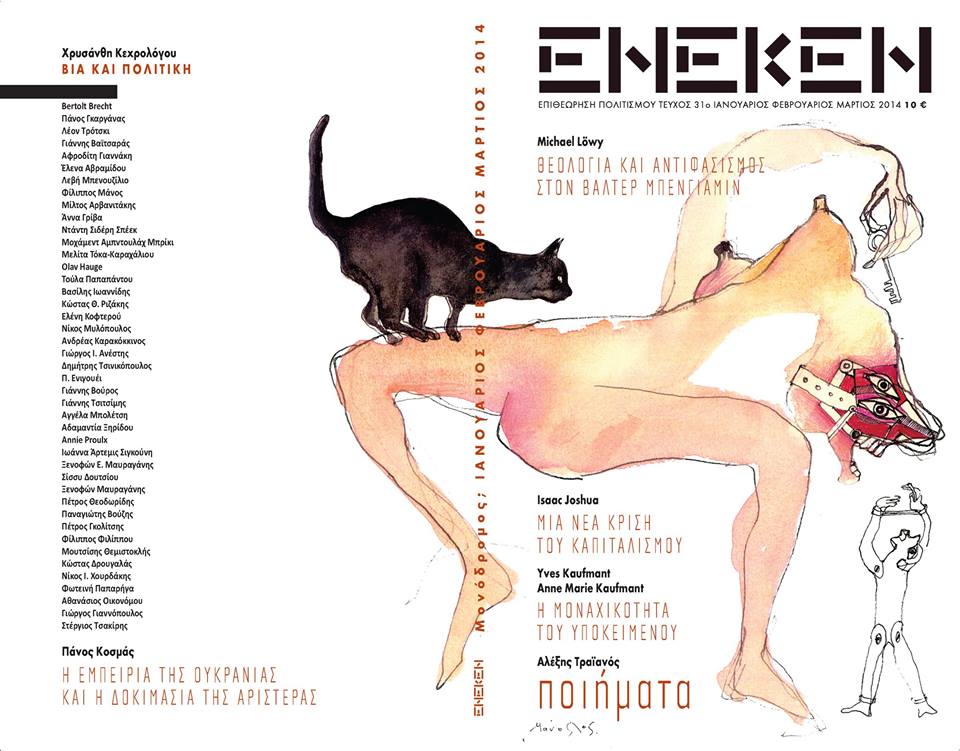
Κυκλοφόρησε το “Ένεκεν” Νο 31, Ιανουάριος-Μάρτιος 2014

Με χειρόγραφα του ποιητή ΑλέξηΤραϊανού και ένα ανέκδοτο ποίημά του κυκλοφορεί το νέο τεύχος του περιοδικού ΕΝΕΚΕΝ. Μαζί και πλούσια ύλη.

1974982_842584982434558_2086303666_n

Τζούλια Φορτούνη, παιδική ηλικία

1601195_1451080868444853_538100595_n

πάντα εκεί γυρίζω
κλειδωμένη στην υγρή αποθήκη
με μια επίκληση πολυσύλλαβη
ν’ ανοίγω ρωγμές στο σκοτάδι
γράφοντας ποιήματα

πάντα εκεί γυρίζω
παγιδευμένη στο άβατο μιας ενοχής
συλλέκτρια στιγμών
σε γκρίζα αναμονή
να προκαλώ πλημμυρίδα λέξεων
άμπωτη αποσιωπητικών

πάντα εκεί γυρίζω
με μια αρμαθιά δισταγμών
να στέκομαι δακρυσμένη
στη σκουριασμένη πόρτα της μνήμης

αναζητώ ένα στίχο
ένα φως
-ένα μονόξυλο-
να με ταξιδέψει
πέρα από την άνυδρη σιωπή
στα ανθισμένα λιβάδια του μέλλοντος

*Από τη συλλογή “Φυσικό αντίδοτο”, Εκδόσεις Μανδραγόρας, 2013.

Στρατής Παρέλης, είσαι προϋπάρχουσα κάθε χρώματος και κάθε μουσικής

Μιλάς. Τα λόγια σου καίνε.
Μικρές αιθέριες υποστάσεις σαν από φλεγόμενη βάτο.
Και στο κορμί σου συλλαβιστά το μεσημέρι κάνει την επιδερμίδα σου
μια γεωγραφία ανεξερεύνητη.
Το χνάρι των ερώτων μας στα σεντόνια, στην κλίνη
στο δωμάτιο με το χαμηλωμένο φως
τις ρίμες που ακουμπούν στο πατιναρισμένο κομοδίνο
και λιγώνονται από το τρεμουλιαστό αήττητο κερί.
Τότε που είσαι από ύλη και όχι
που είσαι προϋπάρχουσα κάθε χρώματος και κάθε μουσικής
νότα ενός αγγίγματος που είναι η αγάπη που σου ‘χω.
Με βρίσκεις στις φλέβες σου, στο παλμό της συνήθειας
στο βράδυ σου στο πρωί στην εφηβεία σου που τείνει στο άπειρο
στο ποίημα που σε περιγράφει, στο ποίημα που σε καταποντίζει
σε μια χοάνη του μυαλού όπου δεν έχουν λόγο
ύπαρξης ούτε η θλίψη ούτε η καταχνιά από του βίου τα εμπόλεμα πάθη.

*Το ποίημα και το βίντεο αναδημοσιεύονται από το ιστολόγιο του ποιητή στη διεύθυνση http://stratisparelis.blogspot.com

Γρηγόρης Σακαλής, Αγώνας

46408_524450210899351_393143089_n

Ψεύτικα λόγια
σου τριβελίζουν το νου
γυρνάς πίσω
ξαναγυρνάς
δεν ξέρεις
γιατί επιστρέφεις
γιατί ήταν ψέματα
διασχίζεις συχνά
τα μαύρα φύλλα του χρόνου
και, θαρρείς,
τ’ απομεινάρια του χθες
μα σύντομα ξαναγεννιούνται
κι εκεί που νόμιζες
πως έχεις ξεμπερδέψει
βρυκόλακες τα λόγια
κι οι στιγμές
γεμίζουν τα ξερά ποτάμια
της μνήμης
διεκδικούν
περισσότερο χώρο
κι έχεις τώρα
μεγαλύτερο αγώνα
να δώσεις
για να τραβήξεις μπροστά.

Κατερίνα Γώγου, Εξορία

983574_306611749494167_1156300429_n

Είναι πολύ καιρός, σχεδόν έξι χρόνια
Που δεν ξέρω που κοιμάμαι
Πετάγομαι ιδρωμένη στον ύπνο μου
Αν λέγεται ύπνος ένας συνεχής πυρετός
Που μυρίζει ασημένια χαρτάκια
Οινόπνευμα
Βαριά χάπια
Και απάνθρωπη μοναξιά
Δεν θυμάμαι που κοιμάμαι
Νομίζω με ψείρες το χειμώνα στα Προπύλαια
Και τα καλοκαίρια κάτω από σταθμευμένα λεωφορεία για σκιά
Όταν έρποντας η μνήμη μου επανέρχεται
Μια νύχτα το σχήμα ανθρώπου πήρε
Κι αφού υπνώθηκα
Έρωτα βαθιά μέσα μου έκανε
Μπήκε
Από ‘κει αρχίσαν τα δεινά
Γέννησα ένα παιδί
Σταλμένο να χτυπήσει από μέσα το κάστρο
Πέρα από τις αφετηρίες όλων των ανέμων
Πίσω από τα γαλανά βουνά
Αυτή ήτανε η τιμωρία
Γιατί η Βασίλισσα είχε χριστεί πολεμίστρια
Έπρεπε να μείνει ανέραστη
Τα παιδιά τα κάνουνε μητέρες
Ήτανε δηλαδή άλλων δουλειά…

Hermann Hesse, Όλοι οι θάνατοι

1510973_306824976139511_1924742511_n

Μέχρι στιγμής έχω γευτεί όλους τους θανάτους
Και θα πεθάνω γι’ άλλη μια φορά
Γνωρίζοντας το θάνατο του ξύλου μες στο δέντρο
Το θάνατο της πέτρας στο βουνό
Το θάνατο της γης στην άμμο
Το θάνατο των φύλλων στου θερινού χόρτου το θρόισμα
Κι ακόμα το φτωχό, αιματηρό θάνατο του ανθρώπου…

Όμως θα ξαναγεννηθώ ανθός
Δέντρο και χλόη θα ξαναγεννηθώ
Ψάρι κι ελάφι πούλι και πεταλούδα
Και μέσ’ από την όποια μου μορφή
Η νοσταλγία θα μ’ ανεβάσει και θα φτάσω
Τον ύστερο πια πόνο
Τον πόνο των ανθρώπων…

Αργύρης Μαρνέρος, Τέσσερα ποιήματα από την “Αίθουσα Αναμονής”

Natalia Sergeevna Goncharova, Factory (1912)

Natalia Sergeevna Goncharova, Factory (1912)


ΣΠΑΣΜΕΝΑ ΑΓΑΛΜΑΤΑ

Τώρα το ξέρω
Πρέπει ν’ αγαπήσω τη ζωή
Ανάμεσα απ’ τα συντρίμμια
Που βρίσκονται μπροστά μου
Πρέπει να αγαπήσω ξανά
Κάθε μικρό κομμάτι
Κι ένα ένα να τα βάλω στη σειρά
Όμορφα δεν είναι μόνο
Τα απείραχτα πράγματα
Και τα σπασμένα αγάλματα
Έχουν τη δική τους τη χάρη
Και ίσως είναι αυτά
Που πιο πολύ μας μοιάζουν.

ΣΥΣΤΗΜΑΤΑ ΠΑΙΔΕΙΑΣ

Κάποια μέρα σε μια σχολική γιορτή
Οι μαθητές ντύθηκαν παπαγάλoι
Και έλεγαν το μάθημα χωρίς χάνoυν λέξη
Και όλοι βαθμoλoγήθηκαν με άριστα.
Και από τότε δεν ήτa.ν μόνο σχολική γιορτή
Αλλά επίσημο πλέον σύστημα παιδείας.

ΤΗΣ ΑΝΑΛΗΨΕΩΣ

Σήμερα είναι της Αναλήψεως
ΕΙπε ο γραμματέας στο Δεσπότη
Την ώρα. που έφευγε βιαστικά
Καλά που μου το θύμισες παιδί μου
Πρεπει να φύγω αμέσως για την τράπεζα.

ΣΧΟΛΙΚΑ ΘΡΑΝΙΑ

Μου μίλησαν
Πιο Πολύ για Αβραάμ­
Παρά για Σωκράτη
Πιο πολύ για Χριστό
Παρά για Διόνυσο
Άσε τα σχολικά θρανία
Είπε ο γέρος της παρέα.ς
Και δες στην πλατεία το χορό
Μέσα. στη μνήμη του κορμιού
Ήτανε παντα Διόνυσoς ο χρόvoς.

Jacinta Le Plastrier, When they Come for You: Poetry That Resists

1653289_545297308911453_1332070702_n

‘This machine surrounds hatred and forces it to surrender’ were the words inscribed on the banjo of American folk legend and activist Pete Seeger, who died at 94 in late January 2014. Reading the tributes to Seeger, I was struck by a recurrent theme: his moral courage, which he lived out unrelentingly across a lifetime. Commenting on the ‘not common behaviours’ which made his life exemplary, a New Yorker post by biographer Alec Wilkinson wrote of ‘his insistence on his right to entertain his own conscience’.

That ‘insistence’ began early; Seeger preferring to face jail rather than invoke the Fifth Amendment defense when called to testify before the House Un-American Activities Committee in 1955, and refusing to name personal and political associations. He avoided jail only on appeal in 1962. In October 2011 he was among the leaders of the ‘Occupy Wall Street’ march. The tributes also led me to think of the ways in which other high-profile figures in popular music – Bob Marley and Bob Dylan – have in the past century harnessed, insisting on their same right, the active, lyrical power of poetic language to express moral and political dissent.

This is one of the reasons for the diminished audience for poetry in the 21st century; its audience, lean as it has often been, has been further subsumed by other arts. Of course, at the same time, the meld of lyric and instrument harks to the days of the lyre, the bard and troubadour, lyric’s origins and tradition. Yet there is an essence in poetry, where a poem can be a pure or unique instance of language (to use Paul Celan’s thinking), giving it the capability to be a stand-alone language of resistance. It has been often, in the works of accomplished poets, a language of essence, able to name what is essential to the fully lived human experience, and what depraves it. There are abundant examples. Celan himself – in the words of translator Katherine Washburn, after being earlier a ‘pure poet of the intoxicating line’, and in the steep of the Surrealists – became ‘heir and hostage to the most lacerating of human memories.’ As a Romanian-born Jew, Celan worked in a forced labour camp for 18 months from 1942-1944. Both his parents died in Nazi camps. Just one excerpt here, from his 1952 book, Poppy and Memory:

Black milk of daybreak we drink you at night
we drink you at noon death is a master from Germany
we drink you at sundown and in the morning we drink and we drink you
death is a master from Germany his eyes are blue

(trans. Michael Hamburger)

Continue reading →

Δημήτρης Τρωαδίτης, Από τις “Απόπειρες ονείρων”

1383591_241756395979703_1896401429_n

απόπειρα δέκατη ένατη

έχουμε χαθεί
σ’ αυτά τα ταξίδια
ψάχνουμε γυρνώντας
στα ίδια
ακολουθώντας τα νερά
του ποταμού
να φτάσουμε
στη μισοεξαφανισμένη
κοίτη του
από τέρατα κυνηγημένοι
σκέψεις κουρασμένες
χαϊδεύοντας τα στήθη
δαγκώνοντας τα χείλη
ανακαλύπτοντας σκουριασμένα
ανοιχτήρια στο βυθό
της θάλασσας
από αρχαία καλοκαίρια
με κάποτε κόκκινο
ξυλιασμένο καφέ χρώμα

απόπειρα εικοστή

φοβάσαι να χαράξεις ελπίδες
για να μη συρθείς στη δύση
των ερώτων σου
τ’ αντικριστά παραπετάσματα
δεν σε επηρεάζουν πια
το λιγοστό φως δεν σου στέλνει
σκληρές λάμψεις
παρά μόνο ανταύγειες
χωρίς πτυχές
για να υπονομεύσει το βλέμμα σου

*Από τη συλλογή “υπολήψεις – απόπειρες”. Για να διαβάσετε ή κατεβάσετε τη συλλογή αυτή πηγαίνετε εδώ: http://www.apostaktirio.gr/index.php?option=com_content&view=article&id=2738:test&catid=57:e-books&Itemid=66