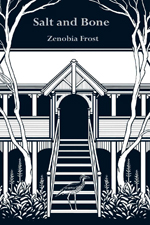
Salt and Bone
by Zenobia Frost
Walleah Press, 2014
In its own words, Zenobia Frost’s Salt and Bone slinks ‘between ibis-legged houses / and wakeful graveyard’, and belongs to ‘the hour of the curlew’, a liminal space that speaks of ghosts and transformation. As a collection, the poems are pervaded with a sense of haunting, plagued by abject bodies ‘aching for salt and bone’, the suffocating presence of water, and the archeology of death. It is noteworthy that Frost’s work both begins and ends with a warning of the power of unknown and strange things; a reminder, perhaps, of the gaps that exist between the ‘real’ and the imagined.
Indeed, Salt and Bone is a collection that relishes in the gothic and the macabre, often anchored in the physicality of the body or objects rendered as bodies. In ‘Auf Wiedersehen Spiegeltent’, for example, the deconstruction of the circus tent is figured as a kind of flaying – ‘the circus is gone/ big top / stripped to bone’ – while its performers bend and collapse like origami: ‘their drunken limbs forget / the ways they should not bend /[…] they fold back into boxes / like costumes like paper’. Frost’s manipulation of bodies is both unsettling and striking, at times even verging on a form of delightful masochism, as demonstrated so vividly in ‘Odontophilia’ (a fetish with teeth), in which the poem describes a fixation ‘on the ache as teeth / shimmy loose’. As the poem replays ‘this ritual of / fidgeting pressure’ that is at once so alien and so familiar, it conjures a vicarious pleasure that is simultaneously alluring and othering, a quality that marks a number of the poems throughout the collection:
‘this first infant pleasure
worries the bruise of your mouth
long to press just one peg free
to tongue the root red
gum erupts
in shards of molar’
Continue reading