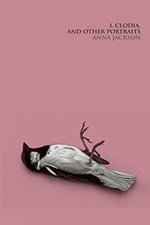
I, Clodia, and Other Portraits
by Anna Jackson
Auckland University Press, 2014
Early in this collection, Clodia demands to be ‘loved by one of the new poets’ (4). Instead of beginning with the poet’s invocation of a muse, the muse of I, Clodia seems to summon the poet. Over 34 pages, Jackson imagines Clodia Metelli, the witty, promiscuous Roman aristocrat generally believed to have been the subject, ‘Lesbia’, of Catullus’s love poems – his interlocutor – her voice dovetailing easily with his. This biographical sequence is followed by another, observing an unnamed photographer during ‘the worst disaster of her career –/ this photographing of faces, this creation/ of ‘portraits’’ (41). The poet’s potential as portraitist and biographer preoccupies I, Clodia.
When a poet adopts the perspective of a historical figure, it is tempting to interpret the poem as a costumed performance – the ‘I’ belonging to the poet despite its period disguise (Dorothy Porter’s Akhenaten has been read in this way). ‘I, Clodia’, however, is a conduit for the subject’s voice. This is a departure for Jackson, whose poetry is often laced with autobiography; in Catullus For Children (2003), the Roman poet is coaxed into contemporary New Zealand, specifically into the lives of Jackson’s children. By contrast, ‘I, Clodia’ takes a scholarly and empathic imaginative journey to 1st-century BC Rome. Meticulously researched, technically precise, and psychologically persuasive, this does not appear to be a masked self-portrait, but a portrait of someone Jackson understands deeply.
Continue reading




 To Koskino