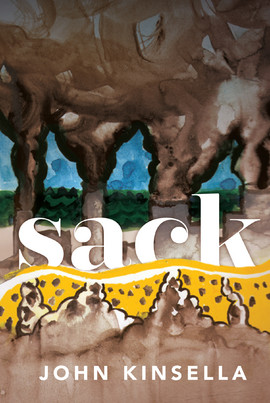
sack
by John Kinsella
Fremantle Press, 2014
In the first rabbit poems by the late J S Harry, her rabbit-character, Peter Henry Lepus, is thrown into a number of desolate or alien environments. Peter is ‘dumped … on the Desert of Sense’, ‘comes to … FORTY-THREE BLENDS / OF DUSTED-OFF & SUNDRIED RATIONALISM’, and ‘gets lost in “Calcutta” / on his way to visit Farmer McGruber’s vegetable patch.’1 He is displaced most comprehensively in the middle of Iraq, 2003, a warzone that amplifies his naïve and interlopic perspective. Such meaning-deprived contexts let Harry explore belonging, identity, and the stability of concepts themselves. In the poem, ‘Small & Rural’, for example:
Peter L. is twisting
this way & that
time-jumping
in & out of the texts he is – here – there –
squatting briefly, to sniff the air above
– when he comes to a paddock which pens similar ontological indeterminacies to those of his self. There exists, firstly, the paddock’s OED-style meaning: ‘a small field or enclosure, usually a plot / of pastureland, adjoining a stable’; then its poetic meaning, which incorporates geographically specific information; psychotherapeutic semiotics; other things ‘the word paddock’ could stand for; the word’s etymology; and the behaviour that this entire network facilitates or does not facilitate. It is important for Harry’s Peter, perhaps because of this semiotic vulnerability, that ‘the pads & stink’ of predators like ‘the dog fox & vixen’ remain absent from these paddocks. He is also only a rabbit, after all.2
We can consider the paddocks of John Kinsella’s sack to be constituted by a similar ontological indeterminacy. However, Kinsella’s are utterly littered with the kinds of hazards that worry Harry’s Peter. In Kinsella’s poem ‘Peter Negotiates the House Paddock, 1965’ – as far as I know, Kinsella’s Peter is not a rabbit, and is unrelated to Harry’s – there is ‘bent deadwood threatening to grow, and kinked tetanus-wire of fences’; there are ‘gwarder and dugite’ snakes, and ‘in hollows … foxes and rabbits plan for the coming crops in related but contrary ways’. Not only hazardous, Kinsella’s paddocks contrast to Harry’s as they are simultaneously fecund and bisected by man- and tectonically-made divisions: ‘Lines of bricks buried up to fetlocks show whole garden- / beds ready to be.’ (Later, in ‘Penillion of Stanbury Moor’: ‘Segmentation / Of field – flection / Of plastic bound / Bales; that moss-stoned / Vista across / The weir’). They are paddocks powered by the inexorable earth, and they transport the providential history of local lore.3
Continue reading →




 To Koskino