By Jena Woodhouse*
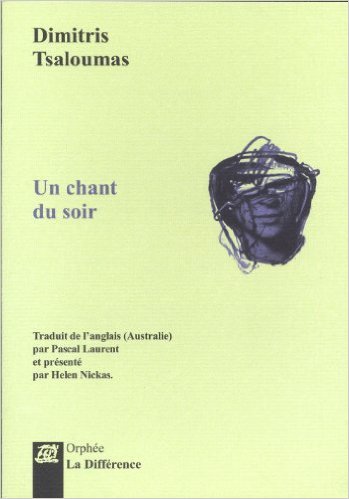
Un chant du soir [selected poems from Tsaloumas’s collections in English], translated into French by Pascal Laurent. A bilingual edition [English and French], 128 pages. France: Orphee/ La Difference, 2014. ISBN 978-2-7291-2066-5
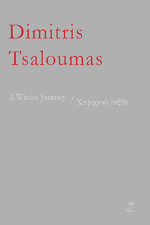
Dimitris Tsaloumas, A Winter Journey.(Chapbook) A bilingual edition in English and Greek. New Greek-language versions of the original English poems prepared by the poet. Brighton, Victoria, Australia: Owl Publishing, 2014. ISBN 0 9775433 1 5
The Introduction to both publications is by Helen Nickas, author, academic, and a publisher who, along with the GACL Committee who publish Antipodes, has done so much to bring Greek-Australian writers and writing to the attention of a wider readership.
As ever, Dimitris Tsaloumas brings to his creative practice a distillation of experience, observation and perception enriched and filtered by several cultural and linguistic sources, animated by personal memory and a mythopoeic imagination that characteristically taps into memory’s aquifers to elicit dramatisations and evocations unconstrained by time. It seems that he is able to bring a divinatory instinct to bear on this process.
Although Dimitris Tsaloumas was born in Greece, on the island of Leros in the Dodecanese archipelago, his formal education was initially in Italian, as those islands were under Italian hegemony from 1912 to 1947. By the time he left Greece in 1951 to migrate to Australia, he had already published two collections of poetry in Greek. In the course of his studies at the University of Melbourne, he later acquired fluency in French, and embarked on what would be a lifelong journey into the English language, which was to become the medium for nine collections of poems.
Rich textures of language and structures of thought are matched by thematic abundance, yet while the heart of the matter may sometimes prove elusive, luminous presences pervade the poems that deal with love and ideal beauty, loss and memory. Tsaloumas has commented that Helen of Troy is his symbol of beauty in general, and this title poem of the collection Helen of Troy and Other Poems (2007) is one of those included in Pascal Laurent’s beautifully presented bilingual selection of 45 poems, Un chant du soir (pp. 108-9), translated into French in consultation with the poet, thereby giving Francophone readers access to the stylistic and linguistic pleophony and polyphony of Tsaloumas’s poetry.
Other iconic poems that seem to travel effortlessly from the original English texts to the French – testimony to the dedication, care and skill of the translator, Pascal Laurent — include selections from Falcon Drinking (UQP 1988); Portrait of a Dog (UQP 1991); The Barge (UQP 1993); The Harbour (UQP 1998); New and Selected Poems (UQP 2000) and Helen of Troy and Other Poems (UQP 2007).
Tsaloumas’s abiding themes and concerns cohere as a preoccupation with beauty, the ideal as sometimes glimpsed in the actual, but more often purged of worldly impurities by memory or art, as in the case of Helen, the poet’s mnemonic for beauty. But the supreme muse is perhaps memory, not only personal, but also collective and cultural, whose role is pivotal to poetry. Without memory, beauty lacks awareness of its antecedents.
The quest, the journey, the return, nostalgia in the Greek sense of the word (a yearning for the homeland); the hovering, luminous presences of seasons past; mutability and the idea of the immutable, which exists as memory: these motifs recur in the fabric and fibre of Tsaloumas’s poems as guests and visitants of the cosmology from which he draws consolation and renewed inspiration. Persephone incarnate, ‘partridge-breast proud’: a local girl glimpsed gathering flowers in spring near the mouth of the Underworld at Cape Tainaron (‘The Traveller and the Maiden’ Un chant du soir, pp. 102-3); Eurydice (‘Orpheus’ lament’ , number 11 in the sequence A Winter Journey); the mother (who is a recurring visitant in the corpus of Tsaloumas’s poetry, as for instance in ‘Visits’, poem number 4 of A Winter Journey); the mysterious ‘lady of ships’ in the poem “Aubade for the Lady of Ships’ (Un chant du soir, pp. 56-7) are among many feminine personae who perform multiple roles, as couriers of memory and psychopomps plying between past and present, between dream archetype and the physical world of sensory impressions.
The sequence of 14 poems titled A Winter Journey (originally published in Helen of Troy and Other Poems), references Schubert’s eponymous song cycle in its title, and also seems to contain allusions to Ovid, the poet in exile, in images of deprivation, wolves, the steppe. Hints and clues in the sequence seemingly support a reading of it on one level as an encrypting of Ovid’s experience, paralleled in part by that of Tsaloumas himself.
However, when I decided to put this hypothesis to the test, and asked the poet in a letter (in early 2008) if this were the case, he replied as follows:
‘It amazes me that the Ovid association never occurred to me before, during the writing or after. And yet your comment makes the connection so obvious that I can only wonder. However, this is only circumstantial…. My sequence has to do with the burden of memory in the desolation of old age and the return or revival of that mysterious sense of guilt that was ‘buried’ and forgotten in the vigour of youth. Memory, even the memory of beautiful moments, is now a source of pain….
‘This collection (Helen of Troy and Other Poems), in spite of the sadness of its tone, was meant to constitute a celebration of beauty in all things in life, including death!’
Irrespective of how readers may interpret A Winter Journey, the calibre of the work places it among Tsaloumas’s finest achievements, a poetic ‘leap/ over the bounds of self’.
….
yet I know temptation
is in the weave of sainthood
the test by fire before the leap
over the bounds of self
(A Winter Journey 9, ‘Temptation’)
Although the title of this sequence seems to presage a journey, the persona of the poems is snowbound, waiting for the spring, the thaw, and his journey is an inward one. Visitants arrive from afar in place and time, as do wolves:
After the wolves came mother
though the door was barred
….
others too came from albums
of yellowing years
faces blurred
though not unfamiliar
….
mother’s eye steady
burning through the hut’s murk
(A Winter Journey 4, ‘Visits’)
‘Summoned by unknown spirits’, ‘against [his] will’, the poet waits at a
point of static motion
dead centre of the rose
of winds
(A Winter Journey 1, ‘The call’)
But the reader is given to understand that
this is no public gesture
this voyage
no trespassing on alien land
(A Winter Journey 9, ‘Temptation’)
The essential paradox (in various guises) that lies at the heart of many of Tsaloumas’s poems here surfaces in the eleventh poem of this cycle, ‘Orpheus’ lament’:
….
Back under the sun
Orpheus blinks and sings again
of love regained and lost
never bestowed whole
and therefore imperishable.
Strange that Orpheus’ song
should have made famous
love’s impotence
and its division beautiful
beyond compare and reach
of man-born time.
The cycle ends with a burial in poem no. 14, ‘Songs of the woodworm’, alluding to the ambiguous nature of the poet’s journey, with implications for the ultimate and inescapable destination of each person’s life.
While Tsaloumas’s language of choice in the original poems of the present collections is English, his poetics are illumined by ‘the rich glow of an older tongue’ (‘Washing-up’, Un chant du soir, pp. 106-7), and informed by structures of thought and emotion whose origins lie elsewhere. Tsaloumas’s art is nourished by many sources, among them the context and continuity of cultures older than the one whose language he composes in. Perhaps it is this circumstance that imbues the content and language of the poems with a distinctive timbre and patina, the rich glow of an older tongue: resonances from a cultural milieu not alien to English – since Greek culture and thought is one of the antecedents of modern European cultures – but not innate to it either. Tsaloumas’s nightingale, his rossignol (Un chant du soir, pp. 60-61), is a far cry from Keats’s bird of the same name:
Last night in our square of rubble,
on the stroke of twelve, a nightingale
was heard. And panic-stricken folk
leaned out of gutted windows
above lamp-posts that bent distraught
over the brinks of craters
wondering, bitter that such a bird
should visit in their grief with not
a tree, not even a spire to support
its crazy song.
.…
I laughed, and from the shadows cried
don’t be such fools, brothers,
the song proffers no hope. That gift
you’ve squandered long since.
This is the hour of its perfection.
Be grateful to the bird that scores
the vastness of that loss.
….
The haunting texts selected for translation into French by Pascal Laurent include, in addition to those already cited, many of Tsaloumas’s finest poems: songs for out times and for all times, of the here and the hereafter, embodying an uncanny instinct for locating the eternal in the moment. They include the iconic ‘Falcon Drinking’; Old Man with Canary’; ‘The Barge’; ‘To the Poet’, with its sardonic, slant allusions to Plato’s Republic; ‘A Summer House’; ‘The Harbour’; ‘The Shrine’; ‘Morning Coffee’ — a dual portrait viewed in the light of the quotidian; ‘Stoneland’; ‘The Veranda’; ‘The Inheritance’; ‘Helen of Troy’…. and, among my personal favourites, the delicately drawn charm of ‘A Postcard to Matina’, which I quote in full:
A Postcard to Matina
The boats by the tamarisks on the far left
will sail again before dawn, and with the sun
dripping forge-red a mere three fathoms
above my bed in the horizon-filled window
I’ll be thinking again of my fishing days and all
the water loveliness of child-bright summers.
I linger under the sun. There’s no pleasure
in triumphs no longer shared. I write this card
a mile past its frame, on the far right, against
the harbour breeze. Splinters of laughter point
the lime-rock light thorn-deep, and as before
you walk between the festive sea
and the white of houses as if these days
belonged to another year. Yet nothing’s changed,
in spite of memory. A stained-glass autumn
hangs near the door on our pomegranate tree,
olives are crushed and fish is fried at dusk
in every kitchen, and all the island cats
shine peaceably in the bounty of the season.
The moon’s back huge as ever, platter-full.
(Un chant du soir, pp. 38-9)
This symbiosis between cultures, paralleled in these two new publications by the twin versions of the poems presented side by side, in English and Greek (A Winter Journey) and English and French (Un chant du soir), evokes sublimated relationships and nostalgias, as well as generating productive tensions, implicit rather than explicit, between different emotional landscapes and the syntactical shapes of ideas, the grammar of thought.
Ambiguity, ellipsis, antithesis and dichotomy, contradiction and paradox, shadows and luminosity abound in the art of Dimitris Tsaloumas, romantic idealist, peerless lyricist, excoriating sceptic, and poet of all life’s seasons. Yet amplitude and kenosis, feast and frugality and fast, flow and ebb are surely also the rhythms of the natural world, and Tsaloumas, who for much of his long life has migrated annually between homelands, Australia and the Aegean, is attuned to this language as well, the primal and maternal one, an awareness of origins and eternal cycles of renewal, and the blueprint for beauty that is nature’s gift to art and memory.
Note: Dimitris Tsaloumas’s most recent publication of new poems in Greek is Thirst (Dipsa), a chapbook published by the literary journal Planodion, Nea Smyrni, Athens 2010, which contains some of the most remarkable poetry he has ever composed. Only Dimitris Tsaloumas could have written these incandescent poems.
*This piece firstly published in “Antipodes” 2015, annual literary journal of Greek-Australian Cultural League of Melbourne.


 Γ. Βέης