Reflections of A Temporary Self
by Grant Caldwell
Collective Effort Press, 2015
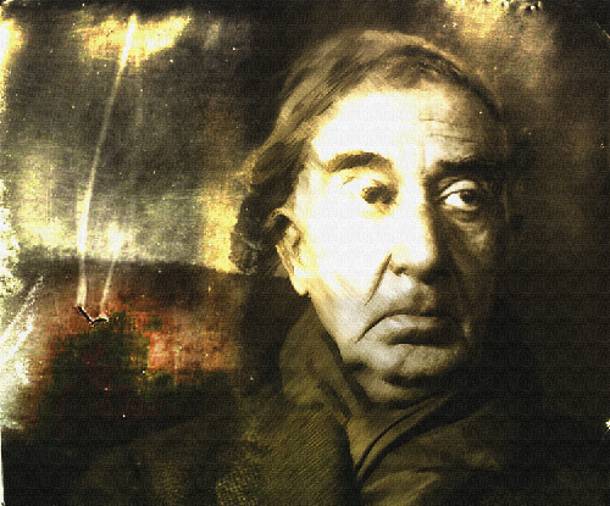
Publishing a selected poems is an act of confidence. While no one who writes poems would want to be judged on their worst effort, a selection suggests these are the poems that – if readers must judge – the poet be judged upon. The act is, however, doubly denied by Caldwell in the qualified title, Reflections of a Temporary Self, and by the front cover author photo: is he asleep or isn’t he? The I-don’t-necessarily-give-a-fuck attitude is part of the package. I qualify the attitude because Caldwell, in producing an eighth book (consisting of poems from six previous books and new poems), clearly does give one.
The large type will be welcomed by the poorer sighted and it has a poster effect that gives the pages authority, suggesting that this is public poetry: it’s what I saw, heard, thought; what do you reckon? The poet might have moved on, into a new self, but the gesture remains. In noting my impression of the unapologetic strain in Caldwell’s work I don’t mean that it is necessarily aggressive. It can be unapologetically sweet:
wallabies kissing in a twilight field
holding straws in their little hands
ears revolving
all this and the joey
and the young shoots of clover
they love so much (‘ontos farm’)
Like John Shaw Neilson with the death taken out. You could say with the lilt out, as well; by analogy the impression is of a rock’n’roll Zen, especially this aspect cited by Wikipedia: ‘the personal expression of … insight in daily life, especially for the benefit of others’. The latter part of the quote is pure ironic Caldwell. Reflections contains a sarcastic poem about the facile adoption of Buddhism as an identity (‘einstein, buddhism and my stiff neck’) and it is one of the poems that verges on the genre of the grumpy-old-man poem. Yet, typically, the judgment is on Caldwell, or at least his narrator: thinking about Buddhists, he falls in the creek and bangs his hip. (It seems quintessentially Australian to fall in a creek and hurt yourself, rather than get wet or drown.)
There’s rhythm, there are images, and sometimes they meet. Caldwell is interested in the melancholy affects of repetition, as in ‘across the sea’ (‘the sea comes … it never stops/it never stops’); and in mundane investigations of logic in these concluding lines from ‘thirteen ways of looking at a window’:
with the dark the window becomes a mirror
when you turn on the kitchen light and you
watch yourself reflecting reflected in the light
though you can’t see your face for the shadow
This circularity is given its major form in ‘two black chairs’; as the poem goes on it becomes replete with chairs and tables, and a purse and fairy lights, and ‘elvis before his dissipation’, losing its sense of line (or gaining fullness) as the page becomes full with the swirl of words. All poems are concerned with the logic of their structures, but logic is also a theme of these poems, as if they want to work out the possibilities of logic in poetry. ‘like a tennis ball’ resembles a song structure – what could easily be read as a hip-hop structure, though I think it’s too unromanticised for that – where the abjection of alcoholic (prosaic) unhappiness is redeemed (poetically) by the mundane-lyrical image of a tennis ball in the last line.
Caldwell’s untitled haiku are read to advantage in a column of four, where the effect is of reading a series, rather than one per page, which might well have seemed flat or inconsequential. His haiku momentarily slow down reading by offering change in tone, voice and space. The mode is not completely distinct, however. The following two haiku from a camping sequence point to Caldwell’s interest in logic, circularity and repetition:
red hot coals
in the late night camp fire
tomorrow’s ashes
in last night’s ashes
yesterday’s potatoes
never to be eaten
‘yarra yarra (ever flowing river)’ is a three part collage of Aboriginal place names, and includes many that have negative connotations (‘ONNUA white man with gun’; ‘BOGONG place infested with fleas’) but ultimately the momentum is towards a more positive affect: the final section including terms like ‘WOONINGCANNING where wild ducks flock and play together’, ‘MANGOPLAH people singing’ and ‘QUINDALUP a happy place’.
As a record of ‘more than thirty years’ of writing that tries different modes, the book’s diction is, inevitably, a mixture. At times the disparity’s too great: while irony can give a lot of weight to the vague ending (‘yair … sure …’) of ‘bar-b-q in blue’’s comic anecdote, it’s not so easy for irony to lighten the load of the following poem’s conclusion: ‘into new depths of ontology’ (‘mundane avenues of compensation’).
Caldwell’s version of the ‘I do this, I do that’ poem is one of white poverty: the drug and scam milieu. In ‘the colour of black light’ the narrator makes money from secondhand books then talks to the bookseller about Charles Bukowski, as if he defined the extreme version of white poverty as poetry and he probably does. It’s not as nice or as affectionate as O’Hara, but there is the same compositional thought and structure, where the elements of a day are brought together to make a poem. You can have no money, but if you have a TV you can still watch a documentary on Matisse. Class culture is complicated, and complications are normal.
Other poems (‘terra nullius’ and ‘baghdad etc.’) deal with the logic of hyperbole. Extreme comparisons are made to suggest the fabric of everyday power struggles that are implicated in greater ones everyday intolerance as a sliding scale to that of big business, government, the military. ‘baghdad etc’ begins, ‘it is better not to think’, and in this again, Caldwell is a kind of anti-O’Hara that is not quite paranoid.
When reading his poetry in performance, Caldwell characteristically makes enjambment explicit through a pronounced pause, and enjambment is something that figures in his poetry as much as the line as such. The poem ‘the fat bread’ employs spacing and line breaks to an extreme extent, in a way that is both highly contrived and wonderful; something about this poem – and the way it faces a photo of a child (presumably the author) as a scarecrow with arms wide – makes it seem an original contribution, both obvious and unique. It’s like a couple of haiku added together then stretched apart till breaking point:
in the park
the arrowfast tortoise
shell
cat
stalks
the fat bread
bloated
pigeons
pecking in the sun
dry
grass
Yet it is not completely obvious, because the syntactic inversions are not predictable; yet they do fit, and enliven and ironise the images. ‘the arrowfast tortoise’ evokes the fable of the tortoise and the hare, and makes it a character of the poem, along with the fat bread, neither of which are strictly visible. That ‘fat bread/bloated/pigeons’ are still pecking is itself ironic, but narrative irony is less emphasised than that of syntax, while spacing ironises both word and phrase as image. It is a wry little masterpiece.
The title of ‘the neverending poem’ suggests its relation to πO’s ‘Everything Poem’. It collects found moments of text, facts and observations. It is not that long, ending with a shudder-making quote from Margaret Thatcher. Its overall tone might be described as rueful. Another found poem, ‘amerika’ is like a dub version of Allen Ginsberg’s ‘America’, with the tone and apostrophe stripped from it. A collage drawn from a 1960s textbook, it is revealing of sexual and economic oppression:
sue is more attractive than ann
jean is more attractive than sue
[…]
i will have steak but sue will not
she will have lobster
[…]
if you left your jobs
you would look for other jobs
Caldwell brings the two aspects together in the couplet, ‘it is time you bought a new car/it is time sue got married’.
Apart from the typos, there’s a rough and ready feel to this selection, resulting in the inclusion of some poems that do no more than those before them (sequentially if not chronologically), and in some wonky enjambments (‘you have control now’), but these can also have a payoff. Caldwell’s line breaks replicate, at least some of the time, an idiosyncratic verbal style that speeds up and slows down, and can make lines seem strained or truncated on the page. But not all of them; and the style can turn up a great line like ‘there to back him mainly’: ‘him’ being the poem’s titular horse, ‘tobin bronze’. The story of the race is strung out a bit long (if you don’t define being an adult as the ability to defer gratification) before finally arriving at the end’s kicker: no spoilers from me.
Caldwell, as someone who has been teaching creative writing for some time, is under the radar in terms of his influence on thousands of young readers and writers of poetry. Teaching, however, can sideline a poet’s own work. Reflections of a Temporary Self might seem as necessary as a white pepper milkshake, but taste is produced by reading, not by not reading: and besides, conventional poetry readers are the last thing a various place like Australia needs.
*Michael Farrell‘s Cocky’s Joy was published by Giramondo in 2015. His scholarly book, Writing Australian Unsettlement: Modes of Poetic Invention 1796-1945, was published by Palgrave Macmillan.
***From Cordite Poetry Review at http://www.cordite.org.au