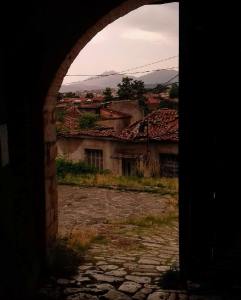
Tamistas Mhnymal, στα χρόνια των ωκεανών

στα χρόνια των ωκεανών
ακούστηκαν η οχιά των πεποιθήσεων
κι ένα μουλάρι από αφρούς θυμού
που φύλαγε τον κάθε ρίτσο
στο αρχαίο μαυσωλείο
των παρορμήσεων

τα ξημερώματα
τα βράχια στάθηκαν αμίλητα
στην επική κορδέλα εντολών του γουόρντ
οι απελάσεις των συναισθημάτων
αισίως τελεσφόρησαν
ξημέρωνε

αμήχανα θα συνεχίσουμε
στης μνήμης τις ξερές ερήμους
θα μετανιώσουμε για τις νυχθημερόν
του μπιμπερόν δαγκωματιές
μέχρις εκεί τόσο
παλιά

παλιάνθρωποι
δεν συγχωρούν αυτούς που
από έρωτα εκπέσανε

ΕΑΝ ΑΥΤΟ ΕΙΝΑΙ Ο ΑΝΘΡΩΠΟΣ.

yorona's avatarγια τη φωτογραφία και την κριτική

Εσείς που ήσυχοι ζείτε

στο ζεστό σας σπίτι

και το βράδυ γυρνώντας θα βρείτε

φαγητό και πρόσωπα φίλων.

Σκεφτείτε εάν αυτό είναι ο άντρας

Αυτός

Που δουλεύει στη λάσπη

που δεν ησυχάζει ποτέ

που παλεύει για λίγο ψωμί

που πεθαίνει για ένα ναι ή ένα όχι.

Σκεφτείτε εάν αυτό είναι η γυναίκα

Αυτή

Που έχασε

Τ’ όνομά της, τα μαλλιά της

τη δύναμη να θυμάται

κρύο το στήθος άδεια τα μάτια

Σαν βάτραχος το χειμώνα.

Σκεφτείτε ότι έχει συμβεί

τις λέξεις αυτές σας ορίζω

γράψτε τις στην καρδιά σας

στο σπίτι, στο δρόμο

πριν κοιμηθείτε όταν ξυπνάτε

επαναλάβετέ τις στα παιδιά σας.

– Ή

– Το σπίτι σας να ερημώσει

– η αρρώστια να σας καταβάλει

– οι γιοί σας να σας απαρνηθούν.

Primo Levi

«εάν αυτό είναι ο άνθρωπος.»

View original post

Κατερίνα Ηλιοπούλου, παιδικοί άνθρωποι

Είδες πώς φώτισε το πρόσωπό του
Με 50 λεπτά μόνον
Η αυθεντική χαρά μετουσίωσε τη φτώχεια του
Σε καθαρό φως
Είναι παιδικός άνθρωπος; ρώτησε το κορίτσι
Ναι, παιδί μου, οι παιδικοί άνθρωποι
Δε ναρκισσεύονται, δεν κομπάζουν
Δεν υποκρίνονται, δεν αρέσκονται στα παίγνια
Απλά ξεχνιόνται στην παρατήρηση
Των ανθρώπων που ξυπνούν αξημέρωτα
Και κρέμονται από χειρολαβές
Που εκμηδενίζονται σε μάζες
Που γιορτάζουν και πενθούν
Οι παιδικοί άνθρωποι έχουν έκπληκτα μάτια
Γιατί τα θαύματα δεν συμβαίνουν
Χωρίς μαθητευόμενους μάγους
Οι παιδικοί άνθρωποι διαλύονται
Μέσα στους άλλους
Χωρίς να φοβούνται μη χάσουν την υπόστασή τους
Σαν τις σταγόνες στις μεγάλες θάλασσες
Αυτός άλλωστε, είναι ο προορισμός τους

Introduction to Charmaine Papertalk Green’s Nganajungu Yagu

By Anita Heiss, Charmaine Papertalk Green and Zoë Sadokierski

Since Charmaine Papertalk Green’s poetry was first published in The Penguin Book of Australian Women Poets in 1986, her voice on the page has been consistent: eloquently powerful, respectfully challenging and true to her role in life as a Yamaji Nyarlu. Nganajungu Yagu is no different, considering, as it does, respect for ancestors, connection to country, the role of the poet and Yamaji identity.

The writing in Nganajungu Yagu is dedicated to Papertalk Green’s mother, and is built around a series of selected correspondence between her and her mother; each provides a deeply personal insight into not only their relationship, but the cultural, political and social landscape of her Yamaji country during the 1970s.

As Papertalk Green writes, these are ‘not just letters’. Rather, they create a tangible story and bond between Yagu and Daughter, and gently remind us of the sacrifices made by most of our matriarchs over time. Each letter and response provide not only a ‘mark of existence’ for the writer but a medium for mother and daughter to connect while at a distance. Her gift is one that makes us pause and reflect on our own behaviours. The love and respect penned here will inspire readers of any age and identity to think about the ways we engage people we love through words. Or, more importantly, the ways we should engage.

The revival of letters here not only reminds me of the nearly lost art of letter-writing, but the impact a letter has on its receiver. ‘I could feel the love hugs springing off the paper’, she writes in ‘Paper Love’.

I challenge any reader to put this book down and not feel compelled to write a letter to someone in their life – past or present.

It is through the bilingual poem ‘Walgajunmanha All Time’ that Papertalk Green clarifies her role as a First Nations writer, and I honour her for keeping our people, our stories and the Yamaji language on the literary radar and accessible to all readers through her poetry. When the academy, the literati and festival directors discuss Australian poetry in the years to come, they should all have Nganajungu Yagu on the top of their lists, and Papertalk Green as a key voice in the poetic landscape.

In the United Nations International Year of Indigenous Languages, Nganajungu Yagu is a work of cultural significance and educational influence. As I closed this book for the first time, I found myself circling back in my mind to a number of phrases. Those that keep recurring are –

Yagu, I always remembered the beauty of our culture
despite the racism seen in every step I took along years
culture love was and is the anchor for everything done.
This entry was posted in GUNCOTTON and tagged Anita Heiss, Charmaine Papertalk-Green, Zoë Sadokierski. Bookmark the permalink.
Anita Heiss is the author of non-fiction, historical fiction, commercial women’s fiction, poetry, social commentary and travel articles. She is a Lifetime Ambassador of the Indigenous Literacy Foundation and a proud member of the Wiradjuri nation of central NSW. She was a finalist in the 2012 Human Rights Awards and the 2013 Australian of the Year Awards. She lives in Brisbane.

http://www.anitaheiss.com/

More by Anita Heiss on Cordite Poetry Review →
Charmaine Papertalk Green is from the Wajarri, Badimaya and Southern Yamaji peoples of Mid West Western Australia. She has lived and worked in rural Western Australia (Mid West and Pilbara) most of her life, and within the Aboriginal sector industry as a community agitator, artist/poet, community development practitioner and social sciences researcher. Her poetry has appeared in Antipodes, Artlink Magazine, Cordite Poetry Review, The Kenyon Review and The Lifted Brow, as well as in the anthologies The Fremantle Press Anthology of Western Australian Poetry, Inside Black Australia: An Anthology of Aboriginal Poetry, Ora Nui: A Collection of Maori and Aboriginal Literature, The Penguin Book of Australian Women Poets and Those Who Remain Will Always Remember: An Anthology of Aboriginal Writing. She lives in Geraldton, Western Australia.

More by Charmaine Papertalk Green on Cordite Poetry Review →
Zoë Sadokierski is a Sydney-based designer and writer. She has designed more than 250 books for various Australian publishers, and is Vice President of the Australian Book Designers Association. Zoë lectures in the School of Design at the University of Technology, Sydney, where she runs the Page Screen research studio, experimenting with publication models for limited edition print and digital books. She also writes a column on book culture and reading in a digital age for The Conversation.

Home

Introduction to Charmaine Papertalk Green’s Nganajungu Yagu

ένα έτσι, επιστροφή στην κανονικότητα

Όταν αρχίζεις να πιστεύεις
πως δεν αναπνέεις
και πως το μεγαλύτερο πάρτι της ζωής σου
πρόκειται να έχει συμβεί και να συμβαίνει
καλύτερα να φοβηθείς
και να γύρεις πάνω στην μπάρα
να πάρεις τηλέφωνο όποιον εμπιστεύεσαι
και να ικετεύσεις για την απάντηση
στο νόημα της ζωής και του σύμπαντος.
Εφόσον η κλήση τερματιστεί
τράβα σπίτι και αυτοκτόνα.

*Αναδημοσίευση από το ιστολόγιο ένα έτσι στο https://enaetsi.wordpress.com/2019/07/20/επιστροφή-στην-κανονικότητα/

**Η εικόνα της ανάρτησης είναι του Γιώργου Μπλάνα.

Jennifer Mackenzie Reviews Elif Sezen’s A little book of unspoken history

A little book of unspoken history
by Elif Sezen
Puncher & Wattmann, 2018

Where do footsteps lead, these frustrated blind hunters

In these times many of us from all corners of the globe have more than one place we call home. Concepts of nationality, attachment to place, a sudden annunciation of enlightened belonging or steadfast refusal of it can be dissociative, painful and conversely full of artistic promise. The very notion of home may be welcome or fraught with regret. It may involve mixed emotions or at worst, trauma.

Elif Sezen, a Turkish-Australian multidisciplinary artist currently living in Melbourne, has developed a sophisticated methodology to work across media and to explore these themes. By foregrounding a personal inner life within the rigours of artistic and spiritual practice, she eschews narcissism through a focus on the transformative image. As a poet, translator, and as an artist Sezen has access to a world of imagery which appears to float in an imagined but deliberately structured dimension. Through deft selection, her practice of writing does not overwork its own tropes, which centre on childhood, trauma, displacement, the politics of migration and the metaphysical ambiguities integral to journeys real and imagined. Sezen’s images of trauma carry with them an apparent resonance, tantalisingly suggesting an overcoming, but also simultaneously suggesting the indelible trace of that trauma.

An example of this effect can be seen in the epigram ‘Slap of the morning’:

Slammed doors are still being heard
Who are they?

Coming after two poems focusing on childhood, ‘On the topic of first parents’ and ‘Childhood’, the poem resonates as a deep early memory suggesting violence with the sonorous slap and slammed, and fear through the final line Who are they?. The poem, employing Sezen’s regular trope, the door, appears to echo through space in a similar way to a masterly haiku.

Speaking generally of her artistic practice, Sezen has written: ‘I suggest the continual expansion of a poetic persona as a methodology of surrendering to the infinite’. Her poetry renounces the world’s ability to deliver infinity; instead its imagery emerges in devotional splendour or in political anger at the cruelties inflicted on refugees, especially those in long term detention.

When I first encountered Sezen’s work several years ago, I was attracted by what I saw as the European texture of the work, with its philosophical emphasis and often-romantic interiority. This connection has been astutely observed by Nadia Niaz, in a review in this publication of Sezen’s first English collection Universal Mother. Niaz focuses on the influence of Rilke (and importantly, his use of Sufi imagery), but also stresses Sezen’s access to diverse traditions, including Ottoman and Persian poetics, and to modern protagonists such as Forugh Farrokhzad. Several poems in A little book of unspoken history are dedicated to what can be seen as a constellation of artists, images of whom form something of an interior gallery, a feature many of us share, functioning as icons of our very existence. Sezen’s gallery includes Holderlin, Kahlo, Camille Claudel, and significantly in ‘Our celestial doorway’, a moving tribute to Farrokhzad:

Let’s meet up in your
imaginary Esfahan
in a city where women glow in green, head to toe
when we bend down from
the Khaju bridge, our reflections
on the water turn into non-poisonous ivies,
a city of secret sovereignty
where bombs won’t explode

A significant poem included in A little book of unspoken history is ‘Chronic Fatigue Syndrome’. The open, sequenced structure of the poem allows the key state of the suffering of the body to move effortlessly through themes of spiritual renunciation, the trauma of non-belonging and the vicissitudes of migration doubly effected and politicised. In an artist talk at her recent exhibition The Second Homecoming at Counihan Gallery, Sezen mentioned how moving back and forth between Izmir and Melbourne had left her without a sense of home. In this poem, fatigue enforces a focus back upon the self. In 1. Awareness, Sezen writes:

Now that I am tired
I must open up inwardly, like a lotus blossom
yes, I must open my paper-like lids
towards the benign feature of absence
for I will encounter her, in the very bottom:
that archetypal mystic, resembling my mother
by her glance perforating the silvered smoke
my small self will pass away
because I am tired
because fatigue is a lovely trap made to
save my body from its old cage
I get rid of the worldly clock
losing beguiling sleep

This sequence leads to a surge of empathy, where like an ascetic removed from the fray, the poet releases the possibility of benevolent compassion:

become a voluntary mute
so I can speak for them

They surrender their souls
wrapped with flesh and blood and breath
back to where they came from

As the poem continues, it develops a floating sense, the pinning of an elusive image, the transformative power of angels, and the devastating liberation of surrendering to pain:

La Minor impatience
Do black humour
CRESCENDO the pain
Is so glorious here

In 8. Homecoming the preoccupation with health, the body and inner awareness moves outwardly to expand upon themes of connection and conversely, the dissociative experience of migrations between two homes, and to embrace a conscious and deliberate act of site-specific remembering and forgetting:

Istanbul Airport is the doorway of my
time tunnel. No talking!
Act like nothing happened
hereby I discovered the reason
for the lack of bird-chirp
that others dismiss
because I am a bird too
I too forget the necessity of flight
in all directions of the
forbidden atmosphere of mystery,
simultaneously
‘We must declare our indestructible
innocence’, grumbles my mum
her eyes staring towards the
beyond-horizons
The birds pollute the new President’s sky.
A deaf child disappears from sight
in the alley, after listening to the song
which only he can hear
I call him from behind, with no luck
and find myself
in Melbourne again, inevitably
I chop and add mangos into
my meals again
I forget the malevolence of a
suppressed father figure image again
I forget my most favourite scent,
jasmine
how holy this forgetting is, I know
for it will pull me back to that doorway
for I’ll want to go back home again,
home without geography
without footsteps
how sweet is my abyss.

No memory of fatigue
I’ll again make merry.

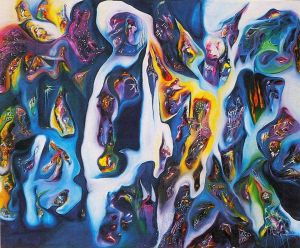
Because of Sezen’s productive impetus, it is difficult (and I would argue unnecessary) to separate the impact of a book of poetry from that of an art exhibition. In The Second Homecoming a series of brilliantly coloured ‘Door’ paintings reminded me of how artists such as Rothko and Kandinsky transformed colour and form to suggest an inner subjectivity or a spiritual connection between self and the world. The majority of the paintings presented at the exhibition represent a series of caves, rendered in swirling black paint, each canvas with a view rendered in different shapes of an idealised and distant landscape, evoking a sense of something longed for, attainability uncertain. In the exhibition notes, Sezen writes, ‘Initially, I was thinking of refugees, the Indigenous peoples and others displaced, but obviously the work could refer far more broadly, physically or spiritually.’ Of the Door series, she says that they ‘rather represent an elusive notion of a gateway, where everything is possible and homecoming can be dreamt into reality’. In thinking of First Nations peoples moved from or barred from their traditional Country, or of refugees in indefinite detention on Nauru we can imagine how unattainable that ideal may be. In the poem ‘Dear Immigrants’, the poet demonstrates how the withdrawal of compassion, the very notion of being comfortable with the imagined necessity of locking someone up, turns upon the populace:

And just about to say Well Come, we
rather remain silent
as if ripping out the tree roots from its soil
or sending the raindrops back where they came from
locking up our dear immigrants, outside
till we lock ourselves into cells,
shrinking more and more.

The theme of compassion is something that Sezen expands upon throughout the collection, perhaps representing this most expansively in ‘A thousand petal woman’, where a meditative practice reveals the strength and frailty of the practitioner:

I am gifted to see this
and yet I forget it again
I meditate upon the deceased again
I inhale Nagasaki,
exhale Hiroshima
you think that I am purified
that’s why you call me a Sufi

Whereas I am a confused woman
I have a growing homeless kid within me
she is not me, she is me,
I am.

By situating the political in an expansive consideration of the body and the spirit, in centring personal experience within rich philosophical and poetic traditions, Sezen’s oeuvre offers a fresh and original mapping of the question of home. In ‘A meditation on timelessness’ she writes:

Writing writing writing is such a deprivation from which I build
up an invisible reign on an earth where my footstep doesn’t
belong to the spot it steps upon …

Yes, my dear friends
every poet is responsible
for their own timelessness.

Earlier in this review, I referred to my initial sense of a European context to Sezen’s poetics. This certainly holds true as I gain greater familiarity with her work. Aside from Rilke, there are resonances of French poets such as René Char and André de Bouchet in the work. The above quotation from ‘A meditation on timelessness’ for example is something that Char himself may have written. However, with more recent reading of writers from Turkey and Iran, it is clear to me that although a European connection is certainly there, Ottoman and Persian exemplars, particularly in relation to Sufism, are more crucial. Writers such as Bejan Matur, Sholeh Wolpe, and fellow Melbourne writer Shokoofeh Azar engage with classical texts of Rumi, Attar and Hafiz, as well as with the innovative work of Farrokhzad and the contemporary writer, Shahrnush Parsipur, and it is with these practitioners that Sezen’s developing work may be more fruitfully approached.

*Jennifer Mackenzie is the author of Borobudur (Transit Lounge, 2009), republished in Indonesia as Borobudur and Other Poems (Lontar, 2012) and has been busy promoting it at festivals and conferences in Asia. She is now working on a number of projects, including an exploration of poetry and dance, ‘Map/Feet’. Her participation in the Irrawaddy Festival was supported by a writer’s travel grant from the Australia Council for the Arts.

**Τaken from Cordite Poetry Review at http://cordite.org.au/reviews/mackenzie-sezen/

Ιάσων Σταυράκης, Υπήρξα και εγώ βολεμένος

Υπήρξα και εγώ βολεμένος.
Δεν σας κατηγορώ.
Για κάθε φορά που με σιγουριά υψώνεται το βλέμμα.
Για κάθε φορά που με κύρος βαράτε στο ψαχνό.
Για κάθε μήνα που η δόση για το νοίκι, ιδρώτα δεν θα φέρει στα νύχια, στο λαιμό.
Για κάθε νύχτα που η καύλα της ασφάλειας θα σας οδηγήσει σε ύπνο μυστικό.
Κοιμηθείτε χωρίς φόβο
κι εγώ θα κατέβω στο πηγάδι του μυαλού να μας φέρω νερό.
Κοιμηθείτε χωρίς φόβο
κι εγώ θα πηδήξω με φόρα τα βράχια των δειλών.
Κοιμηθείτε χωρίς φόβο
κι εγώ θα γίνω ο ποιητής των φτωχών.
Κοιμηθείτε χωρίς φόβο
κι εγώ θα γίνω ο ποιητής των χαζών.
Κοιμηθείτε χωρίς φόβο
κι εγώ θα γίνω ο ποιητής των καιρών.
Κοιμηθείτε και ξυπνήστε
κι εγώ θα έχω την μοίρα των ποιητών.

Δημήτρης Γκιούλος, Προϊόν

Να μεταδίδεται ο πόλεμος σε λάηβ στρίμινγκ στο γιουτιούμπ
να συνηθίσεις τη φρίκη
αύριο θα ‘ρθει κι εδώ
πάλι σε στρίμινγκ θα κοιτάς, πόλεις, κτίρια, ανθρώπους να πέφτουν
ήδη πέφτουν κι ας μην ακούστηκε κάποιο σάλπισμα
(Τα τείχη μέσα μας είναι)
σε θάλασσες μολυβένιες
σε δρόμους χωρίς σήμανση
-πραγματικότητες σεσημασμένες-
σε αίθουσες δικαστηρίου
σ’ αεροδρόμια με φτερά εισιτήρια.
Και να είσαι σχολιαστής.
Να είσαι κυνηγός.
Θεριστής.
Αιχμηρός σαν ξυράφι
αποτελεσματικός σαν βόμβα
τα πάντα θωρών σαν drone.
Κι η φρίκη, προϊόν.
Σαν να είναι σειρά στο νετφλιξ
σαν να είναι αγώνας στο ΝΒΑ.
Μέχρι να ρθει εδώ.
Να γίνεις εσύ η πόλη
το κτίριο
ο άνθρωπος που θα πέφτει
Προπονημένος στη φρίκη
η βουτιά σου με δέκα θα βαθμολογηθεί.

Κάπως έτσι, από το 2017

Έκτωρ Κακναβάτος, Post Thermidor

Καί πού ήσουν τάχα λαίλαπα ή
το φθαρμένο μου γάντι πυγμαχίας
τι μ’ αυτό;

Νύχια της άρκούδας άνηφορίζουνε τή φλέβα μου
Ή θεωρία συρματόσχοινο πού κόπηκε
ή καυσαέριο πατημασιά κοβάλτιου ας είναι καί σφυρίχτρα
τι μ’ αυτό;

‘Όρκο παίρνω ήταν μεσάνυχτα πού ή θάλασσα
παράτησε την ολομέλεια
περνούσε σύρριζα τον τοίχο
πέταξε τα έσώρουχά της
τα κολλημένα πάνω της επίθετα 
τον οδοντογιατρό της.

Λαμπάδιαζαν οί λεωφόροι
τα κορίτσια κόβανε τις ωοθήκες τους
τις ρίχναν στη φωτιά οί φλόγες κόρωναν
τύλιγαν τον ούρανοξύστη
Μάτια μου έτούτος… άκαυτος

έ… καί τί
μ’ αυτό;
Μάτοα μου έτούτος… άκαυτος
Λευκοντυμένες άφηναν τ’ άμφιθέατρα οί πιθανότητες
ρίχνανε τα πτυχία τους στον οχετό της νύχτας
’Ιθαγενή άερόστατα ανέβαιναν
άπ’ τίς θερμοκοιτίδες

Κι έγώ
στις τσέπες μου όσο γινόταν πιο βαθιά
επώαζα φυσίγγια.
’Απόμακρη έξω άπ’ τις ράγες έπέμενε
άναντίρρητη σε ό,τι άφορά τό ούρανί
τό μπλάβο
τό πορτοκαλί
έπέμενε ότι λάμπουσα
αν καί παρηλιξ
ή γοερή διάνοια των μπολσεβίκων

’Από τό άπαρτο οδόφραγμα έπέμενε
non passaran καμένη στο ιώδιο
ή φωνή μου.

Κι αχ πώς δίχως τροχούς έπέμενε
καταμεσής στην άσφαλτο
μπαταρισμένη εκείνη ή Άνοιξη
πού τό νιογέννητο άτσάλι βάλθηκε να γερνά
μες στη γροθιά μου…

*Από τη συλλογή “Στα πρόσω ιαχής”, εκδ. Άγρα, Φεβρουάριος 2005.

Ashraf Fayadh, Cracks in the Skin

My country passed by here,

wearing the shoe of freedom….

Then off it went, leaving its shoe behind

It ran at a belabored pace… like the rhythm of my heartbeat.

my heart, which was running in a different direction… without a convincing justification.

The shoe of liberty was worn out, old and fake

like the rest of human values, at all levels.

Everything has left and abandoned me… including you.

The shoe is a disconcerting invention

it demonstrates our ineligibility to live on this planet.

it reveals our belonging to another place with no great need for walking

or a place with a floor that has cheap tiles… slippery ones!

The problem is not the slipping… but rather the water,

the heat… the broken glass… the thorns… the dry branches and the sharp rocks.

Shoes are not the perfect solution

but in some way they fulfill the intended goal

just like reason

and like passion.

My passion has become extinguished since last time you left

I can no longer reach you

since I have been detained in a cement box supported by cold metal bars,

since everyone has forgotten me… starting from my freedom…

and ending with my shoe, affected by an identity crisis.

*Translated from Arabic into Italian by Sana Darghmouni, from Italian into English by Pina Piccolo and approved by the author.

**Cracks in the skin, is a poem written by Palestinian poet Ashraf Fayadh from a Saudi Arabia jail, where he has been detained for the past four years on charges of apostasy, with a court sentence issued in February 2016 eight years imprisonment, 800 lashes and the demand that he publicly renounce his work. Since 2016 La Macchina Sognante has joined the international campaign demanding his release and has published one of his poems in translation in every issue. We will follow the same approach in The Dreaming Machine, the English language version of La Macchina Sognante. The artist’s family has called for renewed monetary support to help pay for the expenses incurred by his legal defense team as it prepares the appeal. We will provide more information as that international effort becomes more structured.

On October 20, 2017 the poet was awarded the prestigious PEN Canada One Humanity award which, in the words of the press release issued by the Canadian organization, is given “to a writer whose work transcends the boundaries of national divides and inspires connections across cultures. Valued at $5,000 CAD, the award honours PEN’s commitment to literature as a common currency between nations, and as a catalyst for mutual understanding and respect.

The 2017 winner, Ashraf Fayadh, is a Palestinian refugee living in Saudi Arabia and the author of Instructions Within (2008), a poetry collection that comments on social issues in the Arab world. He is a key member of the Edge of Arabia, a British-Saudi arts community and digital platform that promotes dialogue and cultural exchange between the Middle East and western world.

“Behind Fayadh’s poems, there are stories that show the painful loss of freedom,” said Ashraf Zaghal, editor for Arabic poetry magazine, Laghoo. “His stories about freedom do not necessarily relate to the poet’s homeland but, rather, reach out to the human public sphere and the strife for the essential right to free speech and action.”

In the summer of 2014, Fayadh stood trial in Saudi Arabia on blasphemy related charges related to his poetry collection, which has since been banned from circulation. Saudi courts sentenced him to death in 2015 for the crime of being an infidel, but after international outcry, authorities commuted his sentence to eight years and 800 lashes. Fayadh remains in prison in Abha while he appeals his sentence.

“This award reminds Fayadh, his family, his supporters, and most importantly, his jailers, that his colleagues will continue to advocate for his right to freedom of expression until he is released,” said PEN Canada president, Richard Stursberg.

PEN Canada will present the award Friday, October 20, at their annual event at the International Festival of Authors. Entitled, Glorious and Free? Canada in 2017, the panel features Jesse Wente, Rachel Giese, Desmond Cole and moderator Jesse Brown in a discussion on Canadian freedoms.

The International Festival of Authors will also feature an empty chair on each stage to honour imprisoned Azeri writer and blogger, Rashad Ramazanov.”

Featured image by Ashraf Fayadh courtesy of the artist, from his in-progress project “Spiderscarf” (Shashaboon)

http://www.thedreamingmachine.com/the-poet-in-prison-cracks-in-the-skin-ashraf-fayadh/?fbclid=IwAR3SdjvTBmEoRS0cRhzCL1z6xKPhgX3ENv5-7b8MseIJBZtQQ6LnkhDkciI