By Theo Panayides
September 4, 2019
“I’m a wolf,” says the poet Costas Reousis, “but I don’t live like a wolf.” ‘Reousis’, with the accent on the first syllable, is actually a pseudonym (he was born Costas Papathanassiou, in Athens, to a Cypriot father and a Greek mother) but it’s not immediately clear where it comes from: I thought it might derive from the French ‘réussir’, ‘to succeed’ – but in fact it’s a form of the Greek verb ‘reo’ (‘to flow’), which is quite appropriate. Costas may or may not be considered successful, by late-capitalist standards, but he does undoubtedly flow – both in his speech, in his words and of course his poetry, and physically too, to the bars and drinking dens where he drags his poetic carcass.
A note on the verbal flow: it’s virtually impossible to replicate. The poems themselves are opaque and uncompromising, built on a contrast between curt, craggy form and impossibly rich, fulsome language. (Is it modernism? He prefers hyperrealism, adding however that “a poet is defined by his language” as opposed to this or that movement.) His conversation is almost as hard to pin down. He lived in Greece till his early 30s (he’s now 49) and retains the accent – but it’s not just the accent, it’s the words he employs and the fast, garbled way he spits them out. ‘Sousourada’ he says, on the subject of women, a self-conscious Greek word which might be translated as ‘saucy minx’. “It’s not like I’m begging for it. Whatever works. Fuck it (‘St’arhidia mou’), I’m busy. If it happens with some sousourada, we won’t say no.” He’s a wise guy, the punk in the corner in the murkiest dive in all Exarcheia – but formal too, with an exquisite courtesy: I’ve brought along some books, he says gravely, “if you’ll allow me to present them to you when we’ve finished”. Even if this piece were in Greek – which it really should be – I’d struggle to convey even an inkling of his style. In English, forget it.
A note on the physical flow: he gets around. I should mention straight away that Costas was touted as a possible profile by a bartender friend, having made an impression as an interesting customer – and we also meet in a bar (actually a bar-café, Kafeneio 11 in old Nicosia), sitting at a corner table with bottles of Keo. Other friends recognised the name when I said I was profiling him (“I have a reputation,” shrugs the man himself, when I put all this to him), and told lurid tales of having seen him late at night, clearly drunk and arguing with himself – or his demons? – in a loud voice. ‘So you like to go out?’ I enquire delicately.
Costas nods. “And it sometimes happens that I go out and drink a lot,” he adds. “Beers, mostly – but a lot of beers. A whole kafasi,” he adds, another mainland-Greek word which means ‘crate’ but, in this context, is more like ‘a shitload’.
So, like, 10 beers?
“Try 24,” he replies. “But okay, don’t get me wrong. I have to be very…” he tails off, with a gesture that implies having reached the end of his tether.
He must feel pretty sick the next morning.
“I feel nothing next morning. Nothing, nothing at all. Because, for me to go and drink a crate of beers, my nerves must be so shot that even a crate of beers won’t calm them down!”
It’s not just the drinking, either. There are four cigarette butts in the ashtray at the end of our hour together. Costas smokes two packs a day, going up to four when things get especially fraught. What about drugs? Has he ever indulged?
“What are you, the neighbourhood cop?” he ripostes, snapping back into Exarcheia-anarchist mode. “What kind of question is that?”
There are other things he’d rather not talk about, like what his father did for a living (“It doesn’t matter”) or what he himself now does as a day-job, one of three compartments in his life (the others being poetry and the frequent nocturnal wanderings). He used to work in media, as a writer and sub-editor – but was made redundant at the time of the crisis, spent four years unemployed and now works (from eight to four, or thereabouts) at a more mundane job he’d rather not specify. It’s unclear if he’d ever go back to his old position, or if he’s burned his bridges. “I’ve left jobs with all guns blazing,” he explains emphatically. “Oh yeah! ‘So you’re firing me? Well, I’ve got a few things to say to you first’.” It’s those ‘nerves’ he mentioned earlier (he describes himself as “confrontational”), the emotions that well up inside him and have to be channelled – into fiery eruptions, and of course into poetry. I ask about friends; does he have a big circle? “I do,” he replies wryly. “Old ones, new ones – and quite a few that I used to talk to, and don’t anymore.”
Does he never reconcile with people, after they fall out?
“Eh, rarely.”
Does he bear grudges?
“Me? No.”
So the others do?
“St’arhidia mou.” It’s not that he’s self-destructive, explains Costas, but “after 20 years [in Cyprus], and so many clashes, I don’t want anything to do with them. I’ve returned their books, the ones they were kind enough to give me. I don’t even want you on my bookshelves!… I find it all so annoyingly utilitarian,” he sighs, of the poetry scene, “and – well, miserable, you know? Miserable.”
You can sense that dynamic in his poems, so much high-flown, singular language packed into a few pithy lines; the emotion feels about to spill over. Even his blog (reousis.blogspot.com), where he keeps an archive of poems and writings, has a high-flown name, ‘Asklipieio tis Pikrosynis’ – the first word a reference to Asclepius, the Greek god of medicine, the third a fancy riff on the word for ‘bitterness’, so something like ‘Medicine for Bitterness’ only much more ornate and poetic. Language is his pet, his weapon, his plaything. The poems in Costas’ 2009 collection O Kratiras tou Geliou Mou (‘The Crater of My Laughter’) don’t even have punctuation marks (or verses), the words expelled in a rich, indecipherable stream which “only I can recite” (he’s known for the impressive way he recites his poems). “Costas Reousis’ poetry is savage,” reads a quote on the Politeia bookshop website, where the book is for sale: “This is not the kitten of post-modernism, which allows you to stroke it. These are leopard-poems, depositing their slaughtered prey on the vast acacias of the savanna”. Unsurprisingly, Crater – along with last year’s Sbaralia (‘Smithereens’) – is his own favourite among his collections.
Sbaralia isn’t actually his most recent work. A new collection, El Kamino – his ninth, albeit shared in this case with three other poets – came out in May, and two further books, collecting poems he’s penned over the years, are due to be published by the end of the year (there’s also talk of Sbaralia being presented as a stage production with live music in 2020). I seem to have caught Costas Reousis at the best possible time, his most productive in ages; even my friends who mentioned his drunken exploits (and actually like him very much) admit that he seems to be going through a mellow phase, prone to posting selfies on Facebook where he unsmilingly presents some of the poets – Apollinaire, Ted Hughes, Garcia Lorca – who’ve meant most to him.
Like he says, he’s a wolf but doesn’t live like a wolf. There’s a solitary aspect to Costas, yet he’s sociable too. “It’s because I’m eccentric and grumpy,” he grunts when I call him an ‘underground’ poet (his point being that he’s not really underground, his style just makes it seem that way) – and he is indeed eccentric, yet the eccentricity is also a persona. He cares and doesn’t care what people think. There’s a reason, after all, why he never drinks at home – only in public, where he and his demons can battle it out in full view of everyone. Is it just a performance? Surely not. But it’s like his poetry, which really comes alive when being recited; Reousis the man – the punk, the grump – is a big part of Reousis the poet.
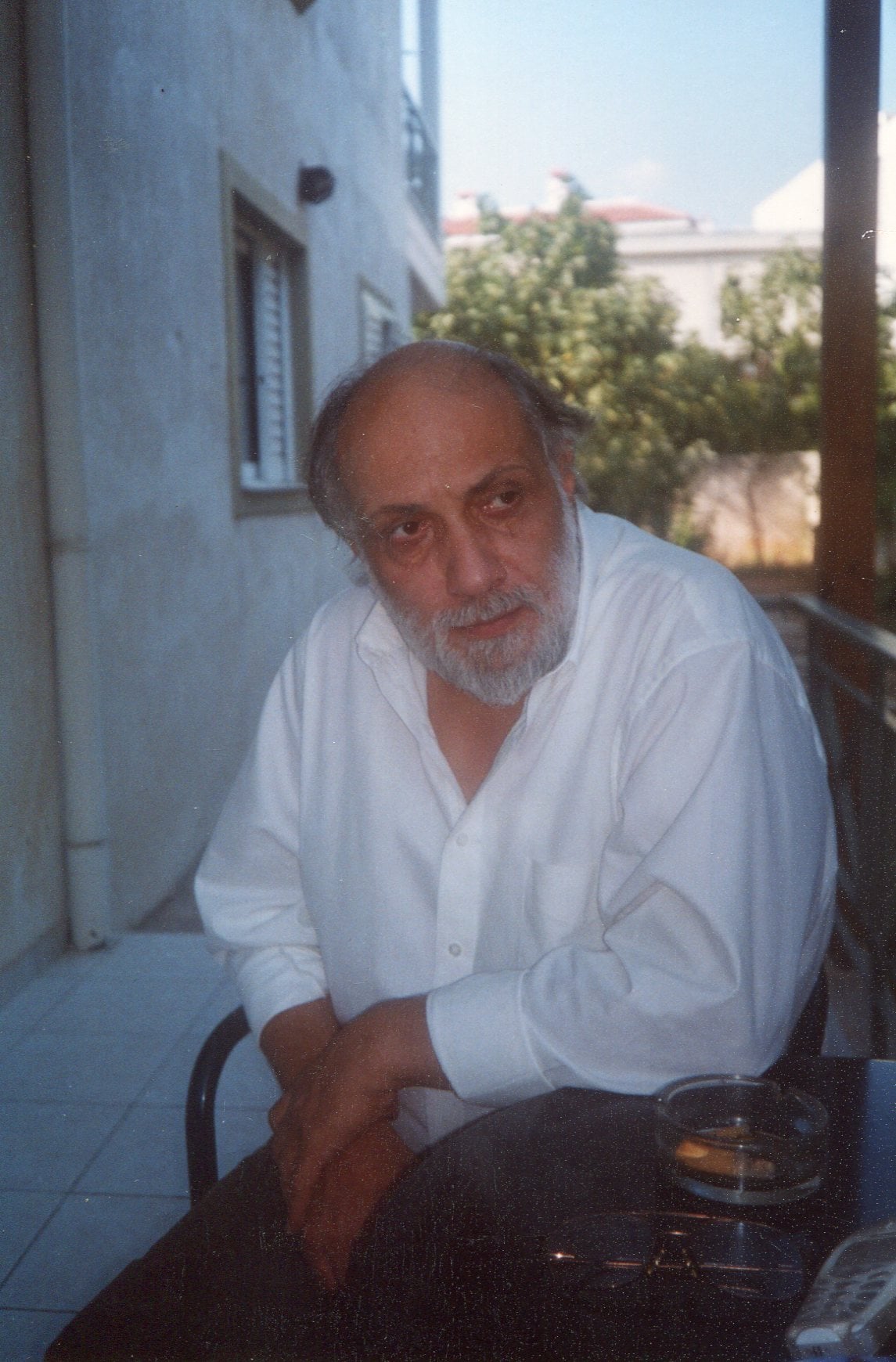
He looks more irascible than he is, with his heavy glasses and thick, lumpy features. He never smiles in photos, keeping his mouth tightly downturned – though it may be because he has problems with his teeth, a chronic periodontitis that’s plagued him since childhood and ravaged his gums to the point where he can’t even wear false teeth anymore. “I took such a beating,” he recalls with a grim chuckle. “Such a beating from the dentist, you can’t imagine.” His body, it appears, isn’t his biggest ally; he’s also had some operations (nothing serious, he insists) in the past few years, starting around the time when he lost his job. This is probably part of the reason – conscious or not – for the current burst of productivity, a sense of Time creeping by and his own half-century on the horizon, though the newfound structure of being back in work after four years also helps.
He’s become more driven as he grows older; the three parts of his life now fit together “with military discipline”. Once the day-job is done, he picks up paper and pencil (he always writes in longhand) for the poetry part – though it’s not like he writes every day: “Most of [the poems] appear fully-formed,” admits Costas. “When the time comes, they appear fully-formed”. Still, he can think about writing every day, pore over half-finished poems and imbibe the poetry of others; he’s a fan, hence the selfies on Facebook.
He’s also, let’s be clear, an established poet, whose work has been translated into Spanish and Italian – but it’s not just the work, it’s a certain sensibility. Even those who couldn’t make head or tail of his challenging (or pretentious) verse can sense something special in this high-strung man with the fickle body and nervous disposition, the trail of quarrels and late-night eruptions. He’s always written, ever since childhood, didn’t study Literature – he did Law instead – but always pursued it; his first book of poems came out in 1995. At the same time, there’s more to his life than writing. “I’m not sitting there with my quill in my hand, filled with divine inspiration,” he quips. “I’m a bit of a hoodlum. Quite a bit, actually.”
Costas’ flat is essentially an office – then, once the poetic part of the day is done, comes the third (also quite poetic) part, where “I roam the streets, as much as my stomach can take”. I wonder if he does it to inspire the Muse, but he waves me away: “What do you think, I take notes? I go out! Just to say something crude, do something stupid”. It’s different when he has a girlfriend – he’s been in long-term relationships, though never lived with anyone; he needs his privacy – but right now his life is simple: day-job, poems, carousing, back again at 8am. It helps that he only needs about five hours’ sleep.
“I don’t have a shrink,” crows Costas Reousis, positing his non-wolfish flow as a kind of therapy. “I need my nerves, and I like to express them. I’m like a heart,” he adds, he has to keep moving and pumping, violently if necessary; “It’s how I am, you either accept me or you don’t”. This summer’s been a time of industriousness, putting the new books together; his work – he says – has become a bit more talked-about in the past couple of years. I suspect he’s slightly torn about success, craving the attention and hating that desire at the same time (“The main thing,” he notes, “is not to start brown-nosing”). We finish up our Keos and get ready to leave – but wait, there’s one more thing! “Don’t write the ‘Costas’ with a ‘K’,” he enjoins, looking very impassioned. “With a ‘C’, please!”. Consider it done.
Photo: Haris Panayiotou
*From here: https://cyprus-mail.com/2019/09/04/a-poet-in-wolfs-clothing/


 To Koskino