Review by James Stuart*
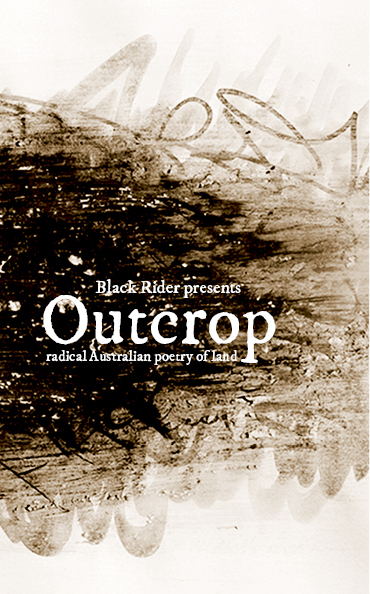
Outcrop: radical Australian poetry of land Jeremy Balius and Corey Wakeling, eds Black Rider Press, 2013
As I write this review, sunlight filtered through a pall of smoke casts a dull orange glow over my kitchen bench. The Blue Mountains are burning. Sydney’s haze resembles downtown Beijing’s and it’s only October. Such an apocalyptic scene – part of the ‘Australian experience’ I am assured by our Prime Minister – provides context for the world into which Outcrop and its ‘radical poetry of land’ emerges. This is not to suggest that the anthology’s outlook is primarily environmental, but that alternative ways of examining land are sorely needed.
On the whole, Outcrop, compiled by Corey Wakeling and Jeremy Balius, is experimental – a distinct and welcome contrast to an often straight-forward field. Sadly, Wakeling’s editorial lacks the clarity of the subtitle’s territorial claim. His scholarly credentials are not in question, but his opening remarks resound with statements so close in meaning that a PhD seems necessary to distinguish their nuances. At times his stated territory becomes so inclusive as to seem self-contradictory, for example:
‘Moreover, the ecological itself disturbs the primacy of the figural image when its concerns are micro as well as macro, disguised as well as visible, and subsistent as well as existent.’
But this does not detract from the importance of the works, all of which invariably, as Wakeling notes, ‘express[es] a crisis in relation to land.’ He continues, more directly:
‘This collection believes in not only poetry’s potential for critique and dissent, but too the possibility of recuperation and efflorescence of land’s multiplicity in a theatre of language. This theatre of language may entail utopia or dystopia, realism or surrealism, but I feel more so that this collection in its radicalism welcomes the gamut of these contrary forces.’