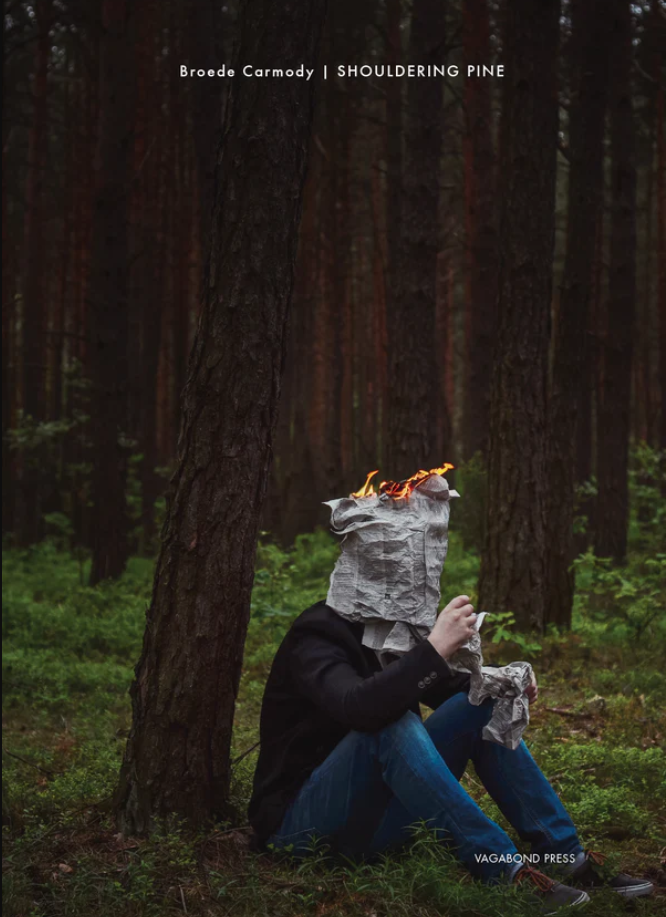

Shouldering Pine by Broede Carmody
Vagabond Press, 2023
Greatest Hit by Holly Isemonger
Vagabond Press, 2023
A book-length poem can offer the best of two worlds: the thematic and spatial breadth and depth of an epic-style length on the one hand, the delineation of units and fragments via the physical space of the page on the other. The poem can be read as one long piece, but also becomes chunks, giving the reader gentle permission to find their own flow without the designation of titles or sections. Broede Carmody’s second book of poetry, Shouldering Pine, uses this book-length form to construct the tensions and connections between its emotional and geographical spans as it takes the reader through a sort of loose, meditative journey. The speaker of Carmody’s poem is often driving out of Melbourne and through country Victoria, with a European interlude. They are anxious in the general anxiety disorder sense (typed out by “the Melbourne GP” “with two fingers” (12; 12)), and in the eco-catastrophic sense – “Sometimes it feels like I’m speaking with a bird’s throat. The bird is underwater” and “Have I told you how campfire smoke / reminds me of home but also / preparing to flee grassfire?” (13; 55). These articulations of anxiety, though refracted through the personal subjective experience, suggest a sense of an emotion that is both lonely and widely felt. Eco-grief and eco-anxiety, terms emerging from research by Finnish scholar Panu Pihkala in the late 2010s, are today increasingly researched and widely understood emotional responses to climate disaster. Braided together is also the grief and anxiety of the bushfire-pandemic period that began in the 2019/2020 summer, leading into Melbourne’s series of lockdowns. There are also the echoes of elegy for a deceased friend (never named but likely referring to the much-loved and much-missed writer Kat Muscat, who died in 2015). This braid forms a sort of through line in the book, among smaller threads of scenes travelling and camping with friends and tense conversations with lovers. The otherwise sublime images of landscapes are peppered with discomfort at the settler position on stolen land – after noticing the imprint of sheep’s feet in dirt, the speaker immediately goes on to name this unease:
This wasn’t meant to be a colonial poem.
This poem can’t be anything but a colonial poem.
(9)
This is seemingly the limit of the colonial settler position of the poem, and it’s hard to tell whether it is part of the speaker’s own thinking or has become a reflexive, almost self-conscious response to the poems’ contemporary pastoral leanings. Rivers and mountains make frequent appearances in Shouldering Pine but the settler position never quite returns. The overwhelming mood turns to defeat: “Sometimes I wonder if we’re better off just giving up” (21).
Despite exploring these uncomfortable emotions, the poem’s opening sets up a sharpness that seems to accompany the work throughout: the poem opens with the speaker at what seems to be a campsite, pricking chestnuts with a knife. Later the scene comes more into focus; “split open a burr / & not all the nut will come out,” and “We scratch soil / like we would a wound,” while “The city’s spine begins to puncture the horizon” (8; 9; 12). This sharpness gives way to a softening that reveals itself in gentle epigrams, often ending a page, such as with the lines:
There is so much empty space in ourselves.
If you think about it, even cities are full of stillness.
(14)
Chestnuts are mostly grown in the north-west of Victoria. Another poet who wrote about mountains and land was the Galician poet Uxío Novoneyra, whose poems of the Courel contain many chestnuts (the chestnut tree is found in Galicia). It’s a small touchstone but one that reveals how Carmody’s close attention to such a seemingly minor detail of place can link his work to poems across time and space. And besides, these secret and often unintentional codes, these words and images that allow poems passage to each other via readers, are often precisely why reading poems can become expansive, distracting, delightful. That said, the voice in Carmody’s poem is ultimately more attuned to the human subject than Novoneyra. The lines in Shouldering Pine often hold weight and depth: of complex feeling; of a quietly dying world. But occasionally they alert us to a sense of play, too, where “pre-dawn peeling away, skin after rock climbing” turns peeling away into a sort of hinge phrase; despite the comma, I imagined it’s the rock climbing that peels skin away, too (15). These little turns within or across lines inject some energy into otherwise still poems, though occasionally the jolt feels a little left-field such as when the speaker, reflecting on how “It was his collarbones that undid me,” follows this with “Normally, humidity bounces off alpine air” before returning to the collarbones-owner’s jaw (24). Another epigram here ties together romantic desire and the natural environment: “Like mountains, we learned to make our own weather” (24). It’s a move that reminds us that the speaker is attentive to many things at once, and not necessarily interested in disentangling them.
The line a couple of pages later, “Sometime a hawk is just a hawk / even if you don’t look up,” causes this reader to pause longer than feels comfortable (26). Eventually, taking away the quest for meaning and noticing only the tone, its gentle wryness becomes a little more enjoyable. There’s something about it that teases us, lifts a little out of the sometimes heavy or sad world to remind us that we are silly little humans, trying to understand our place and make sense of the world around us, and we never know if we’re getting it right or not. But this is followed by another epigram that pits the loneliness of a city of five million people against “acres & acres / of pine tree plantation,” which falls a little flat (28). Despite this, there’s an overwhelming sense of the visual pleasures that attend hitting the road with friends or lovers, fanging it out of Melbourne and into rural Victoria (even if we occasionally think about slipping off the Hume). One particularly vibrant passage begins: “Post-turbulence I hug the road’s blue / curve. Mid-morning melt— / lakes twisting other lakes” (35). The speaker, driving perhaps, listens to their passenger’s description of the surroundings and they become “as calm as folding linen / sheets into clean straight / lines” (35). Further down, the speaker reflects on “The way water refracts light & / insects but also swallows them. You flick / me across the sauna like paint” (35). Here, the passage takes on lyric imagery and makes ample use of simile, moving away from the slightly more bare-bones narrative or reflective sections of the poem. It becomes like an aria in the contrast of colour it presents – there’s “a scribble of trees” and “A reindeer bows into slush” (35; 35).
This is a book that searches for a sense of beauty in the grim events of the past few years, though it doesn’t shy away from the uncomfortable and unresolvable grief and anxiety that hangs around, no matter how closely we pay attention to the sublime beauty of nature. After all, as the speaker wonders at one point: “If the natural world sets the human mind at ease, how come so many regional & rural kids die before their 21st birthday?” (22). And anyway, as we are reminded towards the end of the poem:
Just because a place is /
beautiful doesn’t mean you won’t slip
down an abandoned mine
shaft. We’re all panning
for specks of something.
(47)
Let us for a moment attempt a new understanding of ‘internet poetry.’ It might be called a subgenre of a contemporary form of Australian poetry that blends spry lyricism with playful experimental techniques. The short poem that opens Holly Isemonger’s Greatest Hit is an Instagram caption: ‘Nice Pic of Me In the Sun’ in which “this is a hell poem,” Instagram is “for positivity!” and, of course, “this is the poem” (7; 7; 7). It immediately prepares us for what is to come: a series of playful poems that intersperses bouts of earnestness with a sharp critical eye for the conditions that create our resistance to that very earnestness. If this sounds complicated, it’s perhaps because its execution is too sophisticated to render into plain language. Besides, as the speaker asks in ‘Sweat’: “when did summer? why is this / person?” (8). In fact, that poem ends with these lines, which are somehow more moving than they appear to be:
I miss you
my god, this bed
I love it
(9)
Then again, it’s not such a mystery that these lines are moving; it might be more accurate to say this is an effect Isemonger has created with the precision of her tonal shift.
Elsewhere, poems such as ‘The Drowned Woman vs. Ted Hughes’ remix and reconstruct found text from sources such as, in this case, Ted Hughes’s poem ‘The Drowned Woman,’ Walt Whitman, and Jørgen Leth’s film dialogue. Isemonger tests this fragment-citation approach in different ways. A distortion of the fragment citation can be found in ‘sad witch psalms ;(’ taking place on several pages that appear periodically in the collection, sporting a dense sans serif, sentinel, and tablet-like in the middle of each page, a sort of astrological poetics of self-aware sincerity, where “light leaks like pus through windows onto nudes,” gently echoing the earlier poem ‘Sweat,’ for whose speaker “this is a mode of leakage” (14; 8).
Similarly to Carmody, Isemonger reveals a suspicion of the Australian tendency towards romanticising nature. Remember Carmody’s colonial sheep? Here, “A pastoral morning stomps into the room” while “Verdant trees shake outside the window” in ‘The Varieties of Melancholy Experience,’ a poem that meditates on each day’s sadness, from “Sunday sadness is indignant” to “Thursday sadness appears a day early” and “Saturday sadness is a performance conducted for others” (15; 15; 15). It’s subtle but the critique sits below the surface. Settler poets can no longer unironically take up the pastoral without recognising the logic of its underlying violence (think of the loudness of ‘stomps’ in the aforementioned line), even when it’s a mere fleeting mention.
Despite these meditations on sadness, on recovery, on the tenderness in reaching to another person for love and comfort in dark times, Isemonger remains committed to her poems as a site for playfulness, too. In contrast to Carmody’s poem, the poems in Greatest Hit tease out the knife edge of sad and absurd or comic more thoroughly. There is a corporeal reality at the base of these poems, too, so that when, in ‘Genesis I: I–VIII,’ “The poem woke me up this morning. Rude,” the speaker soon wonders (43):
Where does my body end and a new day begin?’ I don’t want to rest or write anymore. You are. I want to play!
With feeling!
(43)
Many of the poems use remixing of language and phrases to form subsequent stanzas, often presented as paragraphs with few to no line breaks. In ‘My Life As an Artist,’ which in fact plays with shorter couplets, the line “I lost sleep last night – so tired my head is a potato” becomes “I lost my night working potatoes,” and “thick plants bud” but later “my depression is a much-thickened underground part bearing buds from which new plants arise” (27; 27; 27; 27). Isemonger’s use of the exclamation mark often feels careful and precise: “don’t harvest my labour!” immediately breaks us out of the poem’s emotional state into a sort of silly clarity (28). The ostranenie-like techniques employed, the interest in contemporary film (several poems respond to director Lars von Trier), the commitment to luxuriating in bedsheets and reaching for the nearby body; these reveal a commitment to the poetic form as a site for holding many things at once. The result is both delightful and moving, and the silliness I keep referring to often feels deliberate in the construction of a complex texture.
While this review did not set out to be a comparative reading of the two collections, it’s hard to unsee thematic parallels and divergences across them. One curious parallel is the hinge of the word ‘which’ that serves to pull in the excess for a line. For instance, in Shouldering Pine:
The wind speaks louder here.
Which is to say, it sounds like the ocean.
Which is to say wallaby grass touching wallaby grass.
(33)
Compare this to ‘Sweat’s:
this is a mode of leakage
by which I mean linkage, by which I mean:
if we arrange our bodies like this
(8)
Is this hinge of “which is to say”/“by which I mean” a move to encompass excess? A way of opening up the poem so it can contain more? In each case the phrase allows restatement, emphasis, but also reorientation: from the wind to wallaby grass, or from sweat to bodily arrangement. I’m not sure what else can be said apart from noticing and wondering about each instance. Perhaps that is the point.
Both Carmody and Isemonger are interested in exploring contemporary experiences of messy and unromantic feelings: anxiety, grief, depression, abjection, but in formally different ways. Where Carmody prisms these through a lens of an ‘I,’ road tripping, living, loving, in a loose but momentous long form, Isemonger takes up forms of play and experiments, leaning into the aesthetics of online speech and poetry games. Where Carmody’s work follows the cool mountain air of Melbourne and regional Victoria, Isemonger’s poems are splashy in the spray and sea foam of New South Wales’s South Coast. Where for Carmody, moving through place feels somewhat embedded in the work, Isemonger’s surf aesthetic geography is a minor presence, where handwriting “looks like writing for the beach,” and “if you have a wound salt water will aid the healing; / if you have a beach the tide will erase / the whole thing” (46; 46).
They are full of rude hipbones, ultradian rhythms, and extreme sensations that remind us of the fluidity of body and mind, and the futility of Cartesian dualism.
*Taken form here: http://cordite.org.au/reviews/gomez-carmody-isemonger
 To Koskino