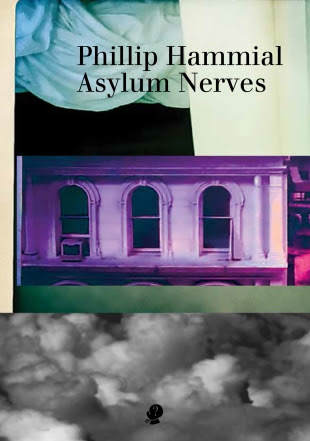
Asylum Nerves: New and Selected Poems
by Philip Hammial
Puncher & Wattmann, 2015
Poems don’t need condescension any more than we do. If we pick up a book and the poems come to life only at a certain page, maybe it’s our brain that needed a refresh. Philip Hammial is certainly up for a refresh of everyday culture: of foodie-ness, for one, such as in the high school project scene of ‘The Float’, where food is garbage and his art teacher gives him an A; or the vegetables of death in ‘The Vehicle of Precious Little’. There are enough stories in his poetry – represented here through a selection from twenty-five collections – to replace a whole bookshelf of novels.
Hammial is a poet of at least two turns, meaning that he follows Jasper Johns’ ‘legendary instructions’: ‘Take an object. Do something to it. Do something else to it.’ If we substitute idea or concept for object, there arises an interesting comparison between poetry like Hammial’s and conceptual poetry (or between Johns and conceptual poetry). Where Hammial tropes narrative or theme, and Johns appropriates images which are then recycled, we might ask whether conceptual poems take a concept and do nothing to them, or do one thing. If we think of the best-known examples – Kenneth Goldsmith’s book-length Day or Traffic – there’s a satisfying radicalness in thinking of them as pure curation: of zero intervention. This is, of course, not the case: the poems have undergone at least one action of ‘something’: the medium has changed, the original newspaper and broadcast are published in book form. Yet other texts, such as Goldsmith’s ‘The Death of Michael Brown’, underwent at least two modes of change: an autopsy report given as a reading, its language has also, according to Goldsmith, been given ‘minor tweaks’. What of another press-worthy conceptual work, Vanessa Place’s Gone With the Wind tweets? Are they, as tweets of a whole novel, following Johns’ instructions or not? There is a change in medium, from book to internet, yet the twitter constraint of 140 characters means that the tweets are fragments. Is this one thing or two? Perhaps it’s a new grey area. Perhaps this is too circuitous a way of saying that different kinds of poetry can be criticised in simple, broad terms as having done too many – or not enough – things to be interesting.
For my money, Hammial is generally on the money in his selection (I’d drop the unlively ‘SOS’, though). The prose poem ‘Possessions’ tells of a man who carries his belongings inside himself, including his clothing and his dinner, which he then eats. The following poem, ‘Runners’ features a man wearing ‘fish shoes’ who is winning a race through a river, ahead of men wearing ‘rabbit shoes’. But then we learn that the race takes place over equal amounts of water and dry land: the winner, then, is ‘anyone’s guess’. (This impasse of equality is overcome in a later race poem, ‘Grand Prix’, where it appears that ‘a bicycle built for seventy-six’ nuns will beat ‘a bicycle built for twenty-two’ monks.) Less satisfying is ‘Wheels’, about a man with wheels who has them surgically removed to ‘stand on his own two feet’.
Hammial’s prose poems mean narratives and characters. There’s a lot of men, or, as Avital Ronell might say, a lot of loser sons – the better kind, who have read and understood Freud. Take the narrator of ‘The Country Is Belgium’, who appears to be trapped in a nightmare tennis contest with a ‘huge man’ named Flowerkranz: ‘I always lose’, he says. Or there’s Anthony Glitz, the patient of Dr Eva Plotz (a memorable woman character), who when taken to the woods to release his demons can’t, in the event, let them go. The drive back to the city has Dr Plotz surrounded with demons and detritus, as if an allegorical victim of the helping professions—such as academia. Yet, while Ronell’s sons are defined by fighting with their fathers, Hammial’s narrators – in the enjambed poems – are often haunted (if haunted is the right word when the dead have a physical presence) by their mothers (their grandmothers are another story).
Poems such as ‘Of Tubs, Sailors & Inflation’ and ‘Mad About Me’ resemble late Ashbery in their claims and tone, but both rely on narrative intentness and circularity. The latter is a signature move of Hammial: there are enough examples in this collection to suggest an alternative grouping, of poems that repeat their beginnings and those that don’t; whereas Ashbery relies on a particular enunciatory drive. More interesting is ‘What I Do In A Horn’, which flirts with aspects of lyric – address, persona, feeling – asking us what kind of person is saying this, and what is their situation? The scenario of being in a horn (what kind of horn, exactly?) is described in tones and terms by turns Borgesian, cliché, practical, novelistic, pathetic, parodic (of who? Beckett?) and tricky:
In a horn I find
the false notes & put them
out of their misery.
In a horn I reach
for a brook, to strangle it before it babbles
my shame, dirty and rotten.
In the horn I examine the stomach contents
of a fruit fly & come to this conclusion: food
is a fool’s game.
In a horn there’s a knot
that you can’t untie; I can,
but I won’t.
The poem’s last anaphoric stanza is the Kafkan ‘In a horn / I’m home safe’. A horn can be both corner and room, where ‘Beautiful it is to be unnoticed’, as Kafka wrote in a letter (Ronell calls Kafka ‘perhaps the best of the loser sons’).
A short lyric about ‘Money’ is not about doing things, but about the truth and image of getting rich: a rhyme implied, yet not supplied till seven lines later, by the first line: ‘It’s in a ditch.’ It might seem old-fashioned to think of money as having material substance, for the rich at least; for me there is something profound and timeless about this poem with its rich people jigging hand in hand, distant from the dirt they once had to climb in to get the money; but I can’t help seeing wigs and knickerbockers.
Hammial writes unusually smooth poems, keenly attuned to vowels and consonants. The alliteration of ‘Filthy because first, I fell from a family/of fifty’ is soft because of the fricatives, yet is further lightened by its patterning of ‘i’ sounds (‘Getting Clean’). In this passage from ‘Correspondence’ there is a shifting interplay between i, o, t, c, m, oo, l, g and p sounds:
Could
it be cyanide? Bite at your peril. I’ve lost
my appetite. Which is just as well because the party’s
over, the last guest leaving with my children
in tow. I’d like to go too but don’t have a ticket,
turned away by the conductor, the locomotive hissing
in the moonlight as its huge wheels slowly, reluctantly
begin to turn, my garden
ground to a pulp, Their nourishment
comes from elsewhere. From
Constantinople possibly …
So what? Well, the musically pleasing aspect of the poems is part of an overall effect of (ironic) mildness and subtlety, a thoroughgoing consistency which perhaps contributes to the reason Hammial’s work has not been given significant attention (admittedly relative in the poem-abnegating paradigm of public culture). Even the topical extremities of (Prime Minister) ‘Howard’ on all fours, or the sarcastic ‘Can’t/ afford to be concerned about a few reffos when / xenotransplantation risks are spreading epidemic / diseases to the whole of humanity / us included’ (‘Talking Trash’) end up being, ultimately, pleasing. This might go down well in places where pleasure has an intellectual cast. But our bourgeoisie is not good at enjoying anything that strains the brain. A ‘very major’ poet (quoting Martin Duwell on the back of the book) is a more appealing category than a plain major one, and an alternative to John Forbes’ notion of a minor major one. Yet any kind of major poet – good or bad – to be major, has to be discovered by an audience at some point.
We look overseas for international poetics but we have poets from the U. S., Asia, Africa and Europe living here. Originally from the U. S., Hammial has lived in Australia since the 1970s; his poems aren’t always indicative of place, but North American life is a distinct element in some. Perhaps Hammial is better thought of as an international poet, though there are, potentially, diasporic and postcolonial readings to be made of his work. It’s easy to imagine a version of Hammial being feted in Europe or elsewhere. Writing well is not enough, as all Australian poets realise quickly; what we do with that realisation determines whether we persist (as Hammial clearly has), and with what grace. Hammial’s career is comparable with that of π.O., in that both have published most of their work with their own presses—Island Press, in Hammial’s case. This hasn’t prevented a number of short-list appearances, but has perhaps limited his work’s distribution and critical reception. (Unfortunately, this Puncher and Wattmann selection of his work has spelled his name as Phillip rather than Philip on the cover.)
I get the impression that, in mid-career, Hammial attempts to up the ante with In the Year of Our Lord Slaughter’s Children. Poems from that book feature an anal sex exhibition with a Comtesse that gets grandmothers off (‘Grandmothers’); a vulture trainer (‘Discipline’); ‘Junkies who spank’ (‘Soft Targets’: still using that circular ending, however); and a gang-raped ‘Lucy’. The troping of narrative gets bleaker, too, as in ‘Bicycle’, where a five year-old ages sixty years while bike-riding through wars and ending at an open grave. That is the freedom of poetry: you can do anything but get attention. Doing more means more only; every prolific poet has this problem. Asylum Nerves feels like a lot of Hammial, yet as a selection from over twenty books (and seven new poems) it’s actually a fairly strict sampling. It’s still, perhaps, too generous. A few tickles, a few pokes in the eye, that’s all we need. Which is this?
Party
Bring your favourite corpse to the party.
Fun & games for everyone.
I take mother.
Egg & spoon: mother in a swoon,
I shuffle to the finish line.
Pin the tail: blindfolded & spun around three times,
I pin it to mother’s stomach.
Fox & geese: foxy lady, I’m the goose again.
Tag: levitating, she can’t be caught.
Treasure hunt: mother the treasure,
she can’t be found.
Parcel-parcel: unwrap my prize, she’s it.
Three-legged race: legs tied together,
we finish last.
Or if you like the language of cryptic crosswords and getting caught in the rain, try the beginning of ‘Cattle’: ‘Big wise cattle don’t / jell’. ‘Wig Hat On’ is a standout for reading aloud; its conclusion a chiming (with the poem’s beginning, natch) definition of a poet: ‘A big time singer / who could with a hatchet do’. Ouch, we might well say, for not only is writing well not enough, nor is assembling books of well-written poems. There doesn’t seem enough differentiation between the books excerpted in Asylum Nerves. A more severe selection – or infinite other organisations – might have been more suggestive of the energy that is in the poems. I find myself longing for metacommentary: ‘I took this poem, then I did x to it, and then I did y to it.’ Do the poems speak for themselves, or to themselves?
*Michael Farrell‘s Cocky’s Joy was published by Giramondo in 2015. His scholarly book, Writing Australian Unsettlement: Modes of Poetic Invention 1796-1945, was published by Palgrave Macmillan.
**From Cordite Poetry Review at http://www.cordite.org.au
 To Koskino
Great post. Enjoyed reading. Thanks for the share.