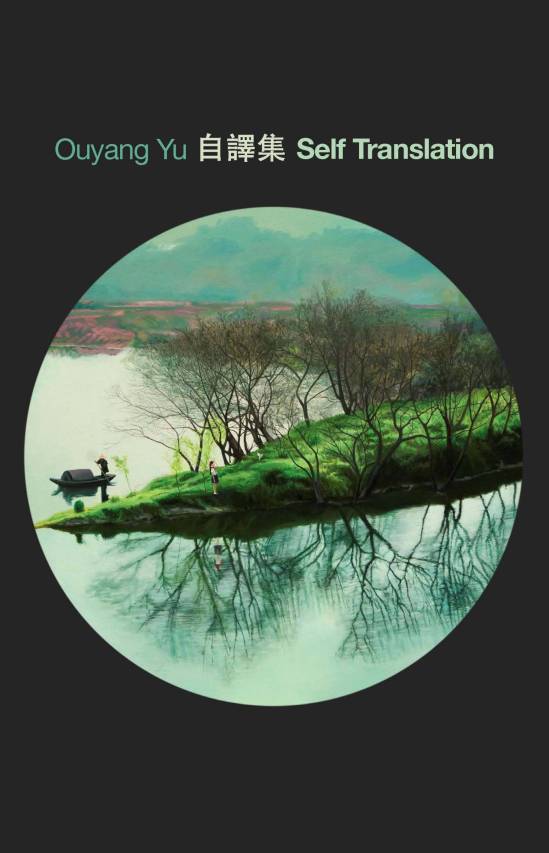
In the ambiguity of Ouyang Yu’s title, Self Translation, we can read not just a creolised or transformed Chinese Australian self, but two selves: a Chinese self on the left page and an Australian on the right. Nor are the two selves completely discrete. Yu’s poetry is as central – and essential – as anyone’s else’s to Australia right now: if the concept of centrality is useful. My point is that he is not just doing his own unique thing, but is writing Australian lyrics that state ‘the death of nature is most beautiful’ without being obvious or obviously ironical (‘Beautiful Death’); he can also begin a poem called ‘Christmas, 1993’, with the line ‘this is the season of death’. In Yu’s poetry the excoriation of the nation is rejuvenated; in ‘Song for an Exile in Australia’ Yu writes, ‘in a loveless season in Australia’, ‘in a poemless season in Australia’ and, in a brilliant image, of ‘the/wheelchair of imagination’. But it’s not all bleak. ‘On a Sunny Noon’ is a hilarious take on the migrant poem:
on a sunny noon
i was eating
a delicious fish head
sucking
its eyes
one by one
it was
the head
of a fish
that used to swim
in the murray
Racism is a continuing theme in Yu’s poetry, one that receives innovative treatment in ‘My Country’, which sympathises with a ‘filipino woman … yelling: back to the philippines!’. Here the going back (from Japan) is presented as the migrant’s desire. The poem is further complicated by its allusions to Australian national literary tropes. The title of course recalls Dorothea Mackellar’s poem of the same name, whereas the ending: ‘you bastard, my country!’ – aimed at China – recalls Xavier Herbert. As indicated there is an occasional bleed or fissure between the selves of the book. In ‘The Double Man’ (whose name is ‘australia china’ or vice versa), Yu puns on ‘Motherland’ and ‘Otherland’ (the latter being the name of the journal Yu founded and edits).
But to make this pun, where ‘Mother’ loses its ‘M’, Yu writes the English word and the letter ‘M’ on the Chinese side also. ‘At Dusk’ gestures to further mobility, with a note that is parenthetical on the Chinese side only: that the lines could be read in a different, suggested order. The Chinese version of ‘The Train’ ends with an exclamation mark but not the English, whereas ‘My Country’ ends with an exclamation mark in English but not Chinese; and while there is apparently a Chinese equivalent for ‘Marlboro’ in this poem, ‘extra mild’ is given in English on both sides.
Further, in ‘Zero Distance’ ‘zero’ is a word in the English title and poem, but the number ‘0’ in the Chinese. Yu also occasionally uses phonetic Roman versions of Chinese words, such as ‘hua’ for China and ‘ao’ for Australia, which are the names of ‘two women’ in the poem of that name. The romantic and the sexual are both present in Self Translation but as distinct concepts. In ‘Zero Distance’, Yu writes ‘Human relationship … It’s the standard thickness of a condom’, and in ‘No Title’: ‘When the English language comes flooding in/ I’ve lost my memory// The 5,000-year-old structure collapses overnight/ As my tongue straightens like a penis’. The poem points to the relation of language to memory: ‘Pretty soon, I’ll forget my parents/ And brothers altogether’. Yu brings a refreshing oddness to the oddness of Australian poetry when he writes lines like: ‘i take you/ in my arms/ as a mother/ caressing her baby/ a mature baby’ (‘Untitled’). Another ‘Untitled’ poem aligns the phrases ‘some become lines of poetry’ with ‘fish enter the arts’.
The book ends with three visually exciting poems that combine Chinese and English, self and self. ‘The Double’ translates line by line; it plays thematically with alternation, with black- and whiteness. ‘My Sadness’ begins with a quote from a letter by W.B. Yeats to J.M. Synge that Yu has translated, followed by the English original; the poem translates from an Irish and French context to Yu’s Chinese Australian. The final poem returns to the double bilingual mode: except that both sides include Chinese and English, alternating. The poem is a meditation on Robert Frost’s ‘The Road Not Taken’, which encourages the monolingual reader to take both roads (poems) by reading the Chinese or the English back and forth from left to right pages. The last stanza in both poems is in both languages, with the word ‘taken’ taken from English and replaced by Chinese, and placed in the Chinese text on the left. Finally the poem ends with an extra line in English in the left, mainly Chinese stanza: ‘There’s nothing you can’t do that you do’. The blank that corresponds on the right is our yet-to-be translated future.
*From http://www.cordite.org.au
 To Koskino
Reblogged this on Manolis.