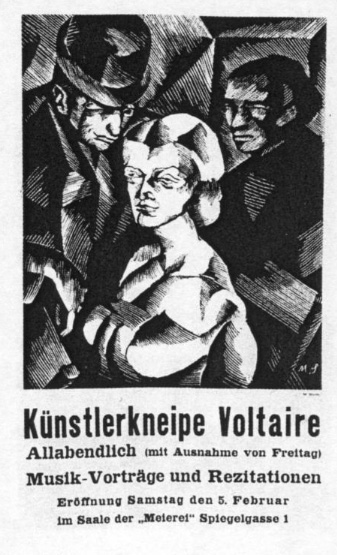
One hundred years ago the poster attached here signalled the first evening of cabaret Voltaire which was also the start of the DADA movement, come help us celebrate the anniversary of this event
on 5th Feb 2016 around 7.30 pm.
In “Some Velvet Morning” 123 Queens Parade, Clifton Hill.
Performers: Razor Hope, Jeltje, Peter Murphy, Ashley Higgs, Sjaak de Jong, Anna Fern, Santo Cazzati, Harry Williamson
Also the launch of the second “Audacious” CD, and if it’s anything like the first “Audacious”, this promises to be a truly wonderful event:
Friday, 29 January, 7pm @ Under the Hammer, 158 Sydney Rd., Coburg!
The history of the Dada movement is imbricated in the lightning-fast intellectual break-through set off, simultaneously and independently, in various parts of the world by several groups of young artists, writers and philosophers: in just a few years, from 1916 to 1923, it was to shake the aesthetic foundations of the period, be they traditional or avant-garde, and set off a revolution which, from surrealism to pop art, would in half a century upset our vision of the world.
A somewhat unexpected announcement appeared in the Zurich press on 2 February 1916: “The Cabaret Voltaire. Under this name a group of young artists and writers has formed with the object of becoming a centre for artistic entertainment. In principle, the Cabaret will be run by artists, permanent guests, who, following their daily reunions, will give musical or literary performances. Young Zurich artists, of all tendencies, are invited to join us with suggestions and proposals.”
The Cabaret was inaugurated three days later in the back room of the Holländische Meierei, a popular tavern located in a seedy section of Zurich. Jan Ephraïm, the owner of the establishment, turned the job of emcee over to Ball with the hope of attracting a large audience. Ball took as his model the Parisian cabaret tradition, born with the Chat Noir in 1881, which he associated with the cabaret spirit that had existed in Berlin before the war. For him, no one other than the emblematic figure of Voltaire could play the role of godfather for his association. It was from the pamphleteer and master of satire that he drew his vision of a reality radically out of step with its time.
Refugee artists from all over Europe quickly besieged the scene at the establishment. Emmy Hennings, a German singer and Hugo Ball’s partner, sang her own songs as well as many from the repertoires of Aristide Bruant, Erich Mühsam and Frank Wedekind. Those individuals, who were to become the “hard core” of Dada, were present from the beginning of the Cabaret: the Alsatian artist, Hans Arp and the Romanians Tristan Tzara and Marcel Janco. Richard Huelsenbeck joined the festivities on 11 February 1916 at the behest of Ball, who had met him in Munich in 1912 in connection to the Der Blaue Reiter group.
 To Koskino