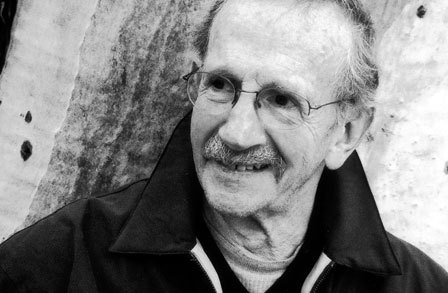
Philip Levine was one of the leading poetic voices of his generation, “a large, ironic Whitman of the industrial heartland,” according to Edward Hirsch. The son of Russian-Jewish immigrants, Levine was born and raised in industrial Detroit, where he began working in the auto factories at the age of 14. As a young boy in the midst of the Great Depression of the 1930s, he was fascinated by the events of the Spanish Civil War. His heroes were not only those individuals who struggled against fascism but also ordinary folks who worked at hopeless jobs simply to stave off poverty. Noted for his interest in the grim reality of blue-collar work and workers, Levine resolved “to find a voice for the voiceless” while working in the auto plants of Detroit during the 1950s. “I saw that the people that I was working with … were voiceless in a way,” he explained in Detroit Magazine. “In terms of the literature of the United States they weren’t being heard. Nobody was speaking for them. And as young people will, you know, I took this foolish vow that I would speak for them and that’s what my life would be. And sure enough I’ve gone and done it. Or I’ve tried anyway.”
Levine earned his BA from Wayne State University in 1950 and began attending writing workshops at the University of Iowa, as an unregistered student, in 1953. He took classes with Robert Lowell and John Berryman, and would later pay tribute to Berryman’s teaching influence on his development as a poet. Levine officially earned an MFA from the University of Iowa in 1957, and later that year won a Jones Fellowship at Stanford University. Shortly thereafter, he began teaching at the University of California, Irvine, where he would remain until 1992. Levine also taught at Columbia, Princeton, NYU, Brown, the University of California at Berkeley, and Tufts.
Though Levine did not return to live in Detroit, its people and economy would remain central concerns of his poetry. Critic Herbert Leibowitz, commenting on Levine’s 1980 National Book award and National Books Critics Circle award-winning collection Ashes: Poems New and Old, wrote: “Levine has returned again and again in his poems to the lives of factory workers trapped by poverty and the drudgery of the assembly line, which breaks the body and scars the spirit.”
Continue reading →






 To Koskino