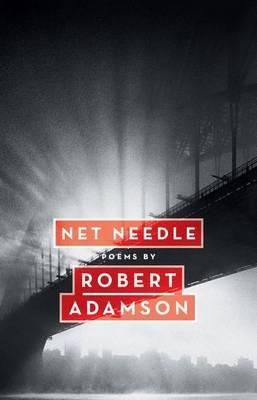
Net Needle
by Robert Adamson
Black Inc., 2015
Net Needle begins with the thoughtful interlacing of seven poems. The first poem, ‘Listening to Cuckoos’, highlights the bird’s ‘two unchanging notes’ during the start of spring. Then, ‘Summer’, with its ‘pallid cuckoo call’ through the poet’s garden threads into ‘Garden Poem’ and how sunlight spans the course of a day until ‘patches of moonlight’ travel into the next poem, ‘Dorothy Wordsworth’. Here, we find the Romantic poet’s sister ruminating near a window where the moon moves ‘across the star-decked dark’. Adamson then cites Emily Dickinson in his Blake Prize-winning suite, ‘Via Negativa, The Divine Dark’, as its praise of ‘life with broken words’ treks meditatively along the banks of the Hawkesbury River. The remaining two poems in this first section linger on waterfronts, but this time ‘a spear made of bone’ (‘Colonial Whaler’) comes to rest beside a tale of the Blues Point fishermen – ‘holding bone / net needles’ – who once, Adamson explains, ‘stitched their lives into my days’ (‘Net Needles’).
Within this small sample of poems lies Adamson’s central oeuvre: the Hawkesbury, birds and animals, fish and fishing, youthful memories of Sydney and of refuge, brutal weather, devotion, and linkages to other writers who have helped shape Adamson and his work. Sunlight and nightlife, the threat of bushfire, faith and questioning, as well as nature in abundant twittering and skittering come to life within these pages.
Each time I read ‘Via Negativa, The Divine Dark’ I am reminded of the beginning of Ray Lawrence’s film adaptation of Peter Carey’s, Bliss.2 In ‘The Coriander Fields of Long Bay Penitentiary’ he writes:
I swallow, nothing’s
left of my pride—
the prison doctor stitched
my cut wrists
without anaesthetic,
his idea of punishment.
Laying with a blanket
on the bed-board,
I think of poppy fields
in the high country of Tasmania,
sun-splotched red blooms
loaded with seed,
their hairy stalks raked
by a wind from Antarctica;
here in my black slot,
an imaginary whiff
of opium mingles with
the bitter aftertaste of iodine.
For Adamson, however, a true high is found on or under water. In this section of Net Needle he explores the many freedoms Sydney’s bays and wharves provided him in his youth. The city’s ferries, boats, deckhands and fishermen figure largely alongside a profusion of marine life. An inventory includes blackfish, yellowtail, ribbonfish, mullet, bream, carp, garfish, whiting, leatherjackets, John Dory, angelfish, whitebait, squid, seahorses, blue-ringed octopus, starfish, stingray, prawns, pink nippers, lobsters, crabs, periwinkles, jellyfish, penguins and bull shark; as well as Sydney’s iconic shark nets, ‘sepia kelp’ (‘The Shark-Net Seahorses of Balmoral’) and fishing bait. But these poems are not simply catalogues; in ‘Sugarloaf Bay, Middle Harbour’, for instance, Adamson envisages the renewed threat of a bull shark after the fatal attack of a woman in 1963:
On windless mornings, the bay
stretched tight, a glass drum,
as if waiting for the vibration of an
unknown force, some dark fin that might cut
a pathway to civilization.
Part three continues Adamson’s discourse with other writers. Here, he muses over Saint Augustine, William Blake, Michael Dransfield, Sonya Hartnett, Pierre Reverdy, Arthur Rimbaud, Percy Bysshe Shelley, Randolph Stow, Francis Thompson and Francis Webb. These poems focus on dreams, fantasy and nightmare, as well as the suffering and conflict of those marginalised, isolated or itinerant writers included here. Adamson’s attention to vagabond poets is best encapsulated through the Rimbaudesque proclamation: ‘I’ll be a clever vagrant / and continue to wander / as the dream repeats itself’ (‘Sensation’).
Net Needle winds down in its final section with journal-like poems that mainly investigate unusual encounters, often with animals, when Adamson is either alone or without friends and family for company. The most notable of such meetings are fable-like and include the death of a pair of tawny frogmouths, the transmigration of a whiting that the poet had caught and eaten for dinner, and wombats ‘doing the double shuffle’. Adamson peppers this section with a myriad of birdlife that adds to his powerful repertoire of ‘avian spirits’ (‘Carnaby’s Cockatoo’).
Net Needle is in many respects a continued dialogue of familiar themes in Adamson’s long career of poetry. Stylistically faithful to what works for him, Adamson is not a writer who will go in search of fresh terrain for each new book. Instead, it seems as if he is writing an extensive book one segment at a time. This great book’s variability of water, its tracks of animals and flight paths as well as the trails of memory, spill over and on to each new page. We have come to appreciate this about Adamson and his ongoing keenness in writing about his life on land and water, and of what he has been meditating on since his last collection. In addition to his enduring passions, Net Needle appears to bind a portion of a rich life into one text; conveying the impression of someone who wants most at this time to share his boyhood memories. His choice to do this here through the medium of poetry rather than memoir enhances and amplifies the intimacy of such disclosures.
1. Dir. Ray Lawrence, Bliss, 1985, Umbrella Entertainment. ↩
2. This chapter of Adamson’s life is beautifully recounted in his memoir, Inside Out, Text Publishing, 2006. ↩
*Libby Hart is the author of Fresh News from the Arctic, This Floating World and Wild. Fresh News from the Arctic won the Anne Elder Award and was shortlisted for the Mary Gilmore Prize. This Floating World was shortlisted for the Victorian Premier’s Literary Awards and The Age Book of the Year Awards, and longlisted for the Prime Minister’s Literary Awards. This Floating World was also devised for stage and received the Shelton Lea Award. Wild was shortlisted for the New South Wales Premier’s Literary Awards and it was named one of the Books of the Year for the Australian Book Review, The Age and The Sydney Morning Herald.
***From Cordite Poetry Review at http://www.cordite.org.au
 To Koskino