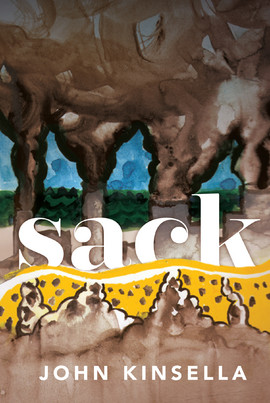
sack
by John Kinsella
Fremantle Press, 2014
In the first rabbit poems by the late J S Harry, her rabbit-character, Peter Henry Lepus, is thrown into a number of desolate or alien environments. Peter is ‘dumped … on the Desert of Sense’, ‘comes to … FORTY-THREE BLENDS / OF DUSTED-OFF & SUNDRIED RATIONALISM’, and ‘gets lost in “Calcutta” / on his way to visit Farmer McGruber’s vegetable patch.’1 He is displaced most comprehensively in the middle of Iraq, 2003, a warzone that amplifies his naïve and interlopic perspective. Such meaning-deprived contexts let Harry explore belonging, identity, and the stability of concepts themselves. In the poem, ‘Small & Rural’, for example:
Peter L. is twisting
this way & that
time-jumping
in & out of the texts he is – here – there –
squatting briefly, to sniff the air above
– when he comes to a paddock which pens similar ontological indeterminacies to those of his self. There exists, firstly, the paddock’s OED-style meaning: ‘a small field or enclosure, usually a plot / of pastureland, adjoining a stable’; then its poetic meaning, which incorporates geographically specific information; psychotherapeutic semiotics; other things ‘the word paddock’ could stand for; the word’s etymology; and the behaviour that this entire network facilitates or does not facilitate. It is important for Harry’s Peter, perhaps because of this semiotic vulnerability, that ‘the pads & stink’ of predators like ‘the dog fox & vixen’ remain absent from these paddocks. He is also only a rabbit, after all.2
We can consider the paddocks of John Kinsella’s sack to be constituted by a similar ontological indeterminacy. However, Kinsella’s are utterly littered with the kinds of hazards that worry Harry’s Peter. In Kinsella’s poem ‘Peter Negotiates the House Paddock, 1965’ – as far as I know, Kinsella’s Peter is not a rabbit, and is unrelated to Harry’s – there is ‘bent deadwood threatening to grow, and kinked tetanus-wire of fences’; there are ‘gwarder and dugite’ snakes, and ‘in hollows … foxes and rabbits plan for the coming crops in related but contrary ways’. Not only hazardous, Kinsella’s paddocks contrast to Harry’s as they are simultaneously fecund and bisected by man- and tectonically-made divisions: ‘Lines of bricks buried up to fetlocks show whole garden- / beds ready to be.’ (Later, in ‘Penillion of Stanbury Moor’: ‘Segmentation / Of field – flection / Of plastic bound / Bales; that moss-stoned / Vista across / The weir’). They are paddocks powered by the inexorable earth, and they transport the providential history of local lore.3
Kinsella’s ‘Peter’ poem ends with a reflection on ‘this’ poem and how we might interpret its particular attitude to history:
This is not
a photo. It’s a black and white rendering of a discoloured
world. But there’s the light, the suffused light around Peter
wheeling through a world remade for him.
Penumbral imagery, and that of grey-zones, suffused light, haloes, and negative space, fill sack. It suggests that environmental conditions and effects, as much as bodily material, constitutes objectivity. Like Wittgenstein’s ladder, ‘this’ poem is merely a beginning and must be discarded if we are to proceed to life. There is always more, and, in sack, more is more connection, not more content. It vigorously reanimates old forms and past lives, and its subjects are revealed in expressionistic dash-strokes:
Gunhorse. Rifle scabbard
slung alongside saddle, weighted
level with horn, slung on latigo
straps, stock towards skull,
angles for ease of drawing
the Winchester lever action
to hell-for-leather
from the mount. (‘Gunhorse’)
Objects are both the main players here, and merely many small epicentres of the action.
Similarly, Kinsella turns something like the ‘desolate grey’ of A D Hope’s ‘Nation’ to affective productivity at a cosmic level.4 In ‘Penillion of Grey’: ‘Evening grey / will have its say: / Total presence, / Complete absence’. In the immediately following ‘Penillion of Summer Grey: Wheatbelt Fire’ – one of many poems in sack set within the wheatfields of Western Australia – the concept of grey is articulated with human complexity. Grey, as the poem’s epigraph quoting Delmore Schwartz intimates, is a kind of becoming-strange.5 It is what we observe when we cannot yet accurately entitle the phenomenological state of play.
There: suspended
In still air dead
As heat growing
Stronger, making
Greyscale of the
Colourworld, the
Hot depression
Of combustion
In the wheat swirled
Overheated:
Single bright spark
From header rock-
Strike sets golden
Crop’s test-pattern
Out of kilter:
Such warm colours
Colour channels
For flammables.
From a distance
The luminous
Dread of absence
And its presence:
The charred, ashen,
And forgotten. (‘Penillion of Summer Grey: Wheatbelt Fire’)
We are left with this post-colonic dump of grey deadness (‘charred, ashen’) yet before that, and after, the poem’s enjambment emphatically accents the bushfires chemical reactivity.
Kinsella’s meditations proceeding from, or within, this world of ‘duns’ – like in his earlier poem, ‘A Cardinal Influences Peripheral Sight’ where duns join ‘browns’ and ‘scoriae’ as synonyms for confused or pre-cognate meaning – mark two significant elements of his poetic.6 First: writing the duns-world (also dunce-world, à la Pope) allows him to import memory, fantasy, research, and politics free from the burden of interpretable accuracy. Kinsella stages the collation and transformation of these elements in poems like ‘Pillage’, which compares the eco-conscious conceit of aluminium-producing conglomerate, Alcoa, to the childish notion that moving tadpoles from their mining-threatened natural homes to ‘an old concrete double-sided washtub’ is ‘a kind of liberty:
[…] We’d observe tadpole conversions.
Alcoa mines bauxite. Aluminium comes from bauxite.
Each act of extraction is lexical and contrite as donation.
No E. M. Forster requirements for narrative
are needed to tell this story. Its outcomes.
Though the sensation of frogskin on your skin
was more than citation. And it is with more
than ‘shine’ that we touch aluminium.
This attitude of detached awareness is inherently eco-logical, and leads to the second, mundane, element of sack’s grey-zone/duns-world poetics: the extraordinary is located at the familiar; the universal at the particular. Grey/duns is not exported or implanted. It is the by-product, and quality, of systemic phenomena. Like his real-life property, Jam Tree Gully, Kinsella returns grey/duns to nature, where ‘nature’ is itself in free and organic play.7 Consider ‘Penillion of Tuning the Harpsichord (for J Mattheson’s Harpsichord Suite no. 12 in F Minor as tuned and played by Dan Tidhar at the Fitzwilliam)’, whose very title portrays the deepening of a singular event into poetry, and suggests that symphonic music is possible from any one thing:
Legomenon
sounds out of tune
but in syntax
attunes hapax.
Such temperaments!
Circle of fifths.
Helix of fifths.
Spiral of fifths.
Each of the collection’s forty-four penillions embarks on this graceful, centripetal dive. The constancy of sack’s elemental comingling necessitates our use of adjectives like Orphic or Miltonian. Something like William Blake’s marriage of godly form and human sensuality at the plane of secular reason is parodied, inasmuch as ethics comes before all philosophy, poetry and god. Every organic thing occurring symbolically at the human level is included in this ethics. (Take Stephen Kinsella’s cover image: a geological cross-section showing fossil fuels extracting below and factory smoke bellowing above, with the book’s title partially buried at surface level). Fittingly, the snake, as totem, slithers through sack as mediator, a negotiator between these worlds. The poem, ‘Sleeping with a Southern Python’ hints at the conjugal-best that earthbound beings can do in reaching for divine (ethical) union. Its Python attempts camouflage, ‘working / black and gentle yellow-olive into the orange of gravel, / willing the gap to close’.
In a world where Everything is dealt with, the structure/s of the book is/are propulsive constraints. In Part I, called ‘Pigs’, longer-lined free verses respond to animal, mineral and ecological life. Part II, ‘Penillions’ is a collection of that Welsh verse form which consists of four lines per verse, four stresses per line, and is traditionally improvised in public competition to a tune played on harp. (Kinsella’s compositional modification involves improvising to the rhythm of his own quotidian footsteps). 8 Part III, ‘To the Letter,’ consists entirely of a poetic letter to WA poet J. P. Quinton, and is, in part, a play on the ‘letter to a young artist’ genre.
The title, sack, indicates this collection of poetic styles and subjects. But this very observation confirms a theme: the removal of elements from their ecosystems (i.e., they’re sacked, like a quarterback in American football is called sacked when he’s tackled); a traditional Welsh verse form that is made contemporary; a tadpole is put in a bath; AC/DC’s Bon Scott is studied in his role as ‘shit factory’ attendant (in ‘To the Letter’); and, in ‘Penillion of the Burning Shed and its Tenses’, the repetition of two lines – ‘And so we learnt / The shed is burnt’ – in each stanza removes the described event from its context and allows it to be the bedrock from which incendiary elements fly.
The collection’s eponymous poem suggests that this action of sacking involves violence, analogises violence, and that sacks contain evidence of violence. Sacks tear and ooze, ‘all trauma and extinction’. This mutilated imagery and these images of mutilation receive sanitised reiteration throughout, but they do not disappear. ‘How many times / have I told this story?’ Kinsella’s epistolarian asks:
I mean,
it was comparative religion,
it was universal truth,
it was more than my Blake-brain
could process. Process. Degree.
Commodity. Production. Surplus.
[…]
The growth of the poet. Food security.
The last line here, almost the last of the collection, juxtaposes two of sack’s persistent matrices: the environmental decimation and politics associated with the latter, and the ever-stranger connective vision of the former.
1. J S Harry, Not Finding Wittgenstein, Giramondo, 2007, pp. 19-33. ↩
2. Harry, Not Finding Wittgenstein, p. 34. ↩
3. For almost two weeks leading up to the Meckering earthquake of 1968, with which ‘Peter Negotiates’ deals, eyewitnesses reported strange geological events, such as the earth rolling as if it had waves beneath it, and swallows holding strange meetings on balconies. See ‘Bulletin 126’ of the Geological Survey of Western Australia (1980) ↩
4. A D Hope, ‘Australia’, Collected Poems 1930-1970, Angus and Robertson, 1972, p. 13. ↩
5. Kinsella chooses the lines: ‘Strangeness grew in the motionless air. The loose / Film grayed’, from Schwartz’s ‘In the Naked Bed, in Plato’s Cave’, Selected Poems (1938-1958): Summer Knowledge, New Directions Publishing Corporation, 1967. ↩
6. See John Kinsella, Peripheral Light: New and Selected Poems, W W Norton & Co., 2004, p. 111. ↩
7. The property is the scene of his last collection, Jam Tree Gully, W W Norton & Co., 2012. ↩
8. See Kinsella’s ‘On Penillion: A Brief Extract from a Work on the Form’, in Spatial Relations: Volume 2, ed. Gordon Collier, Rodopi, 2013, p. 99; also, Cennard Davies, ‘Early Free-Metre Poetry’, in A Guide to Welsh Literature, c. 1530-1700, ed. R Geraint Gruffydd, U of Wales P, 1997, p. 85. ↩
*Simon Eales was born and lives in Melbourne. He recently completed a MA on Australian satirical poetics at the University of Melbourne.
**From Cordite Poetry Review at http://www.cordite.org.au
 To Koskino