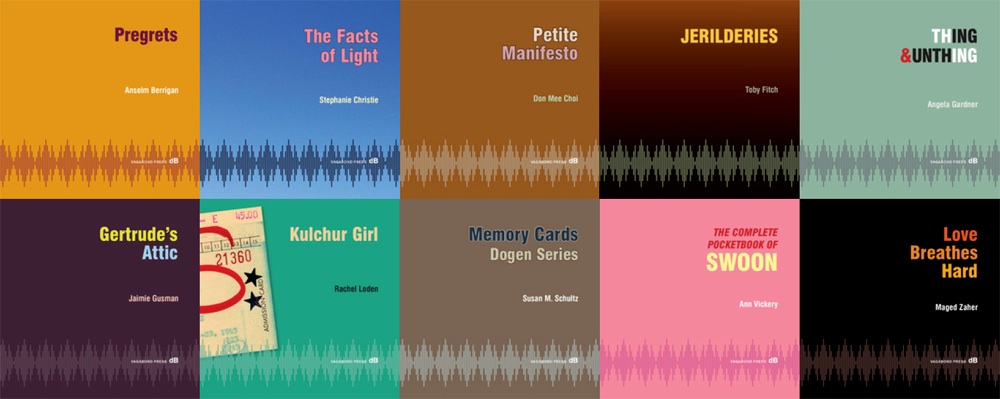
These ten tiny tomes from Vagabond Press each speak (squawk, swoon, glitch, muse, lyricise, confess) of how there is something not ticking precisely inside the reality machine. Or perhaps these books shine light onto how we’ve all gone slightly spectral within our anthropocenic phantasmagorias, lost and unmoored in an experiment that’s become dreadfully strange. Some of these books turn exclusively toward the world, others perhaps come from particular critical engagements; each serves to extend conversation both on what poets do, and what poems are for. Collectively, they map the uncanny infrastructures of all-too-human behaviour and the results are bewilderments, unsettlings, detours and dérives across netherworlds to which most of us haven’t a set of keys. There is enough in this first pack of deciBels to generate joy, dissent, close (or distant) reading and, ultimately, celebration – another step by Vagabond Press into the future (wherever that may be), and led by the fleet-footed Pam Brown.
Thing & Unthing by Angela Gardner
Angela Gardner’s elegiac thing-poems act like ‘breathing the phenomenal / world to shadows, to speckle righted // on the retina’; indeed, these texts are tracking devices monitoring a perhaps delirious odyssey:
the day a broken head, the car a ship of fools
*
In this telling
the sky is weighted
we drive south into ochre and bruise
the hills just an outline fading
These lines – are they end-stopped or enjambed, or both? – jerk us through unstable weirdness, with Gardner modulating precisely. So often, these haunting and defamiliarising noirs trigger an immediate wish to re-read:
It is the end of the road.
Just beyond the hotel
the high tide has been obsessively collecting.
It throws up
a headless seal
plastic bottles
a car tire.
The woman behind the bar says
‘this weather will turn to crap later
We make beer rings on formica
and look out the window
Gardner’s explorations of immanence are startling, revelatory, the poet not so much punctuating as puncturing appearances mistaken as realities. So many of these images have an afterlife, returning semi-coherent and artefactual, resonating long after each page is turned. Yes, this is a book of careful engagements interrogating how ‘ideas start to cluster around objects’: the Queen Anne chairs have ‘firmly muscled legs’ and ‘sun shines closest to childhood, now remembered as longest, warmest’, but Thing & Unthing is also an existential meditation. While early in the book, ‘the body is incoherent’, and the poet showcases just how garbled our intimacies can be, in the final poems Gardner shifts her gaze skyward, apprehending the ‘Pull of air (collective sky)’ as if to scan not only the strangeness of a mundane world, but also beyond.
Love Breathes Hard by Maged Zaher
As if a vivisectionist, Maged Zaher cuts into ligatures connecting friendship and intimacy. The book is sectioned – three parts, three narrative modes – and the initial aphoristic lines are disjunctures onto surreal vistas:
I come with few stones.
We are due from the dialectic by hovering over potential
lovers.
And accepting that the blood of the dead will appear as our
favorite cloud.
Some of the lines are arresting (‘You think of something to say and I imagine my madness turning into a statue’) while others act like stents to effectively keep the narrative pumping (‘I move my dreadlocks to see you as if coming from afar’). Sometimes, the poet seems to deliberately subvert desire for each line to be a spike in the cardiogram:
Day in day out I hear the voices of arrows.
I prepare canned beans for breakfast and wash my clothes.
I am ready for war.
These disconnections spatially extend Zaher’s themes of lovelessness, yearning, violence: by sitting alone, stark and unadorned, the lines are non-unities that, in the next section and like the lovers, come together. Indeed, the second section shifts to an epistolary mode – an ‘X’ writes how they ‘hope you had a lovely visit to Seattle’ before shifting quickly toward confession:
I like your mind especially, and I like how you look and I
love your poetry
Knowing that you haven’t kissed anyone in two years makes
me feel very special
There are three letters here: perhaps responding to ‘X’, a ‘Y’ imagines ‘it is impossible to love in this vast country we live in’; ‘Z’ next responds: ‘obviously I am falling for you somehow – obviously I am scared because of my insecurities’. So it is, from the disconnection of the first section’s aphorisms, that we are shifted toward a sequenced narrativity of X-Y-Z (happilyeverafter, etc). These are the formally faltering movements of individuals shifting toward not only connection, but also communion: ‘I actually don’t care that much about sex – I do – but I don’t – I am more interested in love’. The final section, a coda, takes readers into zones of sentimental eloquence, the lyricism of coupling:
This is not about seduction
It is about hanging out tonight
While surrounded by capitalism
It rains
And we call it love
This continuous threat of collapse.
This, then, is love in a time of commodity fetishism; amid ersatz things, a survey of the real and affective body of an intimate other.
Kulchur Girl by Rachel Loden
Introducing her book, Rachel Loden indicates the provenance of these texts: attending the Berkeley Poetry Conference in 1965, Loden tells us: ‘I took notes on whatever pleased me, occasionally leaping from the spoken words in the room to others of my own invention, with no duty (at the time) to anyone but myself.’ This book, then, is an epigrammatic self-portrait, each page recording polyphonies of voices spliced with the poet’s wandering responses. The style is implicative, the texts a kind of disjunctive reportage:
30 June
All the talk about writing has been vanity.
What is “serious”? I suspect it is something bad writers
sit around and pretend to be.
Lovely fakes, the Stones. Bringing me as close to pleasure
as I can come today.
Silver shoes. Black rain.
Dropping names into her non-narrative (‘four hours a day – // two with Robt. Creeley two with Charles Olson. // Tonight, despite extreme exhaustion, I’ll go hear Robert Duncan read’), Loden’s 50-year old notes employ apprehension as an imprecise technology; primarily, these fragments demarcate a cabal of ‘serious’ writers presenting at a conference and a 17-year old marshaling the perimeters, asking ‘In there a way – in?’ On occasion, the starstruck Loden (who attends the conference ‘a few days after turning seventeen’) enters the domain of her poet-heroes, at which point the notes become feverpitch:
To have Creeley talking and reacting to me?!
He wrote what I said on the board – said it was important,
said he
believed me, he agreed. God.
– and, later, ‘GINSBERG JUST BORROWED 2 PIECES OF PAPER FROM HERE’. In essence, this book is a reverie that diarises experience alongside quasi-profundities: ‘Nothing happens except what is happening’. Recording the event, this is recording-as-event; Kulchur Girl is a poetic bildungsroman portraying a teenaged narrator sometimes feeling at ‘home with these people’ while suffused with those energies of becoming ‘part of what happens’.
Pregrets by Anselm Berrigan
Early on, these sound-bitten vocal simulations ask, ‘why would a human regret shit?’ Throughout the book, Anselm Berrigan remains disinclined toward answering his own question, proffering instead glitching texts that catalogue irreal dreamscapes as if recorded by an affectless droid requiring immediate technological assistance:
I’m not going to run away with the icon
a local wall explained, cautionary Europe
trip, bedding affects between strangers
but the picture plane is being fucked with
by the playground, flat blue bag of floating
snacks just walks itself away, the big bleeding
studio comes down
On and on the Berrigan-droid roves and drones, without need for pause, crossing instead the ‘constant hungry undulating surfaces / formed by a shit-ton of remarks, all invisible connections’. On and on, into the mashed-up, non-narrative, liminal, libidinal, theatricalised grey-goo of textual arenas that seek to organise (perhaps, but who can be sure?), to:
[…] fuck the organic exactitude
of the model! Unless, too, Rhyme is made from
oil, fabric, paper, enamel, pencil & synthetic
polymer paint with necktie, fuck it as well!
& fuck gently the sordid sorrow of fractional
& promised gifts, diversion to scroll, the
establishment of incomplete unity would like
its finked deproductions back […]
Touring and Touretting its way across a tableau of recognisable things, this is the Berrigan-droid’s ‘survival as flatness’, where one line after the next means (necessarily?) that it is poetry we are reading and where incoherence is the highest aesthetic value. As per Berrigan: ‘bon / voyage metaphysics!’ File under Anthrocidophilia or Deathstar poetics.
The Complete Pocketbook of Swoon by Ann Vickery
Ann Vickery’s The Complete Pocketbook of Swoon hits an entirely different timbre, the poet taking up a cerebral stance in poems ticking like bombs. The title surely doffs toward Bernstein’s ‘The Klupzy Girl’, in which:
Poetry is like a swoon, but with this difference:
it brings you to your senses)
Instead of bombs, then, these texts are perhaps a kind of Triage. Vickery tells us in the first three lines of the book how:
This is just fun-size confectionary,
pet-name or a pose generator, to palliate
the impracticalities of play
Yet these texts are neither minor nor mere confections; in the first, ‘Swoon in Miniature; or, The Youth’s Pleasing Instructor’, Vickery’s encompassing gaze lights upon the spectres of Heidegger, Shakespeare, Bowie and a host of others; in this poem-as-Wunderkammer, the critique seems anti-yob and voicing revolt, an enduring shriek of concern for what we may have become: psychically anorexic but feasting nonetheless on ‘Digestible elements of a dickybird world’. Vickery’s fractious, rebarbative style is always a sharp read:
Wind-up lips at the fountain of youth,
standing pixelated in the Radiant Light
spray. I claim my five minutes
of hegemony, you slightly more.
Tear-streaked, we wander through
Ovid, deep culture on your shoulder.
Art’s shade to cast one more version.
To build from hazelnuts a small estate,
A measure lined with elaboration
The Complete Pocketbook of Swoon is an intertextual mosaic of glinting remnants from across canons; Vickery has sampled and remixed from tropes, dictions, genres, to create a Steinian (‘a mirror is a mirror is’) or perhaps Frankensteinian suite of texts in which affect, or vignettes thereof, seems largely abandoned in favour of traced contours of an ‘endless short circuited ghosting’ of spectacles. What seems clearest is that Vickery is not interested in taking readers prisoner with totalised accounts of individual experience; just as ‘Affection never did find a home where it wanted to stay’, these non-lyrical texts flare up as if ‘goosebumps on the earth’s curved hide’. Vickery weirdly hits all the high-notes of abjection; this poet-as-reader or reader-as-poet seems to scorn lyric traditions (truth, beauty, etc) as clichés, as nothing less than master narratives promulgated by regimes. Instead, this is a book floodlit with zeitgeistful attenuations of a changing world; its style both tracks and promotes the shift.
Gertrude’s Attic by Jaimie Gusman
Like Maged Zaher’s book, Gertrude’s Attic is divided into three parts, each part thematically organised around the simple things one might locate in an attic (Heirlooms, Scraps of Lace, Drawings). In these estrangements, Jaimie Gusman employs an openly Steinian style (and indeed a sampling of Stein’s language) to deliver glidings and gildings, associative and often hilarious near-narratives:
Goshdarn animal spikes.
Goddamn apple jam.
I should have used these stilettos
for other thoughts besides murder, sexual encounters, the regime.
I miss all things even though they are simply things.
The zaniness here is mirthful: ‘Gurgle the wings, knife the flower. / A stubborn bloom sprouts like a veil’, Gusman writes, lines swarming with image-as-automata and carefully groomed non sequitur. There is much to this work that seems whimsical, dream-like, perhaps allegorical: a narrator drapes a ponytail (someone else’s) ‘over my shoulder / in the shower / like a gorgeous / elephant trunk’; a couple adopt a dozen baby watermelons; an altar hosts its bride-swallowing groom; and writers name birds after sexual positions – ‘The Snowy Plover, the Common Moorhen, the Pomarine Jaeger Dark Morph’. Gusman’s charm-filled paraphernalia are apolitical enchantments: amid the fizzing frisson of mundane interconnection, here is a poet celebrating their sensorily overloaded mind amid the patterns, textures, and shapes of sundry objects.
Jerilderies Toby Fitch
Toby Fitch’s part-archive takes two objects in particular (Ned Kelly’s Jerilderie Letter and his famous helmet) and verbs and verves proverbially, bullet-proofing against empire-inflected antipodean creation myths. Sampling from and selectively redacting Kelly’s letter, Fitch never simply breaks syntax into wilful (perhaps feral) non-sense; these ‘Jerilderies’ are bewilderments if, by that term, we can agree with the etymology: to bewilder is to thoroughly lead astray, to lure into the wilds. On the first page of this small book, Fitch provides a key to his analytic, redacting all but white space:
– though by the time we arrive on page 39, Kelly’s helmet is corrupted into a pixelated version:
Beyond ‘the English yoke’, Fitch is urging technologised readers to understand how Kelly can be a still-relevant icon of transgression (but of course) and, breaking new territory through erasure, seems to act coronially, reanimating Kelly’s wish:
to acquaint you
with the spewy ground
speedy dispatch to
Kingdom Come
Fitch is enshrining Kelly as our alternative monster-originator, running wild within the boundaries of a recently-occupied domain. The poet extemporises on the Irishman’s plate-iron armour as a first iteration of the antipodean sublime, stumbling through scrub to fill the nightmares – and, later, mythologies – of transported versions of polite society. This deciBels book is loud with a straggling fury, and in the final pages Fitch simply selects verbs from Kelly’s letter:
assisting belonging
commanding mustering
boiling turning getting s
ending showing
obtaining stealing bush
ranging living warning
reading reading giving
warning
An implication seems clear: readers are being lured onto wilder grounds of a conversation about just who it is that we, the ‘wrong-footed’, may be. Like Kelly, we the alter-occupiers are stumbling yet.
Petite Manifesto by Don Mee Choi
‘What spectacle does an Asian eye behold, you ask?’ Often, in Petite Manifesto, lexical matters obscure Choi’s spectacles; one wonders which manifesto is ever petite? From the outset, the author delivers an associative and punning, politicised, carnival-esque prose style:
I was sangfroid and so I sang Freud and dragged out joints of cliché – say we, may we accept sherry? Manegg was born innately. Let me put an end to son envy and colonialism with natalism – that was my intention, ambition. Nevertheless, I stand up to urinate and wave hello in my halo of amniotic trance. Ugly egg, chicken-sized, and natally late. At any rate, you have one (or several). It’s not so much that it preexists or comes ready-made, although in certain respects it is preexistent.
Raucous stuff, though readers may be inclined to ask: are these prose poems, or ficto-critiques (writ large in Choi’s work are themes of neoliberalism-gone-wild), or Sebaldian montages, or Wikileaking exposés (‘A while back, I submitted a short poem by Kim Heysoon called ‘A hole’ to a U.S. literary journal’), or subaltern stylisations shot back at an empire, or Steinian/Kleinian kiss-and-tell-alls, or a kind of slapstick wisdom literature, or a fervidly antagonistic écriture féminine (‘During and after the Korean War, my mother feared going out of the house for fear of being raped by Yankee soldiers’) or, simply, word salad (‘Betty=Bitter=Butter=Batter=Better=Butter=Bitter’)?
The Facts of Light by Stephanie Christie
‘I’m afraid of the new weather’, Stephanie Christie begins, continuing:
and the passivity of witness.
Our real sickness grows resistant
to penicillin and metaphor.
If poetry is indeed a ‘song of omission’ – and in this Christie signals intellectual sympathy with Marianne Moore – then these free verse lyrics suggest a poet stopping from saying too much while at once confessing to how, as a species, we are ‘crazy for self-reflection’. Perhaps Christie is locating toads of affectivity within these imaginary gardens; some of the poems seem as if manias, others tranquil (or tranquilised) reflections. Many enumerate those minutiae distracting us from what the poet perceives as an impending ‘ultraviolent catastrophe’:
Our personal god, our personal debts,
blind dates blossom into blind relationships
you feel meaningless
but it’s impossible to do nothing,
so you stick close to the house
and torture yourself in imaginative ways
If indeed these are confessions, the poems are revelations of disequilibrium both personal (‘my very best dystopic mess’) and collective, Christie contextualising the human project as ‘smaller / than land, weather and ocean / and survival’s the only mastery’. These poems about love, belief, action, and cataclysm interrogate not only how ‘Living spills consequences / all over your dress’ but oddly and authentically celebrate how ‘The fuck-up’s exquisite’.
Memory Cards – Dogen Series by Susan M. Schultz
Appropriating quotes from Moon in a Dewdrop: Writings of Zen Master Dogen and using these as starting points, Susan Schultz’s prose poems are of a different order altogether to those proffered by Choi: what is remembered by this poet is that ‘You are neither sentient nor insentient’ (Dogen’s call) and that ‘I am the sentence that I write. My sentence walks across the screen like a mountain in its folds’ (Schultz’s response). Each poem, taking its cue from the Zen master, is in turn a cue for readers to look and memorise vistas Schultz memorialises as impermanent: ‘The mountain erodes like anger, trees at odd angles, an unrazored chin’. Written over six weeks (each poem footnoted with, presumably, the date of its arrival), these chatty eschatologies are explorations and elaborations (of space, affect, connection) which poke holes through appearances as if anamnestic divining tools:
Although mountains belong to the nation, mountains belong to people who love them. Mountains lean like mothers […] If memory writes fact, we are tattooed skin, nerve, synapse. We know the mountain exists because our brain has been altered by it.
This collection (is it visionary? Revisionary?) uses a bagful of lenses to look and then look again: ‘Eidetic means ‘what we see’, John says. What is visible is marked. Think of what inhabits your losses now’; populated by sons and daughters, sick athletes and neurologists, mothers staring inside restaurants, dogs, birds, a deaf cat, a cat comb, knives and mountains everywhere, these mantra-narratives resist clear sense-making and this seems precisely the point: performing an internal logic, each page is filled with a lifetime’s evidence of not-knowing, each of Schultz’s texts an elliptical and energetic shift toward silence.
*Dan Disney teaches in the Literature program at Sogang University (Seoul). This year, his critical writing appears in Orbis Litterarum and Axon; co-translations appear in World Literature Today; book reviews appear in Antipodes and Verse; poems appear in The Warwick Review and Postcolonial Text. He is completing a book of villanelles.
*Taken from Cordite Poetry Review at http://www.cordite.org.au
 To Koskino