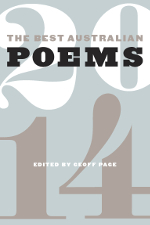
Best Australian Poems 2014
Geoff Page, ed.
Black Inc, 2014
Being in and of one’s time (in favour of it, in fact) means producing work that is sensitive to the discursive furies of the day – the atmosphere of mutating code that the poet must stick to poems in new and strange forms. All else is nostalgia and denial. No-one knows what it means that Australia’s imperial republic, whose god has finally been revealed as cosmopolitan capitalism, is, in the history of colonies, still in its infancy yet so impressively seems to be approaching an end of days. If you’ve got burnt chaps and a warm six-shooter (cowgirl), these are exciting times.
Being a pundit of poetry in my locale I have read and heard many poems this year, both incendiary and flatulent; of all that I thought were great, few (fewer) have made it into this book. The Best Australian Poems is a curatorial exercise, and in this era of the professionalisation of poetry and the gorgeous megalomania which attends it, inclusion in this annual anthology has become for practicing poets a career necessity, and for the retiring a source of kicks from appearing in what is looking each year more and more like an annual Christmas newsletter of Australian poetry. This one reads like an Almanac of Australian Family Poetry Written This Year and Liked (and perhaps slightly corrected) by Geoff Page.
The pursuit of poetry and poiesis has always been for me an erotic one; life is compelled to seek out other forms of life for generative encounters, and this seeking is impelled by various annihilating impulses that gives Eros its devouring shadow. The eternal replay of an embalmed ethos in poetry is one of its perverse pleasures, I think. You should read as many kinds of poetry that are anathema to your tastes and instincts as carefully as your daemons and settling breakfast will allow. Alan Gould’s poem ‘Charlie Twirl’ is hilarious. In the ‘crackerjack’ mode of WWII sentimental packaging, it seems written for the connoisseurs and cognoscenti of cuteisms from that era:
This is the Street of Hullaballoo
when poor link arms with the well-to-do,
two Diggers drunk beyond all help,
vast crowds a-sway like ocean kelp.
Buggeration. We’re doing lines of rhyming couplets that shimmy around a dreadfully employed pentameter. Poets should get high on their imaginations, and famous bits of newsreel are fair game as common places in which to situate a poem, but on Boxing Day with a Drambuie in one hand and a well-rolled Champion Ruby in t’other, do you really want to read lines like: ‘to skip and sway and doff his trilby / pirouette his sideways smile, / and signal how all futures will be / made lighter for his style’?
If I want English craft I think I’ll take Sir Thomas Wyatt: from the present I want dirty ontologies, I want play, I want stupefying (‘Il m’a beaucoup cretinise’ – Lautréamont has greatly stupefied me). This does not bar traditional lyrical flourishes from poems that are productively confounding. Michael Farrell’s ‘A Lyrebird’ is a stunning rigmarole of lyrical palaver:
Swift-footed it stops behind a mountain ash.
All genres are destroyed at last.
History, mistakes, swallowed up in a nominal grub.
The slow wild alcoholics of the nineteenth century dare make no reply.
I tip my beak to the sky.
A nest building lament builds up.
It’s humans taking up too much room.
Swift-footed it stops behind a mountain ash.
Farrell collides the incantatory rhythms of traditional forms with the shape-shifting figures of the bush, merging the historical and the phantasmagoric with the kind of hush that can belong to both the lullaby and the nightmare. Our civilisation is a noisy one, and instead of using the lyric to enforce a romantic synthesis of phenomena, Farrell prefers the quiet racket of a sweet sounding and weird harmonic discord. Sam Wagan Watson’s poem, ‘BLACKTRACKER … BLACKWRITER … BLACKSUBJECT’ is warrior-like in the best sense of being engaged physically and metaphysically. What is being tracked is the devious or dubious self that would presume to write in English without absolute guile:
I’m the blackwriter; the blackwriter who can sense the resentment from other
blacksubjects who have been denied the Queen’s diction. With or without the pen,
though, I’m always the blacksubject; the blacksubject scouting out upon an
endless trail of the Queen’s death notes.
The wicked compounds of blackwriter and blacksubject set at a scintillating distance the techne of language as both a trick of colonisation and a trick that can be turned on its proprietors. With fine ambivalence Wagan Watson celebrates being marked for difference, being hunter and hunted, and his inclusion here shows what happens when weapons are put on the market for one cause and then used for another. The word ‘Queen’ has never looked and sounded so insidious as it does in this poem (I dare you to compare it to Jamie Grant’s awed reference to Lizzie in his spitfire poem).
Jill Jones gives us a whimsical through-composition (fugue) of the manifold types and eras of light that come to make up any (every?) confused moment of being, demonstrating that making perception is always already within the logic of myth-making, that we are wet-electrical archives of broiling code through which lymph, mitochondria and coffee bean continue as a kind of droll fission:
[…] And I think the air
has become more opaque
since the 90s, though it’s still
full of movement, of wings
and sound, water, leaves, disgorgement.
Cassandra Atherton’s prose poem ‘Anonymous’ performs the charm of the proper name as a ‘spinning ginny’, troping with a fine skepticism the signal phenomena of identity that is always ephemeral (bound upon the day), contingent upon jealousy, hormones, doubt, spleen and attraction, moving between private and public iconographies:
Names are important. Daphne Du Maurier knew that. Names are identifiers. Signifiers.
Indicators. Of something more. Names say something about you before anyone has
even seen you … John Proctor wouldn’t sign his name but Arthur Miller signed his
on a marriage licence. Marilyn Monroe. Not her real name. First born children are
supposed to like their names more than others do. I have grown into my name.
Atherton demonstrates with aplomb the name and the word as useful fetish, the sticky semiotic burrs that hold us and the world together.
The world, as we know, is a sheer fucking mystery. Language is to us perhaps the most mysterious thing of all; material and immaterial, seductive and impotent, it can create and destroy. A language inherits us and relies on us to keep it alive, so we may ask, what can it do that has not been done before? A vexed question, of course; but all over the shop the kiddies are having a go. John Forbes noted that Frank O’Hara equated the notion of ‘poetry’ with ‘the most original work possible.’ While we cannot escape the divine limitation of tropes (or can we?) the present imperative to somehow make (poiesis) as we remake is a deadly one (a matter of life and death), though we are bound to the finitude of the sign.
Geoff Page seems to think that Dada is a prankster movement that is a century old and to be kept in the prankster cupboard, like the memorabilia of punk youth next to vases commemorating the allied ‘victory’ of 1918.1 He has elided its more vicious sense of permanently wanting to upset art and the complacency of humanism, even as these things have proved culpable in the success of barbarism over civilisation in his precious twentieth century.2 There are some very good poems here, and you’ll find them by yourself, but the book seems to be an argument for a democratic readership that can be massaged by this shared sense of deep humanism and common sense, whereas I feel that poetry as a technology must also be ‘infidel’, to use Daniel Tiffany’s phrase; functioning as a threat to complacency, running fugitive undercurrents that keep tropes turning in unusual ways. Unlike Page in his introduction, I want poems that scare the horses (Wandjina).
Page kindly advises us that the poems have been ordered thematically, for narrative flow and intertextual chat. Judith Beveridge’s poem, ‘Celtic Fort’, which sorts through a general atmosphere of Irishness (despite maself I’m a sucker for it), effortlessly undoes the hygienic practice of thematic separation, addressing as it does place, the erotic, religion, death, animals, the cult of the plough, war – ‘A beloved enemy / charging over the next hill.’ Paul de Man has warned us that tropes are not fixed grids but an unruly system of signs, and I think it is the work of poetry not only to corral signs but also to promote a bolt back to the wild. Hello future. Hello furies!
I think we should collect and collate nostalgic modes of production, but they must be put next to work that is in continual jeopardy of not making meaning, of stumbling into strange territories and confounding us, for this is what motivates flux and change. Without some measure of ‘avant-garde’ action a book like this becomes useless. We need a productive antagonism between modes, between the revolutionary and the reactionary. Page’s decision here not to welcome that which he reads as obscure, difficult or unclear poetry guarantees a dead republic. As a gelding with a paddock to call his own, he seems to find unruly semiotics ‘extreme’ (as his introduction puts it) and wants to protect the rest of the herd from their possible excitations, which he can only read as irritations. Are the crickets serenading or mocking us, Geoff? ‘Australia’ should thrive on feral systems of production; not having the burdens and responsibilities of being a traditional cultural centre for the west, we are free to mutate in ways that should suit us, bother and baffle us. For ‘Australia’ itself is a confabulation, a powerful phantasy of a collective that has been invented and whose meanings are permanently up for grabs. Madness.
This book is largely an exposition of traditional crafts, with certain triumphs of image, musicality and deft display. While it may reward to linger over the urbanity of Peter Rose’s Catullus impersonation, or Anthony Lawrence’s chiseled tableau of Bacchanalia, or Tric O’Heare’s replaying of a tragic muse of summer, I cannot help but feel that this one is headed straight for the op shop.
1. We are fortunate to have something of an episodic Page manifesto more or less coincident with the publication of this book, in the form of his November blog for Southerly. Of particular interest is the ‘Obscurity in Poetry – a Spectrum’ post, which satisfies for the jealous force of Logos the want of a typology of obscurities. His schema is plotted in eight degrees of virulence, from ‘Desirable and Essential’ obscurity, to the ‘Reckless’ and finally the ‘Wilful’, which stands as a kind of ‘code red’ of naughty (against humanism) behaviour. ↩
2. Across Page’s oeuvre there is nostalgia for the twentieth century, with its two epic wars, as a milieu of superior feeling and consequence. This is where it all happened, leaving us with a sense that nothing now can really happen.
*Duncan Hose is a poet, painter and academic scholar. His latest book of poems, One Under Bacchus, was published in 2011 by Inken Publisch, who also released his first collection, Rathaus, in 2007. He has published poems in Cordite, Steamer, 543, Jacket, Jacket 2, Island, Southerly, Overland, and The Sun Herald. His work is anthologised in Outcrop: radical Australian poetry of land (Black Rider Press 2013). In 2010 he was the recipient of the Newcastle Poetry Prize.
Website: http://www.inkenpublisch.com/hoem.html
**Taken from Cordite Poetry review at http://www.cordite.org.au
 To Koskino