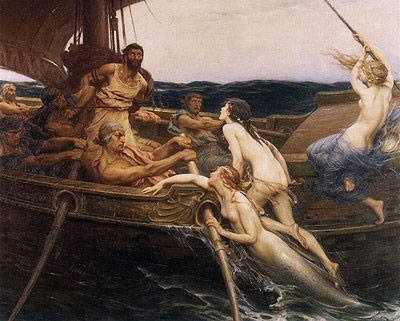
voyage
of dangers
and hardship,
ten years of storm
and tempestuous sea
for Odysseus of Ithaca,
commander of the ship fleet
traveling homeward from Troy.
α ω drunkenness by the shore’s edge at Ciconian Ismarus in the flush of victory’s shout, scattered in surprise,
Libyan promontory’s ‘forgetfulness’ lotus fruit dashes the fresh water mission of patrol party of three,
barbarous giant shepherd of Cyclopes with eye in forehead devours the carcasses of six sailors raw
and Odysseus’s boast that it was he who blinded him led to god Poseidon’s vengeance pledge,
isle of Areolas gracious gift of bag of Winds prematurely opened and their goodwill spent,
in King Lamus’s cannibal land into the pot crews thrown, and the fleet one vessel left,
at Aeaea goddess Circe’s loveless enchantment of food drugged and mischief plots,
god Hermes’s gift moly, a white flower protection, and she bears him three sons,
survival journey to the ghosts of Hades for Teiresias’s prophesy of troubles,
forewarning of the Sirens’ enchantment songs, their bird feet and feathers
sitting in a meadow among the heaped bones of sailors drawn to death,
six sailors snatched to rock by dog-like six-headed Scylla’s whimper,
starving crew steal Sicilian cows and they roast beef for six days
and Zeus’s retribution thunderbolts in sudden westerly storm,
the only survivor of shipwreck, Odysseus drifts to Ogygia,
Calypso’s immortality and youth for five or seven year,
on Zeus’s orders a raft built supplied with victuals,
overboard, then lashed to floating mast and keel,
a disguised goddess seamew beak brings veil,
a protection from the fearsome huge wave,
at Drepane Phaeacian King’s hospitality
and his generosity provides fine ship
incurring Poseidon’s punishment,
arrival at home to discover one
hundred and twelve suitors
courting wife Penelope
thinking him sea lost,
sword battles won,
yet she had not
forgotten her
Odysseus.
LHB
*Homer’s epic poem Odyssey dealt with the story of Odysseus, king of Ithaca. His wife, Penelope, herself had survived the sea with the aid of a flock of purple-striped ducks who buoyed, fed and towed her to shore; impressed, her parents changed her name from Arnaea or Arnacia to Penelope meaning ‘duck’. When she was first asked to decide between her 112 suitors, she referred to a prophesy that Odysseus would return. Penelope outlived Odysseus and subsequently married Telegonus, Odysseus’s son by Circe, thus connecting the two branches of family.
(Information from Robert Graves The Greek Myths Book II The Folio Society 1996, first published 1955 by Penguin, reprinted with amendments 1957, London, pp.646-666).
 To Koskino