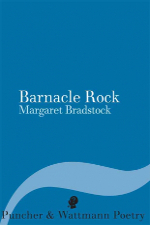
Barnacle Rock
by Margaret Bradstock
Puncher & Wattmann, 2013
Barnacle Rock is time-travelling through poetry. Its significance lies in Margaret Bradstock’s successful inscribing of a journey, from the search for a land of plenty by various explorers, to the position we find ourselves in now: a climate in crisis, a civilisation in error and a country which has displaced its indigenous people, replacing their knowledge with a rusted ‘progress’. Dense, a rich read, it alerts the mind into awareness.
The book is in five sections beginning and ending in the ocean, where, ironically, ‘life’s a beach’. The first recalls those seemingly endless voyages to a place that was half-imagined, ‘the missing continent’, the ‘home of idolators and abundant gold’. We travel with those fearless explorers – Portuguese, Dutch, French and British – who sailed long distances to find the desired land of riches. I think it is interesting to also read this as symbolic of a journey in search of what we as individuals desire – that when found, is easily corrupted, misconstrued, misunderstood – rarely what we expect. The book is a metaphor for the soul’s search, perhaps.
These seafarers saw so many natural wonders – sunfish, new lands of scarps and bush forests –yet Bradstock tells us that ‘the mountains of Illawarra reminded / Banks of the back of a lean cow’, even his ‘transmutant gaze’ saw only ‘anorexic country’ with its bare bones (‘Trompe-l’oeil’). And de Surville:
has his eye on Jewish traders,
pelts, precious minerals
somewhere in the South Pacific,
not this fly-away coastline
with its bleak terrain.
(‘Ships that pass (Dec. 1769 – March 1770)’)
The final poem in this section sees Mawson struggling to reach safety while in:
… the maze
of hidden crevasses, slopes of hard ice
depressions filled with snow,
the soles of my feet come off
with my sock. I tie them back in place.
(‘Mawson: the Heroic Era’)
Beside these struggles for survival there are the tougher battles of ‘the other’: the indigenous –passed over and silent; and the convict, so brutalised, so ‘tired of this life of prison time that passes for real time … you prayed to be hanged’ (‘A Memoir (thumbnails) of Convict Davies, 1824’). What remains from these searches are remnants: Leichardt’s ‘fragments of moleskin trousers’, huts, wrecks, the Mahogany ship, things buried in sand, diaries and perhaps ‘the great harp of the wind’, that ‘might measure the soul of a man’ – while we are left questioning what was found.
Because the first section focuses on history, it has by necessity to fit in information that keeps the reader inside the poem. Bradstock achieves this while not sacrificing poetic craft. Imagery is effective where it occurs, and the free-verse rhythm almost an undulating ocean.
Where the indigenous population was silent, the second section is enlivened with its voices and perspectives, with a sense of its belonging. Yet this is ushered in with a powerful poem on not belonging. ‘The Promised Land’ is one of the strongest poems in the book for its imagery and multilayered meaning: ‘You said you’d “found your spot”’, Bradstock’s speaker notes, yet:
you dive and are gone
in a turmoil of shadow-dreams.
the opaque moon
salty white with silvered snow
reflects only isolation.
The question that drives the poem is: ‘what else were they hoping for … not this panorama of human entrapment … of incompletion, failure, loss / while always pursuing some greater shining vision’.
Poems on the continent’s interior are short, clear and uncluttered. Where the European explorers found emptiness, here it is peopled with old story, meaning-filled landmarks, dreaming. There is a sense of the heart of something beyond the smallness of humanity, a landscape for those in search of soul-country. ‘Desert saint’ or not:
homesick for a landscape
of the imagination, the gaze
of infinite space
a terrain becoming its own icon,
[we] might have dreamed this desolation
this ascetic silence
(‘Mingmarriya Country’)
If I were to choose the strongest poem in this excellent collection it would still be the title poem, Barnacle Rock, last in section II. It could even have come first in the book as a stand-alone section, the ‘mirage of sail’ leading us into the old explorers and their ships; the barnacle representing the creation of modern Australia, the accretion of layering clinging to the Great Rock. Beautifully written, subtly moving, it encapsulates the journey, signposts the stopping points and rings out the message that ripples though the book, beginning:
You will go back through the quiet bush
past Aboriginal middens
rainbow lorikeets nesting
in tree knolls …
And it finishes where:
A man and his shadow
stride across skyline
in the footprints of worn sandstone.
The third section is suburban life with its energy and an underlying uneasiness that something is becoming stilled by it, rusting away. ‘The White Palace’ encapsulates this lack of permanence: ‘I threw out the journal entries / when I packed up my life / and moved on’, yet we know from section I that diary entries are what give us perspective on history.
We move up country, out of country to close-lying neighbours, with powerful poems on Asia and the striking poem ‘Long Phuoc revisited’ – a reminder that modern Australia, too, has played its part in invasive destruction. Definite lines again make multiple meaning:
A subjugated country, they cannot speak
regret or even sorrow
the ploughed fields
seeded with forgiveness.
This section finishes with two deeply moving poems for the poet’s father, ‘Ask not’ and ‘The River’ – in which we are so present in his ‘nights on the Monaro / stars burning like dry ice’, and on the river – the river of many names that eventually carries us all:
You drift in and out of memory
in and out of sleep
a receding tide of the river’s delta
mind sometimes sharper that the oyster beds
we once cut our feet on
sometimes lost in a tangle of the past
tree roots that knot themselves
into the embankments
the eroding silt jetties.
(‘The River’)
Lighter and with some humour, section IV gives us Bondi, Clovelly, Port Macquarie, Sydney Cove, pond life, sea life – all the golden beauty that Australian coast can give, and its hidden threats, from small sea-lice to big sharks – ‘it’s the food chain / and you don’t want to be a part of it’ (‘Shark Alert’)
As we finish that section, ‘Conversations from the bottom of the Harbour’ turns us towards the politics of the final section of the book. Beginning with ‘The catechism of loss’, there are seven intense poems of anger, defiance, regret, and loss. Their messages carefully crafted, they are punchy vignettes of what we’ve brought to the present: Fukushima nuclear disaster in Japan, leaking contaminated water from the Ranger uranium mine, the North pacific Garbage Patch:
… where marine plastics gather
like nylon shirts in the wardrobes of old men
never upcycled, never wearing away
a gyre where nothing escapes.
(‘The sure extinction’)
In the aptly titled ‘How large each death will be’, the poet shows us what we all see and many feel powerless to turn back:
There should be bees, but I’ve seen none this year. Cheated by summer, magnolias are still in bloom not understanding that it’s unseasonal the hothouse effect of constant rain
We are all living, the poems convince us, like the poet: ‘as though my passing shadow / were not the shadow of the world.’ This is a far-reaching book, its craft tight and its scope challenging. Barnacle Rock finishes in heavy territory, but its right to this is well-earned by its growing sense of place and, I’m sure, her growing dismay as Bradstock moves from history to the present, watching the same ignorance and lack of appreciation shape both. From those early explorations to current attacks on natural landscape, an enormous scale of history is covered. And I will resist the temptation to bring this review to a cozy end. We are left justifiably uneasy, rising-anxious:
The days are turning in, a chill in the lambent air like something lost or forgotten, a code mislaid. … Everything is waiting and still this tenuous, fragile feeling like hand-held soapstone sculpture.
*Dr Robyn Rowland AO has published nine books, six of poetry, most recently Seasons of doubt & burning. New & Selected Poems (2010) representing 40 years of poetry. Her poetry has appeared in Being Human, ed. Neil Astley, (Bloodaxe Books, UK, 2011). Silence & its tongues (2006) was shortlisted for the 2007 ACT Judith Wright Poetry Prize. Rowland is winner of poetry prizes, including the Writing Spirit Poetry Award, Ireland 2010. She is an Honorary Fellow, School of Culture and Communication, University of Melbourne, Australia and a member of the National Advisory Council for Australia Poetry Ltd. Rowland curated and presented the Poetry & Conversation Series for the Geelong Library Corporation, 2010-2012. She is currently working on a bi-lingual book with Dr Mehmet Ali Çelikel in Turkey.
Website: http://www.robynrowland.info
**Taken from Cordire Poetry Review at http://www.cordite.org.au
 To Koskino