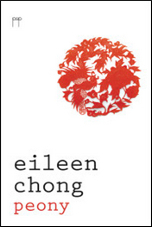
Peony
by Eileen Chong
Pitt Street Poetry, 2014
In a suite of three poems praising the legendary beauty, Consort Yang Guifei, the Tang poet Li Bai draws on the virtues of the peony, a flower that with its luxuriant petals and luminous colours embodies feminine beauty and allure. After Li Bai, the peony became a perennial bloom in Chinese poetry, with the mid-Tang poet Bai Juyi’s ‘Regret for Peony Flowers’ evoking the emotional nuances associated with it: ‘Saddened by the peonies before the steps, so red,/As evening came I found that only two remained./Once morning’s winds have blown, they surely won’t survive;/At night I gaze by lamplight, to cherish the fading red.’ The fragile beauty of the rose-like flower lies at the heart of Eileen Chong’s second collection of poems. In adopting the peony as the titular emblem, she not only affirms the flower as a prized literary icon, but also positions her work in the context of classical Chinese poetry, and in doing so articulates the complex relationship with tradition and origins that has informed her work since her debut collection, Burning Rice.
Chong’s ‘Only a Peony’ carries on the peony poem tradition, sensitive to the literary and cultural symbolism bestowed on the flower; however, it departs from the representations of it as a passive object of beauty subject to the male gaze. Instead, the apostrophic address treats the flower as a living subject:
Peony, Chinese rose, history taught me about you.
You adorn the headdresses of Manchurian princesses,
pinned above tassels that swung back and forth,
mimicking their mincing walk. An upturned bowl placed
under a platform, the sway of hands for balance. A fiction
of bound feet. Were you real, flower of fortune?
The poem questions traditional concepts of beauty in Chinese culture, and explores the intimate secrets of the flower without reducing it to a mere poetic emblem. The poem makes a switch from past to present tense in the succeeding stanzas, establishing a mood of contemplative enquiry, reinforced by a parallel shift from the second-person address to detached observations, evoking in the process not just ambivalent feelings about the flower, but also about the speaker, a modern Chinese woman poet, writing in a foreign culture and in a non-native language, doubly transplanted, first from her ancestral homeland in China, and from her place of birth, Singapore. Chong then wrenches the flower out of its Chinese context, and encounters it anew in a shophouse in her adopted country, where she sees ‘bottles containing the essence of peonies. Pivoine magnifica,/the magnificent peony.’ Here, Chong’s associative eye seizes a cross-cultural moment, juxtaposing Greek myth with Chinese legend, conjoining Paean (from which ‘peony’ is derived), the ‘Healer of the gods’, and Guan Yu, the Chinese martial god whose crimson face is ‘the shade of these peonies before they rot.’ The male gods here are glimpsed through the emblematic prism of a feminine icon, thus in a way reversing the male gaze. The poem ends with a surprising image of the flower appearing on a carpet; ‘a lady friend’ remarks, ‘China’s national flower’, to which the speaker replies, ‘Is it? Am I? I’ve forgotten.’ The conflation of the poet’s subjectivity and the flower recalls the peony’s cultural symbolism, but the questions and the uncertain voice at the end are deconstructive of inherited values.
Chong’s peony poem invokes remote literary forebears, but the affinities of the peony with the rose, and an epigraph from Matisse as well as the reference to the peony as a Chinese rose, reflect a more contemporary tutelary presence: the Asian-American poet Li-Young Lee. In his first collection Rose, Lee rings the changes on the floral image as he seeks to graft his Chinese heritage onto the American poetic tradition that he is now part of. Chong, in the opening poem of her collection, acknowledges Lee as an influence: ‘Chinese Singing’ owes its inspiration to Lee’s ‘I Ask My Mother to Sing’ in emotional theme and trope. In Lee’s poem, his mother and grandmother unite in a song that evokes a lost landscape – the China that they had fled. The use of the present tense, the absence of the father, and the figure of the listening poet suggest a matrilineal inheritance that has shaped the poet’s identity and work. At the end of the poem, Lee is still listening: ‘Both women have begun to cry./But neither stops her song.’ Chong’s poem establishes a dramatic setting of her family engaged in a karaoke session, the grandmother kicking off with her rendition of a song in Hakka, followed by her parents in Mandarin, the lyrics of the song undergoing translation as it is taken up in turns. This generational turn-taking suggests continuity and bond in the transmission of familial and cultural heritage; however, the translation process implies cultural metissage, and the fact that heritage is not possessed once and for all or passed down complete and whole, but renewed and altered in the act of migration. When it comes to the speaker’s turn, she sings not in her mother tongue, but in the language of the former colonisers of a country to which her ancestors had migrated, the only language she is at home in: ‘It is my turn to sing. I don’t know/any Chinese songs, so I sing in English./My family is listening.’ The song brings together three generations and languages, and the interstitial spaces between them create a liminal zone where the issues of postcoloniality, diasporic history, and the tangled webs of personal and cultural identity can be mapped out.
Chong’s ability to fuse the dramatic, narrative and lyric in the balance of line and form – already much in evidence in Burning Rice – allows her to address complex issues in a beguilingly simple way. Her attentive eye fashions from a few concrete particulars a whole mood or situation, and mundane occasions can trigger off sensuous contemplations of love and belonging. In ‘Evensong’ the domestic act and a simple object furnish a sort of ars poetica, mediating the conflicting claims of poetry and domestic commitments, and assuaging the migrant woman poet’s burden of memory and heritage: ‘A poem is a heavy thing. It weighs/as you scrub the potatoes,/rub them with salt, then decide/to boil them instead.’ Culinary motifs, abundant in her debut collection, persist here, enacting the relationship between food, memory and identity. In ‘Rice-dumplings’ the poet and her friend are ‘Reviving the art/of rice-dumplings in an inner-city apartment in Sydney/five minutes’ walk from Chinatown.’ The poem celebrates the food of memory, the contradictions and am-bivalence of being Chinese migrants living in Chinatown captured in the act of food preparation and consumption, as they eat, ‘marvelling at our true selves, so far, yet so close to home.’ With subtle irony, the poem dramatises the complex sense of home and belonging.
Another food poem is ‘Noodles in Hong Kong’, where Hong Kong, China and Singapore come together in a moment of poetic gastronomy made possible by a bowl of wonton or ‘swallowing clouds noodles’. In Burning Rice, the culinary moments revolve around the binary of Singapore and Australia, with spatial memories focusing more on the place of birth. Peony rehearses this binary but the attention is more balanced, and the poems given a more transnational and transcultural spin. The first two sections of the collection are anchored in family history and Singapore, revisiting in memory the places of childhood and resurrecting the figure of the grandfather; and the Confucian reflex in ‘Chinese Wake’, ‘Kumquat’, ‘Death-Houses’ and ‘Release’ enacts rites concerning the dead, foregrounding the poet’s ethnic commitments. While the first half of Peony locates Chinese identity in a Singapore context, the second half is informed by a movement towards global citizenship, as the well-travelled poems cover Rome, Paris, New York and San Fran-cisco, providing a contrapuntal motif to the return to roots and origins.
This transnational or cosmopolitan spatiality reveals an attempt to transcend the Singapore/Australia binary, but the more engaging poems are those that are rooted in Australian locales, more precisely, Sydney’s cityscapes. ‘El-Alamein, Kings Cross’ offers a vivid snap-shot of the iconic fountain: ‘A single child dangles his hand in the water. Mist wets my face/ like a benediction. The seagull bows, then rises in a blur of wings.’ The photographic instant is captured with the visual precision and economy of language characteristic of Tang poetry. The poetry is also attentive to the marginalised: ‘In the corner old Nick kneels before his oiled/wood-box. Yesterday, his birthday; today/the cardboard sign reads only “Home-less/Shoe Shine”.’ This is the heartland of Chong’s second home, and she is staking out her place in these poems of urban topography. In another street poem, ‘The Way Back’, the poet joins a crowd listening to a girl grinding out ‘Waltzing Matilda’ on a music box and is trans-ported momentarily to her childhood in Singapore, before arriving at the realisation: ‘We ad-vance step by slow step, discarding memories like the way back./At some point you must know: the past can no longer be relieved.’ There is a refusal of nostalgia but the feeling of loss and longing abides.
The spatial poetics in Peony offers new readings of place that extend and at the same time disrupt the binaries of past/present, home/elsewhere, Singapore/Australia established in Burning Rice. The naturalness of form, the fusion of image and emotion, the arresting metaphor and phrasing, and the unpretentious language ensure that the themes of love and death, migration and displacement, identity and belonging, are never broached in a portentous way, but are implicit in the occasion and the observed detail. There is weight and heft of subject matter (‘A poem is a heavy thing’), but as with good lyric poetry there is also grace and lightness, like the glass-blower’s art described in ‘Glass-blowing’, where the artisan ‘catches in a gloved hand the clear glass globe/in which swirls a cerulean sea.’ Perhaps Chong’s greatest strength derives from the fact that she is not afraid of feeling, and of capturing it in fitting form and imagery. Li-Young Lee declares in an interview: ‘I value feeling. I think a lot of times in North American poetry there is not a value of feeling.’ This is what Chong’s work offers: a poetry of feeling, rendered in luminous detail and language, alive to the sorrows and joys of daily living.
*Kim Cheng Boey has published five collections of poetry and a travel memoir. He teaches at the University of Newcastle.
 To Koskino