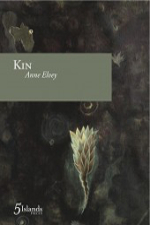
Kin
by Anne Elvey
Five Islands Press, 2014
The kinship Elvey forges between her poems and ecological criticism lends both rigour and reverence to her first full-length collection of poetry. There is a radiant stasis at the core of her poems that encourages the reader to listen to the susurration of multiple, overlapping conversations to which Elvey is contributing.
Elvey is a significant voice in Australian ecological theology. Her research and poetry blog, Leaf Litter, charts a series of important papers and pertinent thoughts about the link between ‘teaching, research and writing as a response to ecological crisis’. The most recent feature of this blog is Elvey’s presentation from the Ecofaith conference in May 2014, entitled ‘On (not) speaking about God ecologically’. In this paper, she considers scholarship on the kinship model, most importantly, extending eco-theologian Denis Edwards’ work on ‘challenging the model of domination and exploitation’. Elvey’s Kin puts into practice Edwards’ suggestion that we ‘have much to learn about kin-ship from the traditional cultures of indigenous peoples.’ Her ‘Claimed by Country’ sequence addresses, in her own words, her responses as:
a non-Aboriginal woman to the places I lived in and visited and my sense
of being “claimed” in part through a practice of attentiveness to the places that
are “country” for their Aboriginal, traditional owners.
She references ‘this practice of attentiveness’ to Miriam Rose Ungunmerr Bau-mann and responds to the Aboriginal people’s practice of deep listening or ‘dadirri’. In ‘Claimed by Country 2’, Elvey contemplates the ways that she is not alone in place or time:
But now,
three trees on the city’s edge –
when the Kalamundu bus lurches
toward Perth, coming into, out of
country, with one hundred and fifty years
of settler shame my ancestors multiplied
on Nyoogah land –
three trees as if
three gnarled concierges
of country is this
the colonising moment
once again? greet me
as if they know me.
I wonder should I call out in return?
In this suite, Elvey puts faith in the relationality of being claimed. She applies a postcolonial ecocriticism in her poetic utterances as she moves ‘into, out of/country’, haunted by ‘settler shame’. Deborah Bird Rose has argued that ‘language is full of ghosts’1 and Elvey’s ‘Claimed By Country’ poems are haunted by the ethnographic voices she enables ‘on Nyoogah land’. The narrator considers adding her voice but she chooses silence, allowing Indigenous subjectivity to in-habit the space.
Silence is a motif made exquisitely self-conscious in many of Elvey’s poems; in this way, the narrator becomes witness to the events. At its heart, Elvey’s Kin encourages listening and reconnecting with the earth and its others. In the only prose poem in the collection, ‘Receiving a past’, the narrator is mute:
I wind a music box with my heart wrapped round the key, to shield the skin of my palm.
It would burn on a sentence spoke, I cannot respond.
The mirror is face to the soil. The frame is filigree. On its reverse ants outline a world.
The juxtaposition of music and soundlessness is framed by the mirror; its shiny front resting on the soil, exposing its ‘reverse’. The chain of ants in the fourth line rings ‘a world’ between Dreamtime and Picnic at Hanging Rock. It is a stunning moment beyond language when, finally, ‘a/small face looks up, mute’.
Similarly, ‘Lamentation’, prioritises indigeneity in an eco-critical claim to attentiveness. The Murray River is referred to by its Aboriginal names ‘tongala’ and ‘millewa’, however, in the final line ‘o murray, o murray’, the English term is prioritised. This demonstrates the long process involved to reach ‘the forgiveness of things’:
the tongala the gongala
in the beak of a gull
threads cotton and rice
too tired to forgive
and sea (does it know)
bends and breaks
ready to admit
the heavy (lifted) metal
o murray o murray
The use of spacing as lacunae on the page, such as those between ‘ready’ and ‘to admit’ and again between ‘heavy’ and ‘(lifted)’ in the final tercet, are metaphors for the halting, weighty moments in the river’s experience. This is a feature also used to dazzling effect in ‘Bent Toward the Thing’ and ‘Nonoq’ to underscore the dawning of an understanding: ‘when to see is to see’ ‘Nonoq’. In this vein, ‘Lamentation’ mourns all that has been swallowed in the process of ‘admit[tance]’ and ultimately, forgiveness. Indeed, Elvey’s Kin is interested in ‘admit-ting’ to things (confession) as well as being ‘admitted to’ a new understanding of things (epiphany).
Divided into three parts: ‘Skin to Skin’, ‘Kin’ and ‘Coming Home’, Kin encourages the tangibility of experience and presents many different interpretations of ‘home’ and what it means to return there. Although the word ‘skin’ is mentioned too often (more than a dozen times) and there is noticeable repetition of the word ‘flesh’, this is because Elvey is interested in a kind of vital materialism. Indeed, Kin explores what Jane Bennett calls:
the fractious kinship between the human and the non-human. My ‘own’ body is material, and yet this materiality is not fully or exclusively human … If more people marked this fact more of the time … could we continue to produce and consume in the same violently reckless ways?1
The body and the bodily are important to the poems in Kin and point to the ways in which the voice is also embodied. This is best explored in the sensual, ‘Plural ecstatic’ where love begins in the ‘a.m’ and continues ‘into REM’. This kind of boundless love is sung in praise of the way in which the body can forge with the elements in ecstasy:
afternoon love
the wind lifts your hair
with rumour of a place other
than your screen. you unbutton your skin
early evening love
the sun drops into the bay.
a dragonfly
trims
the hand-stitched binding of your bone.
The vulnerability of the fragment, ‘unbutton your skin’, coupled with the almost windswept lines where words appear as if they have been scattered like seeds across the page, point to both a wildness and a quietness in the representation of love. It is a love that, in many ways, brings us back to country in Elvey’s poems.
Donna Haraway has argued, ‘material ecocriticism wants to help build on-going stories rather than the histories that end’.2 In Kin, the concept of kinship is recuperative and celebrates the Earth at its core: an ongoing story of patterns and flows; a ‘landscape of kin’ that is infinite.
1.Stated in Bird Rose’s keynote lecture at the Contempo-rary Women Writers Association Conference, Deakin and RMIT Universities, Melbourne, July 2014
2.Jane Bennett, Vibrant Matter: A Political Ecology of Things, Duke University Press, 2010, p.112-113 3.Donna Haraway, The Haraway Reader, Routledge, 2004, p.1=
*Cassandra Atherton is a Lecturer in Literary Studies and Creative Writing at Deakin University. She has published a book of literary criticism, Flashing Eyes and Floating Hair: A Study of Gwen Harwood, Äôs Pseudonymous Poetry (Australian Scholarly Press, 2007), a book of poetry, After Lolita (Ahadada Press, 2010), and a novel, The Man Jar (Printed Matter Press, 2010). She is currently working on a book, Wise Guys, about American public intellectuals, based on her interviews with Noam Chomsky, Howard Zinn, Harold Bloom, Camille Paglia, Stephen Greenblatt and many more.
 To Koskino