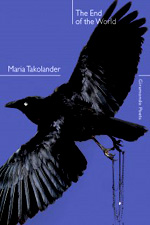
The End of the World
by Maria Takolander
Giramondo Publishing, 2014
Maria Takolander has grouped the poems in this, her second collection, to isolate three slightly different impulses in her work. Because the central section is comprised of poems whose point of view underlies those of sections one and three, I shall deal with it first. All of its poems explore the dark and unforgiving nature of the world. This is the ground of Takolander’s imagination, and here it is unalloyed and unqualified. One group of poems explores the hard landscapes of Finland. ‘Missing in Action’ lists the fates which befell family members: ‘My great grandfather: lost to Stalin’s purges … My grandfather: his heart stopped on the swampy farm in Mellilä/where he dragged up life from the earth after the war … My grandmother: dead soon after she got an electric stove.’ The title poem, ‘The End of the World’, is an impression of Punta Arenas, in Chile:
where mongrels and Alsatians cling to any sex
in the eclipse of foreign trees and under the brittle sun,
and where the cold will not let go of anyone.
Of these expressions of bleakness, one of the most powerful in terms of the nudge and rea-lignment of perspectives – is ‘Convicts’:
Only a couple of hundred years ago, grown men and women
were child-small. Around England, everyone mattered less.
When people were hungry, they grabbed at bread made by bakers
with stubby fingers. When people died, planks were nailed together.
At all times, earth was easy to come by. After rain, bogs sucked
at the bald cart wheels of men and women trying to get somewhere.
In the cities, the cobblestones were grimy with children, drunks
and sluts. For money, some women hung out faded washing.
On the ocean, ships had low ceilings. For sailors, the toneless
creaking of wood and flapping of canvas sounded like direction.
Beneath the barrels of tack, the convicts listened to the magnitude
of the ocean and the wind, fixed to the clammy timber like snails.
Contemporary lives, no doubt, are hard enough. But they are rarely so overwhelmed by the pressures to survive as those of their forebears. Where we have found relief from the worst of these pressures, poets have become fascinated – and appalled – by what seem like the impossibly unforgiving conditions their ancestors had to endure: by how close these conditions still are – and how soon we forget them. One iconic poem in this respect is Philip Larkin’s ‘The Card-Players’:
Jan van Hogspeuw staggers to the door
And pisses at the dark. Outside, the rain
Courses in cart-ruts down the deep mud lane.
Inside, Dirk Dogstoerd pours himself some more,
And holds a cinder to his clay with tongs,
Belching out smoke. Old Prijck snores with the gale […]1
But Australian poets – not surprisingly, when one considers our history – have also been drawn to the tension between lives defined by the conditions of survival, and those in which choices – and even aesthetics – might be possible. Sometimes the tension is implicit, as in the Larkin (the brutality receiving no commentary, but set, nevertheless, against the act of writing), and sometimes it is articulated. In Dorothy Hewett’s late poem, ‘The Brothers’, she imagines:
Those ghostly brothers that I never had
larger than life stalking the countryside
their spittle darkening the dust
ungainly men who never married 2
This is a context not just for her poetry, but for her emotional life. There are many other ex-amples. The whole of Judith Beveridge’s ‘Storm and Honey’ is a meditation on the way the savagery of fishing occurs in an environment of great beauty. One might cite Julian Croft’s ‘Labour and Capital’, about impossible working conditions in the Newcastle of ‘the prosperous fifties when all was well’.3
One feature that Takolander shares with the poets above is that the sophisticated eye is not comfortable gazing at the life it can no longer bear to inhabit. Occasionally, the moral dis-tance is large and straightforward, as in the superb ‘Stalin Confesses’, which attempts to make sense of the paranoid brutality of one of the last century’s key figures – ‘certain only of death,/more biddable than life,/and of how it makes all men sorry’ – by imagining the angry child that goes with him everywhere. Mostly, however – with the exception of some of the poems in section three, which will be discussed below – she, like the others, knows that the distance between observer and observed is not so great: this is a destabilisation – an edge – informing all the stronger poems.
This bleakness continues in part three, but with a slightly different inflection. Instead of a direct confrontation with the unrelieved nature of the world and its inhabitants, the poems focus on grotesque behaviour. There are synopses and exhibits from the world of ‘Cesare Lombroso, Criminal Anthropologist’:
300 ragged-eyed skulls: Abyssinian, Chinese, Patagonian, Italian.
A mummy, drenched in coffee then wrung out to dry.
Models of carnivorous plants, human-sized.
A torn lithograph of a Prussian cannibal.
Pencil drawings by the criminally insane.
There is the story of how the housemaid’s daughter at Curtius’ Waxworks, during the Paris of the Revolution, learnt to take casts from the heads of the guillotined (‘Show Business’). There is a poem about how Charcot’s patients at the Salpêtrière – the hospital to which Di-ana’s body would be taken – had to learn to survive in their brutal, sexualised surroundings (‘Charcot’s Patients’). Instead of being responses to an unforgiving universe, these are stories that Takolander has either gone looking for, or has seized on with the confidence that they contain material she can turn into a poem, and the poems are marginally less strong because of it. They are still good poems, particularly ‘Charcot’s Patients’ and ‘Golden Sigi: An Advertisement’; but they contain just the slightest element of writing for effect – an impression that the author knows what horror is, and that she knows where to find it. Much of Takolander’s sense of the poetic is bound up with the articulation of uncomfortable things: sometimes, there is a stronger sense of this being an inevitable response than at others. Many of the poems in section three concern the appalling practices of early scientists. They do bear repeating, particularly when they are repeated as well as this, but their awfulness is an argument that has been put and won, and the skill and inventiveness of the poems is just that tiny bit undermined by the fact that these are reliable sources of horror.
1. Philip Larkin, High Windows, Faber, London, 1974. ↩
2. Dorothy Hewett, Collected Poems ed. William Grono, FACP, Fremantle, 1995. ↩
3. Julian Croft, Ocean Island, John Leonard Press, Elwood, 2006. or Greg McLaren’s
‘Greyhounds at Dusk’, where the constraints of the Kurri dog-walkers’ lives are set against the thin fierceness of their desire to escape.[4. Greg McLaren, The Kurri Kurri Book of the Dead, Puncher and Wattmann, Glebe, 2007.
It is the first section – comprising poems which are meditations on birth – that raises the impossible question: where can we live? This theme – ‘The Matter of Childbirth’ – does not receive enough recognition as a major new topos, a great achievement of the feminist imagination. One feature of the way it finds expression here is in the degree of distance between Takolander’s meditations on the child – in line with what she knows of the biology of earthly creatures – and the partisanship and forgiveness of the mother. So much poetry is built around the tension between differing points of view: between how we would like things to be, and how, in fact, they are; between the lover’s desire and the partner’s disdain; between the claim, and the ironic revelation. One sphere in which this difference has rarely been allowed to develop is in maternal utterance. Mothers, or so they have been described, are the embodiments of partisan perspective. If a thought runs interference with the way the child is imagined, then it must not, and cannot be entertained. With the exception of lullabies, it is astonishing, in Western cultures, how little poetry of childbirth there has been, until relatively recently. One reason for this may be because the mothers of newly-born babies have not been imagined as possessing minds of their own: as though all instinct and no language, to the extent that they can speak, they are the univocal voices of mother-and-child, and there is little there on which the tensioning of poetry can build. But Takolander, in ‘Morning Sickness’, can read, ‘in a novel by Marie Darrieussecq’, of a woman whose ‘rear-end let forth a litter of mutant-lets, pink and/coarse as tongues and slippery’ and see the relationship to her own pregnancy, ‘the tide com(ing) in, bearing silt stirred from the/fetid sea floor, old with starfish and eel bones. The/moon, for nine months, did not care to claim it again.’ She can lie, in ‘Post-partum’, ‘like an amputated god,/leaking gangrene onto butcher’s sheets.’ She can be, in other words, both participant and observer.
She no longer has to withdraw from language as if she had just participated in a process where language did not go.
Takolander is not unique in this. In ‘Spectacular Motherhood’, Marion May Campbell writes with a similar doubleness, both intimate and ‘objective’: ‘my baby has left me. A million singing hooks tug at me, pull me along the highways to her. As in amorous expectation, my body curves achingly around the space she has vacated. My muscles anticipate her known weight in my arms […] To begin to write about motherhood, I have to dislocate myself, from her, from my self.’1 The mother’s emergence into linguistic self-consciousness is something of a last frontier. We have fought hard over the last few centuries, for the right to think independently about those things for which the only language available has immediately undermined the authority of the speaker – dirty-talk for sex, blasphemy for religion, sedition in politics. For mothers, there was baby-talk, which while essential for the baby, also withdrew the mother from the world of public roles. I am not remotely suggesting that Takolander’s maternal feelings are not in perfect order: simply that, like other poets attuned to their own thoughtfulness, she has not foregone the right to speak with the act of birth. Some of this has resulted from the emergence of a terminology, as our scientific understandings have grown (the word ‘miraculous’, apt or not, did not invite one to consider); some, from a permission to acknowledge her own physicality – and some, simply from insistence on the right to speak. The end-result is a considerable distance between the contemplation of the child and the maternal feeling: the sort of distance in which the dislocations of poetry can emerge, and a further powerful sign, if any were needed, of the restlessness and reach of feminist thought.
Although Takolander is only too aware of the impersonality of the forces that have combined to produce her child, she also wishes to resist that impersonality. Watching ‘the black and white plasma screen’, she writes in ‘Ultrasound’, ‘the bud of your nose alone/makes the universe less impossible.’ In ‘Foetal Movement’, she contemplates the twinned gift of life and pain:
As I watch you shadow box with sourness, radiance and din,
the sources of which you must fear like a medieval Christian,
you make of my belly a theatre for unseen marionettes and
for pain that has no origin – except for the life I have given.
In ‘Sleep’, she writes, ‘How the dark years, those abominable millions of dark years,/Endure in this wombing.’ And continues, ‘When comes the slowing into plangency,//And the sun-quickened birds//Rally and remember to rail,/Believe none of it.//Your brightness, like theirs, is miniature.’ In poems such as this and ‘The Interpretation of Dreams’, Takolander’s poetry cares about the impossible fragility of our gestures:
Within the undead body of our sleeping child
his brain is desperate as a Punch-and-Judy puppeteer.
There are fighting words: ‘Mine! Mine!’
I write them down. But if I were a muse, rather than a scribe,
I would tender dreams that shimmer
like birch leaves and glow like moonstones,
not these darkling hallucinations of a brain
already wiling away the night on its pitiful past.
There is no doubt that Takolander’s is a black imagination. Work that takes the unforgiving nature of the world as its starting point has become an important strand of the Australian imagination – one might cite the poems of Alison Croggon or Stephen Edgar, though the universes in which the imaginations of Robert Gray, Peter Boyle or Martin Harrison operate are hardly more benign. As soon as one has someone to care for, however, the tone changes. Rather than coming to rest, like the poems of section three, on a note of sufficiently-articulated horror, these poems develop a line of resistance, they seek to negotiate with the dark. They have, moreover, an implicit sense of otherwise. Although Takolander never explores it as primary material, some of them bear the background understanding that we do at least try to construct spaces and gestures which hold this horror at bay. ‘Domestic’ is a sequence about domestic violence, from the point of view of the two young daughters of a stricken household. Despite the mayhem and insecurity, there is also a normality which rage has destroyed: the Scooby Doo that the girls can’t watch because the TV is broken; the family dog still watching hopefully from the sidelines; even the ‘squat woman’, a visitor from the world of adult order, concerned for their safety.
It is as if the relative benignity of the spaces we now inhabit have allowed us to contemplate ‘those abominable millions of dark years’ with a directness we never used to allow ourselves – dwelling so much closer, as we did, to annihilation. But now we have these little rooms of respite, and poets such as Takolander are working the tension between their fragility and the forces which surround them. I cannot imagine how we might ever grow used to the indifference that surrounds and enables us – how, now, we might domesticate it in a narrative. The scientists have given the writers an almighty problem. But at least writers such as Takolander have the courage to acknowledge it as ground, and have set out to explore it with the candour and the steadiness it demands.
1.Marion May Campbell, Fragments of a Paper Witch, Salt, Cambridge, 2008. ↩
*Martin Langford’s most recent collection is The Human Project: New and Selected Poems (Puncher & Wattmann, 2009). He is the author of Microtexts (Island 2005), a book of poetics, and the editor of Harbour City Poems: Sydney in Verse 1788-2008 (Puncher & Wattmann, 2009).
**Taken from Cordite at http://www.cordite.org.au
 To Koskino