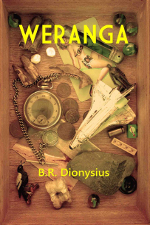
Weranga
by B. R. Dionysius
Walleah Press, 2013
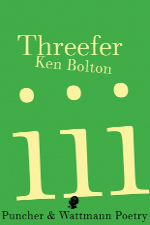
Threefer
by Ken Bolton
Puncher & Wattmann, 2013
Ken Bolton and B.R. Dionysius emerge from different traditions, respectively: a New York School sense of everyday occasion punctuated by the presence and shaping forces of contemporary art (Frank O’Hara and James Schuyler are clearly present in Bolton’s diction); and a modernised kind of Romantic pastoral, littered with juxtaposed objects of the natural and contemporary world. Yet, at admitted risk of over-generalising, both of their recent books can be seen to be dealing with notions of how to write memory in poetry: how to write a poem to be honest to the process, even the implication itself, of remembering. How can language be used in the service of this retrospective vision, they ask; how does language, shaped by differing poetic forms, illuminate, distort or neutralise it?
Threefer extends Bolton’s ongoing study of how to best conceptualise a forever-shifting consciousness. His poetics moves in, and against, a personal and collective artistic and poetic milieu, littered with acquaintances, the urban, the voice of the autonomous poem itself, and the artistic works and figures he admires (even, sometimes detracts):
bland, bleak, Turneresque That old bore give me one of the other great names instead almost any will do Dufy, Picasso Gerhard Richter maybe not Stan Brakhage (‘On Reflection’)
Its three primary poems – ‘Footprints’, ‘On Reflection’ and ‘Some Days’ – point to the book’s title, as in, ‘three for …’ or perhaps (in cricketing parlance) ‘three out for …’ They all adopt Bolton’s characteristically fractured step lines and sense of colloquial, immediate expression in the service of capturing the unsteady, distracted and forgetful mind as it thinks on its own movements, various subjects and the self-aware creation of the poem. Two smaller poems, ‘London Postcard’ and ‘The Funnies’, present themselves in what can be considered a more conventionally structured manner. ‘London Postcard’ is written in four cinquain stanzas, with the fifth a quatrain, reflecting on a photograph and the feelings of self it provokes in the speaker. It asks:
Why such an image will anchor one
And eventually notes how art can end up:
echoing, I suppose, our own anxieties, resolving them in an image of beauty, a balm of solipsism & objectivity, of calm & pity – for ourselves – selves we mend with this distance & identification
Reverting again to the motif of the trio, ‘The Funnies’ cycles through three comics – ‘The Little King, Boofhead, Brenda Star’ – pointing to their ‘true archaic simplicity’, while simultaneously aestheticizing them in the body of the poem. The speaker finds themselves ‘astonished at that innocence’; at what they can come to mean to him despite, or in spite of, their apparent ‘simplicity’. Both of these poems illustrate the broader concerns of Threefer: reflections on art, which are truly reflections of how the self fits into the world; and how seemingly ordinary things, collaged into the poem, can take on a greater significance than their external reality would usually suggest. In contrast to the playful architecture of Bolton’s book, Dionysius’s fifth collection, Weranga, presents itself in sixty-seven poems: each couched in a sonnet-like structure of fourteen lines, in mostly unrhymed free verse that ghosts rather than enforces pentameter. This gives Weranga a clear sense of ordered unity. The consistency of its structure – heightened by recurring references to space and science fiction, animals, the contrast of ‘linoleum’ to the country surrounds, guns and soldiers, oblique references to Greek mythology/history, images of birth and death – lends itself to a compiled narrative. This is a rural, seemingly highly personal, coming-of-age memoir, played against the similar growth of the Queensland region referred to in the book’s title. Its last poem, ‘Bowenville’, quoted here in full, takes a self-reflexive view of the rural setting that has been created throughout the book:
They’ve all gone the way of the Thessalians Remembered for the landscapes they inhabited More than the rhetoric they bled. Guardianships Of the soil come & go; they are the winter rains That never sired. Seasons fickle in their spin. Red weed adds a Martian touch; green arteries Store the fat of the land, all forward thinking. A small girl’s dream fulfilled; dance steps spun, Dust withdraws its argument with lace & skin. It’s curtains all the way to the pink coral horizon. What will they say of this station? It was a fair view From the hill they saw cattle pregnant in their grace; The Bunya Mountains’ spine blue. They saw stars Fall; swollen by the Milky Way’s transformer hum.
Although the ‘landscapes’ may be more memorable than the community’s ‘rhetoric’, it is only through the remnants of this ‘rhetoric’ – ‘bled’, as if genetic or life-giving – that the ‘landscape’ is given any description. This is partly the service of Weranga itself: to dwell on an extended moment in a man’s life through a language which will preserve it; which in its looking to the ‘stars’ will give it a resonance beyond the dirt and grit and persistent struggle – against life, death, sexual growth, boredom, growing up – that fade into vague, even forgotten, memory. As ‘Bowenville’ highlights, it is the means of remembering that seem to curiously relate Weranga and Threefer, particularly in the implications of their differing forms. For each poet, the objects of their poetry illustrate how certain things can ‘jolt him back’ (as Dionysius puts it in ‘Weranga’). Like the cattle grid in Dionysius’ titular poem, the particular shape in a poem’s form revitalises or confuses memory. Weranga is a purposeful reconstruction of memory, its vignettes lending themselves to brief and self-contained recollections of moments, rather than elongated meditations. By persistently returning to and subtly reshaping the recurrent motifs throughout the book, memory presents itself as something in need of being remade. From this controlled retrospection, the various symbols and notions that characterise a life are purposively drawn out to express their shifting significance. ‘Moon’ discusses pregnancy, using the moon landing as a grandiose metaphor – ‘her body, marooned by its own/Elliptical orbit, bent with spacesuit clumsiness’ – in stark contrast to the working ‘men’ coming ‘in for lunch’, whom the pregnant woman must still feed. ‘Stoic’, ‘Hourglass’, ‘Campfire’, and ‘Funeral’, on the other hand, all address the passing of the father: from the moment his ‘stoic’ nature fails him, perhaps partly enabling his death – ‘Nothing could kill him, but himself. His/Cellular rum rebellion took effect’ – to the speaker’s inability to remember the details of the ‘funeral’, which becomes a kind of barely-recalled film:
This is where memory’s spool of film unwound Or the mind’s projector was sun hot & melted Away the organic evident. … This one’s all fiction, all musing Recollection at what took place & what was drunk.
Later poems address a sense of teenage angst and entrapment in a place that, although enormous in landscape, becomes smaller in scope for the growing boy. ‘Tennis Court’ utilises its setting as a metaphor for this limitation. The insects under the lights of the court point suggestively to the life existent in this closed-in world, where (initially) chaste teenage affection blooms: ‘they sat hand/In hand inside the eucalypts’ grey tangy shadows.’ This, of course, develops into something more in ‘And She Was’:
His hands spread across her cover art, Words were naked at their strangeness As melody gave their blood a kick start. Cool young bodies cooked the linoleum As they travelled to a far-flung universe
The patchwork of Dionysius’s book, reading back and forth between the moments of a life narrative, between poems, between the insistence of its fourteen-line form, between speaker and country, between recurrences as they were and what they become, leads to this sense of memory as something to be worked: recreated in a carefully maintained form and language that serve to control memory itself. From the outset, Weranga has an indisputable flow. Dionysius’s lines are eloquently constructed and sinuous, laying themselves out gently, almost caressingly, through his generous use of assonance and the persistent presence of an open enjambment. Diverting grammatical closure line-by-line, they keep the reader sliding on as images and memories of rurality and of childhood fracture, before emerging whole by the end of the poem. And it is this sense of wholeness that is central in Weranga, as if the text, in having its narrative strung out across snapshots of growing up in the country, semantically begins to embody not necessarily the setting or landscape itself, but the emotional nostalgia we bring to any memory of place and the emotional developments, sensations and traumas we associate with it. For this is a collection of poems drenched in nostalgia for the rural, and for the evaporating notion of its isolation in a rapidly technological world. As the central figure grows in the book, he sees the once-unlimited expanse of the country contract before him, stripped back to ‘parts to a mystery’:
Forensically examined, three hundred lots of a life Laid out on the trampled winter grass, an aerial view Of fifty years of obsessive hoarding; some plane crash Investigation team visualizing strewn parts to a mystery. …
Everything to be sold, even drums of old engine Oil, rancid as a tar pit, a sticky black hole from where no Mouse ever escaped. Bargain-hunting, the communicable Disease of the land. (‘Firesale’)
Ultimately, the landscape of Weranga is this cluttered expanse of what is in the poem and all of the things that have been sucked into its ‘black hole’. Weranga is rich in the gradually (de)naturalised space and development of its speaker, setting and language. Yet, there is a lingering sense in reading Dionysius’ book and the imposition of his elected form that there is not a lot of variety in its development. Its vignettes tirelessly move on, shifting focus and moments of time, but never quite expand tonally. This is not to say that its voice struggles for realization in its persistent intonation. Weranga does invite rereading. However, the careful sense of over-construction seems to prevent the imagination from launching beyond restricted logic. With a different perspective of form, Threefer aspires to a more organic, direct presentation of memory, accounting for all its random inexactness, twitching repetitions and progressive distortion over time.
As Bolton writes in ‘Some Days’: ‘“No form, no structure,” & Cezanne/stood very still’. Bolton writes in the book’s notes that the first poem, ‘Footprints’, is attempting ‘to do something similar’ to ‘the CD Footprints Live [which] revives many of Wayne Shorter’s best compositions & adds some new’; while the final poem, ‘Some Days’, ‘was composed in 1999 and much worked on, largely from scraps written in the mid to late 1970s.’ Bolton is indicating a kind of memory-as-collage, in which these ‘scraps’ are still ‘worked’ by Bolton into a controlled shape of unruliness. This shaping occurs by way of punctuation and wandering typography that direct and slow down the reader’s attention – but are nonetheless of its moment, suspect to the poet’s interruption and fragmentation, even if they do happen to produce effects that may strip the poem of some of its desired naturalistic, direct feel. Yet, this effect amounts more to a sense of the time in which the poem was written: the broad spectrum of a cultural, literary or personal moment and the narrative this may elicit, rather than a chronological advancement. Memory, then, never quite achieves the neat compilation in Threefer that it does in Weranga, but Bolton is not necessarily trying to make sense of memories so much as present the moments in which they became present to the poet, and thus become (the) present for the reader:
meaning her thoughts focus on the same things as mind do
(Eva Hesse Rainer Werner Fassbinder – to use them as counters, tokens things skipping constantly between existing in their own right & as ideas, signs
(‘On Reflection’)
Bolton insists on ‘things … existing/in their own right’; that is, being what they are laid bare on the surface on the poem, apprehended by the reader as the material of the poem in the process of being written and being read. Even if these things are somewhat fractured by the discursive language around them, this is to only express the wandering of the consciousness and the easy distractions of, and from, looking back. Appropriately, they exist also as ‘ideas, signs’, pointing to the broader significance that the poem and its scraps, even with direct intent, necessarily attach to these memories. There is a sense of refinement throughout Bolton’s poems, enhanced by his use of ‘found’ or ‘recouped’ materials. To speak generally, it is as if he has always been writing a variation on the same poem: one invested in an artistic and/or social scene, characterised by the poet trying to get started, day or night, while drinking wine and listening to a record, peering at a poem or a painting, the poem looking inwards as it stutteringly develops. ‘Footprints’ even seems to directly reconsider ‘The Terrific Days of Summer’, rhythmically breaking line by line as it elaborates on what a ‘day’ can be:
lists of adjectives for days : terrific days, inelegant days, eloquent days, days, like spring & days like summer, impenetrable days literal days the saddest days days that are stoical, classical or cool
This poem helps to express how Bolton is always finding new and slightly different ways for his work to come alive, by shifting focus, referencing different people and scenes, and, most importantly, reacquainting himself with transcriptions from his past that constantly seem to return the poems to the heady days of Australian poetic avant-garde in the seventies. It is almost a Cubist practice of conceptualising the same commonplace objects into near-abstraction, exploring analytically all their sides and possible perspectives, as if accounting for different people in different times and places. The excellent ‘Some Days’ tells exactly this:
& objects moving / from time to time, perform a slow, cubist minuet moving slowly & subtly about the room the scene seen always as a scene – framed / by the window or the french doors or, – the small box – seen, & recognized, only when seen again, from that same point of view, – from which you must have stared at it for some time, & come to know its details, the way the shadows fall inside it airless & softening.
The poems in Threefer are ‘scenes’ for its objects – its language – to operate within. The objects change as the consciousness shifts in the ‘room’ of the poem, noting the different way ‘shadows fall’ and thus alter the appearance of what may be present. ‘Some Days’, considering what happens in a prolonged moment of recollection covering years and relationships and art, is suspect to moments of distraction that divert the poet’s attention from the process: ‘The cat butts my chin’, leading to ‘My heart sets out/on another one of its trips.’ The scene of the poem is under constant bombardment from a sense of the present, which inevitably alters the way the past is remembered. In contrast to Dionysius’s motifs, Bolton illustrates how memory, sharply aestheticised, subtly shifts and changes. Both ‘Footprints’ and ‘Some Days’ twitchingly return to certain phrases, images, events and names, slightly altered as the memory of the poems – its meandering voice, assured and savvy – comes back to them from slightly different perspectives, seemingly dependent on the development of the poem itself. It is illustrative of how certain things and memories are subject to change as context changes, and, also, how hard they are to keep stable, even if physically present as a written-down ‘scrap’. The interior of the poem inevitably shifts the external significance of its collaged sources, so it comes to carry dense and multi-layered meaning: what it meant in the past when it was recorded; what it means to the poet in the present; and what it means now, actually present and put to use in the poem. This could also be a jazz sense of free association, returning to certain motifs and exploring their melodic potentiality. For instance, in ‘Footprints’:
The Paris Commune Manet O’Hara Coltrane Puvis de Chavannes, in Glebe. In Bega ! – & the loons, like de Chirico – the Germans, Kirchner Kokoschka, Adorno – Christa Wolf.
Four pages later, ‘Puvis de Chavannes’ is absent, the order is changed while space begins to grow between ‘Manet O’Hara Coltrane’, as if the speaker is struggling to remember them as quickly or easily as before, and ‘Kokoschka, Adorno – Christa Wolf’ are located in parenthesis like an afterthought:
The Paris Commune Manet Coltrane O’Hara – & the loons: de Chirico – the Germans, Kirchner (Kokoschka, Adorno – Christa Wolf) Filippo De Pisis
Again, on page twenty-four, this pattern repeats ‘the loons’, adding ‘Konrad Bayer’, while losing ‘Manet, Coltrane and O’Hara’. The figures may have some importance in terms of ‘meaning’ for the poem or the speaker, but what is more immediately apparent, even relevant, is their breakdown into linguistic objects. As ‘On Reflection’ puts it – directly looking to its own ‘reflective’ practice of a walk down Adelaide’s Hindley St, thinking on and embodying the street’s change over time – they are ‘things’ and ‘signs, ideas’ embodied in a language designed to point to the fracturing form of the text itself – ‘loons’ one and all – rather than what they mean as ‘artists’ in the broader network of the poem. I could go on with Threefer: to explore the presence of Adelaide and Sydney as a kind of background that becomes a semantic foreground to memory (in a manner similar to, although purposively more abstract than, Weranga); its discursive strands, and broader repetitions. Bolton’s is a complex mind in action; form is never more than an extension of content, and it is one that rewards different readings. Where does the reader slow down or speed up? How does the reader make sense of a seemingly random ‘#’ breaking up a line of reasoning that returns pages later to perhaps be concluded? In one sense, the poems are chatty, almost light in their scattered appearance and stray observation; and, in another, this very immediacy cannot escape metaphorical attention, even as it desires its language be things. What do all these artistic figures really mean? How have they shaped the text? Does the mention of O’Hara’s ‘A Step Away from Them’ in ‘Footprints’ mean that Bolton’s poem begs an elegiac reading? Does the presence of Rilke in ‘Some Days’ achieve a similar end? If Weranga is an attempt to carefully reconstruct memories to poeticise and, in effect, make sense of them; Threefer asks questions of how we remember and the vulnerability of the apparently objective items we keep as mementos; how suspect they are to the language that contains them.
*David Dick is a Melbourne poet and PhD student at Monash University. He has had poetry published in otoliths.
**Taken from Cordite http://www/cordite.org.au
 To Koskino