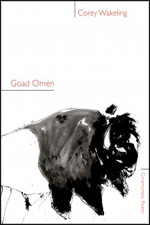
Goad Omen
by Corey Wakeling
Giramondo Publishing, 2013
How do you hear the title to this volume of poems by Corey Wakeling? Goad Omen: two words that really slow you down as a reader, make you dwell on their unnatural pairing. Three dipthongal, molasses-slow syllables. They sound like a slip of the tongue, a conversational mishearing, or typo that should have been Good Omen perhaps. ‘Goad’ is a really old word, ambivalent here as it’s readable as either a noun or a verb, material and abstract at the same time – stick, prod, anku; impel, incite, drive. ‘Omen’ is another kind of referential flip-flop, signifying either a good or bad prognostication, black or white. Nothing in the extruded binary of this title, though, can resolve or clarify these indeterminacies. The meaning they produce is an estranging nimbus of uncomfortableness and unknowable fate.
Turns out this is emblematic of the ontology of words in Goad Omen’s poetic domain, and also of the off- and near-meanings they organise. Wakeling has a remarkably consistent voice, or voices, despite the arpeggio-like range of his shifts and changes. He delights in ironic adaptation/quotation, Malleyesque bathos, shifts between everyday idiom and graphic insistence (‘Pert nark’), alliterative burbling (‘their there-there shenanigan’), mock-seriousness (titles like ‘The Renaissance’), all kinds of surreal jump-cuts, and an Audenesquely arcane vocabulary – sopor, quidam, cryptomeria, bascule deglutition – unapologetically unAustralian, this. His language effortlessly avoids the tried and worn bromides of the poetic – predictable attitudes of the lyric ‘I,’ similes (a few only), deep imagery, rhetorical trajectories that reproduce affective curves – and yet with a mostly steady kind of syntactical plainness as structuring underlay.
Wakeling’s tone is never smart or defensive or self-regarding, he’s always exploring something, responding to the linguistic possibilities of the world at every level, however difficult it might be sometimes to decode. This happens to be related to his distinctive adaptation of a poetry of sentences, inherited variously from Language practitioners like Ron Silliman and Lyn Hejinian, and including Jeremy Prynne, and back behind them the Frank O’Hara of ‘Second Avenue’, but precociously incorporated into his own style. The line is important, but the page is not a field for him. Formally Wakeling is one of those poets who seems to hear poems in blocks, in sentences, and so lineation is mostly to serve the flow, turns and, sometimes, jerks of his syntax.
Hence also his propensity for the long line, a sign of one kind of expansive mentality. This is intimately related to the remarkable effects he gets with syntax, probably the single most important contributor to the distinctiveness of this poetry. A random instance, only slightly more agglutinated than usual, from the long central poem in this collection, ‘Behemoth’s Leviathan’:
All the xanthorreas are faced toward the cityscape
Exhibiting callow figure the eirón metamorphosed of motion, the sullen
Urban yeoman nescient of the house held to the bosom of the cliff,
Who fasts on the gerbil’s wheel and dances the mouse traps in
Conversation the boy in uniform salivates at.
At one level this is poetry as soundscape, although it displays little of the attention-seeking behaviour of sound abstraction in experimental work. Wakeling doesn’t want to manipulate the sounds of words or make them more onomatopoeic or anything, he simply enjoys their unique phonics, individually and in combination. (xanthorrhoeas, actually=blackboys/grasstrees; eirón=dissembler, Sp.; nescient=unknowing; gerbil=desert rat.) As you also see, this is a sentence where the syntactical elements have the appearance of simply being strung together, one after the other, nothing grammatically fancy. But it’s slightly off at almost every point: you read back and forward, trying to get the sense: is ‘exhibiting’ just hanging free, or is the cityscape exhibiting? Is there an article missing from ‘exhibiting callow figure’? Normally, we’d expect metamorphosed ‘into’. The hinge at ‘Who fasts’ drives the reader back to figure out if the referent is the ‘Urban yeoman’ or the ‘callow figure’. Is the boy in uniform salivating at the ‘mouse traps in conversation’, or what? These kinds of provocations to the reader never let up in Wakeling’s poetry. And some readers will no doubt find his poetry provoking. There are ghosts of ordinary meanings, like subjects, themes, geographies, sharp observations of nature (‘bottlebrush seeds discharging like poppers’; cockatoos are cacophonists), but the sprung syntax never relents. Every line challenges our ingrained, instinctual searches for recognisable meaning, reminding us – whether we like it or not – how poetry can be counter-instinctual language in multiple ways.
Sometimes there are moments when Wakeling needs to fix the style, steady the focus, and he can do that, too. In ‘Albert Tucker’s Fitzroy’ for example, there is a kind of relatively straight-forward scene-setting:
To sit on a milker’s stool in the entry to your cottage
With the fallen carnations and Fitzroy’s bitumen smell
Rising like a cordon between your disposal and your neighbours.
That’s because this is the beginning to an ekphrastic translation of Albert Tucker’s 1941 painting, ‘Spring in Fitzroy’, but again not in the expected descriptive mode. Inspired by what is an ugly and disturbing scene, Wakeling imagines his way into it as a fuller and more eventful urban moment than that presented from behind Tucker’s male figure and the heavily restrictive door-frame. ‘Cottage’ is working-class inner Melbourne and real-estate perfect. But generally reading Wakeling’s poems is like the experience of playing with a linguistic slide rule: the calibrations (words) are marks that belong to a system of normative or agreed-upon meanings and relations, but the actual instrument can go any which way and the combinations of signs is never predictable. I couldn’t help thinking, in this connection, of that statement of O’Hara’s from The New American Poetry which seems analogous to Wakeling’s poetics in so many ways:
It may be that poetry makes life’s nebulous events tangible to me an restores their detail; or conversely, that poetry brings forth the intangible quality of incidents which are all too concrete and circumstantial. Or each on specific occasions, or both all the time.
This kind of insouciance seems to apply to Wakeling’s lack of inevitability too, his disorderly sentences, his sometimes tempestuous sounds. It’s an insouciance with its heart in language, not in ideas or tradition.
The other remarkable effect is that this resistance to predictable meanings doesn’t appear at all like word salad, or Vogon poetry. This poetry is not strictly speaking experimental in that sense; it’s artisanal, the order and placement of words matter. You don’t feel there is anything aleatory here, or any primary driver like the dream logic of surrealism. Wakeling isn’t saying: here are my experiments with language, now it’s over to you, reader. In that sense perhaps the most accurate description of Wakeling’s poems is unorderly syntagms, chains of words and lines where the relation of part to whole is constantly disrupted, unexpected, interrupted, by an invisible grammar. The approachable meaning is a load of dingo’s kidneys. There is a serious attempt to communicate here, it’s just that the communication is coming from a different linguistic quadrant. The ‘universal’ translator is having problems with it. But as John Ashbery said of John Wheelwright, whose poetry he doesn’t always understand, ‘his conviction is contagious’.
I was interested to see what was going on in these poems in terms of their version of place, landscape and locale, given Wakeling’s recent co-editing (with Jeremy Balius) of Outcrop: radical Australian poetry of land. In that anthology’s introduction the editors made some interesting points about the ‘possibility of recuperation and efflorescence of land’s multiplicity in a theatre of language.’ I think what they were aiming at here was a kind of advance on the bioregional paradigm in its various guises, the often worthy, if positivist emphasis on ideas of life-places and the communities and ethics that grow from them. It’s the word ‘theatre’ that’s important in that sense, the virtual space of entertainment and performance that the poem creates for the language of place. Language isn’t in the service of ethics, it’s in the service of poetic consciousness. There are numerous little red markers for place in the poems of Goad Omen, and there are noticeable strands of connection like that between places in the south-west of Western Australia and Carlton, Melbourne. ‘The Character’ for example shifts between ‘that division of waters at Cape Naturaliste’ (referring to the confluence there of the Indian and Southern oceans), Albany and Boyup Brook, and ‘May in Melbourne’ where ‘all the fireplaces are attractive.’ ‘Walk the Plank!’ swings between Pelham Street, Carlton and the Toodyay of the Avon Descent. ‘The Swan River’ presents a multiply faceted landscape around Bassendean, a now built-up satellite of Perth out towards Guildford: ‘Bassendean days/are empty but jagged with intent,’ a sentiment probably arising from a suburban barbeque (at ‘James and Carol’s’). Paint factories, sandtracks, a bridge over the upper reaches of the Swan, blossoming ghost gums, the Tonkin Highway, all create an impressionistic and unsettled sense of place, but within the theatre of language, not as a branchline of the McCubbin-time-lapse tradition of representation about the original bush, settlement, urban anomie, etc. So, as the commitment of the Outcrop anthology suggests, acknowledging the impressions of place, locale, country is important to Wakeling, and the evidence of the poems in Goad Omen is that at the centre of this commitment is the idea of consciousness of place as embodied in the performative resources of toponymic language, a poetics of GIS.
Among the remarkably energetic, contrapuntal and dissonant orchestra of Wakeling’s generation of young Australian poets – Astrid Lorange, Toby Fitch, Kate Fagan, Michael Farrell, Duncan Hose, Jessica Wilkinson (to mention a few only) – this collection of poems, a first full-length volume, is all cadenza. Goad Omen is a new music, and a new awareness.
*Philip Mead is Chair of Australian Literature at the University of Western Australia.
**Taken from Cordite at http://www.cordite.org.au
 To Koskino