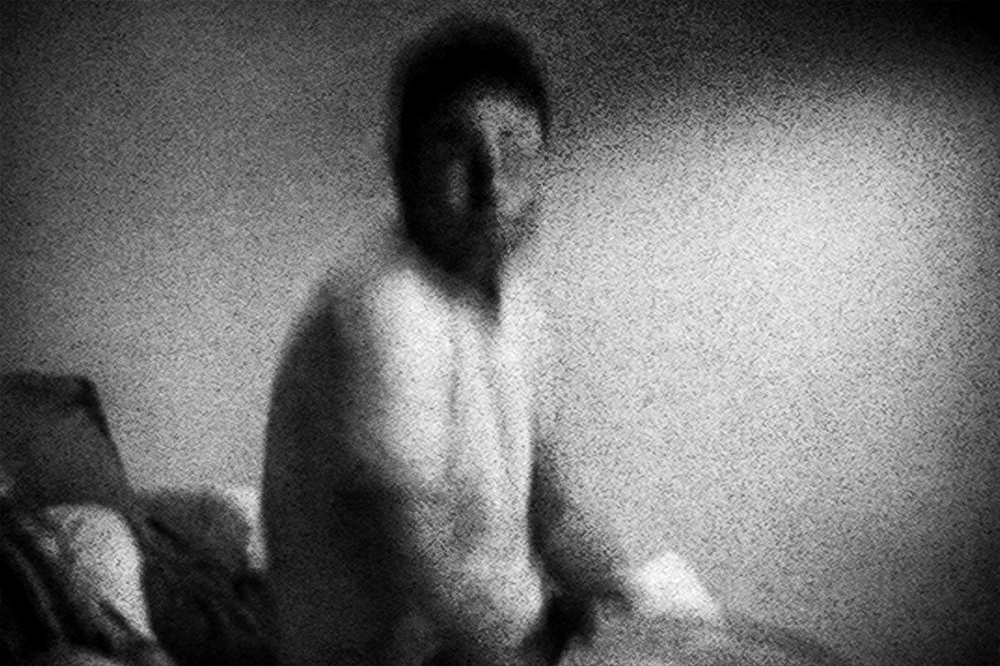
Image of and by Nicholas Walton-Healey
Land Before Lines is a book from Melbourne-based photographer and writer Nicholas Walton-Healey. The 144-page, full-colour volume (the images appear in black and white here for page recall considerations) features portraits of 68 Victorian poets and a single, previously unpublished poem written by each poet in response to their photograph.
Jacinta Le Plastrier: What led you to starting off on this project which, given the complex personalities of so many poets, must have felt like a daunting prospect?
Nicholas Walton-Healey: There wasn’t a single event. For a long time I resisted the idea. It seemed ‘too obvious.’ Before commencing the project, I was spending a lot of time with poets, mainly through my involvement with Rabbit Poetry Journal. I found it really very difficult to be around so many creative, intelligent people without participating in an aesthetic dialogue with them. I mean, although you might be able to go up to a certain poet and say, ‘your work is wonderful because of x, y and z,’ that sort of compliment always means so much more when it’s said in your work.
I studied poetry in the honours year of my first degree. I wrote a thesis on the relationship between the visual and literary arts. If you look at the work of the ‘greatest’ poets, you see a sustained engagement with the work of visual artists. I’ve always been fascinated by that intersection. I know that when I suffered writer’s block, or was in the process of conceptualising a suite of poems or a piece of writing, I often turned to the visual arts or the work of particular visual artists for inspiration. That’s actually how I began taking photographs. So I guess if you really want to trace it back, you could possibly say that the project started here.
The complexity of the poets’ personalities fascinated me. It was actually the main reason I persisted with the project. But this sort of complexity isn’t specific to poets. What is specific to poets is that their chosen medium of expression is financially unrewarding. Poets can’t sell individual works for thousands of dollars. They can win prizes that are worth lots of money but there isn’t that system of patronage or gallery representation or even the opportunity to forge a living by selling private, independent works. I think this accounts for some of the ‘complexity’ of these people’s personalities. I mean, in the best instances, some of these people are producing work that’s every bit as important as that being produced by the country or state’s leading artists, but because poets don’t get the sort of recognition that artists working in other mediums sometimes receive, something gets twisted. I don’t mean to imply that these people write poetry for recognition or accolade so much as to emphasise how unusual it is to see some of the most accomplished and creative poetic minds living in situations or circumstances that would comparatively be described as poverty.
JLP: How long did the project take to complete, and briefly, tell us how it unfolded and developed? How many images all up do you think you might have taken?
NWH: The project took about eighteen months to complete. All together, I took over 200,000 photographs. That’s not something I’m particularly proud of – it suggests incompetence. But digital photography is all about excess. You get rewarded for keeping the shutter rolling. I think the excessiveness of it makes people relax. They get used to having you continually snap away and so become more likely to let you in on that fraction of a second where they display a side to themselves they wouldn’t normally present to the public. Sometimes people just get bored of having their photo taken and that’s really the best time to go to work.
The project started with Jess Wilkinson, who I happened to be in a relationship with at the time I photographed her. I think her book marionette is incredibly brave and this goes back to what I said before about verbally articulating something to an artist. The greatest compliment you can give them is to make a piece of work that implicitly articulates that compliment.
After that, I started taking photos of some of the other poets we were socialising with. Meanjin got on board around this time and suggested I get a poem from each poet I photographed. They published some of the portraits and poems in one of their issues (these appear in ‘Volume 72, Number 3’). The project really just kept growing from there.
JLP: Can you summarise the conceptual intention of the project which is contained in the book’s title, Land Before Lines?
NWH: This project is fundamentally about creative exchange. One of the ways I facilitated this exchange was by asking the poets to nominate a landscape or location where they would like to be photographed. This question compelled the poets to personally invest in the photographic process and made it more difficult for them to complain about the photographs (joke).
I’ve seen so many awful portraits of authors. This is because photographers typically work from the opposite premise; they ascribe to themselves a position of authority. I was very conscious of the fact that the poets I was photographing had far more established and concretised aesthetic convictions than my own, and rather than deny this fact, I elected to work with it.
So this is what the title means. Sure, the ‘land’ obviously refers to the fact that the poets in this book are united by the Victorian landscape and that this unity is privileged over any stylistic or aesthetic ‘lines’ that could be drawn between the poets or their particular use of the poetic line. But Land Before Lines is also a metaphor for a creative sharing that, in this project, is privileged over any division or fencing between photographer and poet. I mean who is actually the photographer and poet? Are the subjects of these photographs even poets? I’m certainly aware that this series of photographs constitutes a portrait of me as much as it does the ‘Victorian poetry community’ or the individual poets presented in the book.
JLP: What your thoughts on ‘auto-ekphrasis’?
NWH: Well, I know that an ekphrastic poem is a poem about a piece of visual artwork that also comments upon its own status as an art object. But I’m unsure of what an ‘auto-ekphrastic’ poem is and I’m not going to waste my time speculating – this is what academics get paid to do.
When I wrote my thesis on the relationship between the literary and visual arts, I used the relationship I perceived between Frank O’Hara’s poetry and Jackson Pollock’s drip paintings as a case study. Those two artists were personally and aesthetically very close (O’Hara even wrote a monograph on Pollock); critics seem to have allowed the distinction between their sexualities to cloud their ability to see the true nature and extent of this relationship. I mean, in order to see this relationship, you really need to get over the emphasis literary critics repeatedly place on the supposed frivolity of O’Hara’s poetry. Although this frivolity is important, especially in the later poems, I think it’s too easy and convenient to just attribute it to O’Hara’s belonging to the second group of artists associated with the New York School (which are supposedly more closely aligned with Pop Art than they are with Abstract Expressionism).
The thing I found most interesting about this relationship was that, when you really start to look into it, there exists numerous O’Hara poems that, although not conforming to the ‘proper’ definition of an ekphrastic poem, demonstrate a very clear relationship with Pollock’s drip paintings. And that’s where I think the power of ekphrastic poetry lies; as an intersection or choice to engage with ideas outside of one’s own medium. This gives the work a greater opportunity of contributing something different to the medium into which these ideas are introduced and I think artists need to engage with ideas that exist outside the formalist constraints of their own medium. Critics got that so wrong about Pollock; I mean Clement Greenberg defining Abstract Expressionism in terms of it being about the formalist qualities of painting. There’s a whole social and political context there that he’s just ignoring. Pollock’s work was very political but political in the only way political art can be – political art cannot be didactic. Similar criticisms were of course made of O’Hara’s work; that his refusal to follow poets associated with specific liberationist movements meant there was a lack of a political engagement. But this was precisely the reason O’Hara had an ambivalent relationship to the avant-garde.
JLP: What drove your choices of which poets to include?
NWH: However partial or incomplete, I sought to construct a kind of representation of the contemporary Victorian poetry ‘scene’ or ‘community.’ This meant including both rural and urban poets, performance or street poets, academic poets, emerging and established poets, as well as poets who exist somewhere between these otherwise tenuous and arbitrary divisions or categories.
I was always very conscious of the fact that, in striving to achieve this representation, the project ascribed to itself a kind of pseudo-anthologising quality. To some degree, this made it very difficult – I certainly don’t possess the qualifications required to credibly embrace the role of an anthologising editor. But I’m always surprised by the extent to which most anthologies reflect the aesthetic principles championed in the poetic work of their editors; they’re certainly not the objective and impartial documents they’re purported to be. So I really just embraced the fact I was coming at this from a completely unique angle and, in a way, I think this actually proved to be a real strength of the project; that it was facilitated by someone simultaneously connected with and divorced from the Victorian poetry ‘scene.’
In most cases though, my decisions were made on the basis of my engagement with a poet’s work. Of course it was often through conversation with other poets that I’d develop a conception about what other work I wanted to engage with. And there were also a number of ‘facts’ that assisted me in this respect. Some poets had published x amount of books or had books published with particular publishers or won or been shortlisted for certain awards or organised important poetry gigs or had work in this or that journal. This sort of information compelled me to consider including poets whose work I’d had little or no prior engagement with.
JLP: How did you come to the selection of poems?
NWH: I made a concerted effort to refrain from selecting any of the poems in this book. I tried, as much as possible, to allow the poet to make his or her own decision about how the poem related to the photograph. While I thought certain poems were more successful in relating to the portraits than others, I really tried to avoid projecting a preconception about how I thought the poet should respond to their portrait. The photograph was never supposed to be anything more than ‘a prompt.’
JLP: What do you think you might have learned overall about poets?
NWH: I don’t know that I’ve learnt anything about ‘them.’ And even if I allowed myself to make generalisations, I certainly wouldn’t articulate them here (joke). Poets are people. People who are not a whole lot different in terms of their complexity or unpredictability from the people I worked with in the Northern Territory or in an abandoned factory in Preston or out in the rural community of Raglan. People are wonderfully strange and, other than class (the poets have, whether through tertiary institutions or self-teaching, typically accessed education), I don’t really perceive any fundamental difference between them and any of the other subjects I’ve worked with.
I’m aware that – off the backs of poets like Rimbaud, Baudelaire, Whitman and Ginsberg (to name a few) – there’s a stereotypical image of ‘the poet’ as an isolated, drunken, romantic bard. And the portraits in this collection certainly play with this stereotype to some extent. In fact, a lot of the poets have even said things like ‘you make us look like we’ve been sleeping on the street for twenty years.’ But poetry is very primitive. That’s actually what attracted me to it in the first place. Pure idealism. That someone chooses to do something because the personal or cultural reward or recognition on offer (which, as I’ve already suggested, is remarkably minimal) is perceived to outweigh every other kind of practical or financial constraint. I think the integrity required to make this decision is really special and I’d like to think the respect I have for these people’s courage and bravery is also reflected in the photos. But I didn’t see any point in taking photos that merely flatter people. We see flattering imagery of people all the time and it’s really very boring.
JLP: We are publishing here some out-takes, not included in the book – why have you chosen these ones? What was the process by which you came up with the final portrait for each poet?
NWH: This process actually changed considerably as the project developed. In the earlier shoots, I selected a handful of photos that I sent to the poets, asking if there was a particular one that resonated with them poetically. But, as the project developed, and narratives or relationships began to emerge between images, I developed stronger convictions about which photographs I wanted to use; certain photographs were privileged because of what they contributed to the wider narrative. The photographs I’ve provided for you here didn’t quite work as effectively as the ones that appear in the book.
JLP: I know that some of the book’s portraits have been used by poets for their own poetry volumes, or social media headshots etc. Do you know how many of the images so far have had this knock-on of publication? It seems to me to have been another wonderful outcome of the project.
NWH: There’s have been a fair few. But I also know that several poets found my photographs really difficult and confronting. Aside from deciding which poets to include in the project, dealing with the responses to the portraits was the next most difficult thing. Sometimes I think I took a photograph that summed a person or a person’s poetry up too well and that struck a nerve. Other times, I privileged certain photographs because they displayed specific technical qualities that I was really proud of. It was actually refreshing when someone objected to a photograph I purposed to use on this basis because it reminded me that I’m dealing with people as much as with aesthetic objects. In some of the cases where a poet objected to the use of a particular photograph, the resultant dialogue proved to be one of the most insightful and constructive things to come out of the project. But I certainly wouldn’t say that all the poets like their portraits! I do truly hope though, that some of them can see where I’m coming from.
*Nicholas Walton-Healey is a Melbourne-based photographer and writer whose work appears in numerous local and international journals and anthologies including Meanjin and Westerly. Land Before Lines (Hunter Publishers, 2014) is his first book.
**From Cordite at http://www.cordite.org.au
 To Koskino