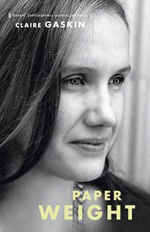
Paperweight
by Claire Gaskin
Hunter Publishers, 2014
In Paperweight, her third full-length collection, Claire Gaskin shows her talent for observing fluctuations in the state of things – personal, political and environmental. Within this, she does not turn from the darker corners of the human psyche. ‘Just do the best you can’ opens with a frank acknowledgement of mortality: ‘your death keeps growing/or your life keeps contracting’. Themes of loss surface elsewhere in the collection. In ‘to construct is to omit’ she writes, ‘I grieve the self that lived here / the graves my shoes are / by the door that doesn’t open’. There are also moments of violence, such as the accident in ‘ensoul’: ‘hell loses colour in the constant rain / no emergency vehicle was called’. These poems permit the world and all its wildness, and yet remain grounded. The notion that a witness has an ethical position is significant in Gaskin’s writing. The trauma of these poems is often gendered. In ‘(after Greer)’ a woman leaves the house ‘with his handprint on her face’. In ‘Just do the best you can’, the speaker writes: ‘and yet I dreamt I was raped / wearing my sister’s wedding dress’. These are feminist poems. Some, such as ‘(after Greer), are direct critiques; in other poems resistance lies in the disquiet of Gaskin’s lucid account of dispossession, rather than an outright call for struggle.
The ability to witness events and emotional states without getting caught up in them is often associated with meditation practices. Gaskin’s poems are meditative in the sense that they are accretions of the world, gathered through calm attention. In the yoga class that I attend, meditation is called sitting, which to me suggests an open, chance-based practice. Gaskin’s poems sit with the world. Yoga could be another analogue for the poems’ attention to the presence and experience of the body. One poem, ‘dreaming of the dreamer’, suggests ‘drawing a line around your body and living within it’. More frequently, though, Gaskin’s poems blur the boundaries of the body and its surrounds. There is rain that ‘fills the pelvis bone / a bird bath’ (‘a liberty of flowers’). In her poem ‘the breeze’, the architecture of the body and the built environment mingle: ‘the breeze flattens to include / spinal staircase to a balcony brow’. Her poem ‘hippocampus’ has the body not as a temple but, pragmatically, a rental property:
I am rent free
I have been living in the house of my body
all the windows and doors open
curtains wet with rain billow and whip
Gaskin also describes bodies as repositories of personal history. In ‘stubborn beauty’ she writes, ‘he held fistfuls of history / close to my skull’. In ‘yes’, the physical work of cleaning taps into older memories: ‘I am cleaning our house of horizons / the pain doesn’t forget my body’.
Gaskin also considers they body, particularly the female body, as a contested and political zone. Her poem ‘(after Greer)’ is one of the more explicitly political examples. Gaskin uses the repetitive structure of the pantoum to collage the derogatory terms for women listed in the Female Eunuch. The simple form of the poem makes for an effective catalogue of the persistence of everyday sexism:
seeking guidance and approval the bit of skirt loses her autonomy
the pregnant trollop
on the concrete by the side of her house
had her daughter on her hip
The title poem ‘Paperweight’ turns a moment in a café into a conversation between the poem’s speaker and Jane Austen, Virginia Woolf, Simone de Beauvoir and Hélène Cixous. Gaskin cites the emergence of écriture feminine: ‘The body must be heard / says Cixous’. Gaskin carries that thought into the following line: ‘the moon is full / the pain in my uterus’. As the ‘vegetables get hot in the car’, the woman in the café writes ‘another six pages’: a woman writing, thinking about the female figure in literature.
In ‘Guggenheim’ the female body in art hangs behind a wry commentary on the ego of the male artist who is seeking:
a woman whose canvas he can soak
stain for clarity and
openness
not someone painterly
like me
The narrowness of the artist’s vision is further revealed by his actions in the final lines: ‘in the suspended room he / compares me to his mother’.
In ‘mosaic woman’ Gaskin offers another take on the painterly, with an ekphrastic poem drawing on Roy de Maistre’s ‘Reclining Figure’: ‘the grey gaze openly dares the disclosed face/the red effect purposely realizes dreamt legs’. Gaskin identifies herself as ‘painterly’. More than her engagement with specific paintings, though, her use of metaphor and imagery constitute the visual impact of her poems. ‘Looking’, the poem that follows ‘Guggenheim’, explores the ground of gender and erotic desire through a series of surreal, charged images:
looking into the eye of my addition
he, shaking the doll’s house above his head
the blue sheets’ white clouds of masturbation
debt to the blinds taste of licking an egg
I climbed up a tree with a flightless hen
the wingspan of his bed’s tightening sky
the sitting is done mainly by the hen
I saw the doorway and let out a cry
Bird eggs and the work of hatching them translates to the human realm, where the hen does the sitting and the man rattles the domestic sphere made miniature, the dollhouse, above his head. The female hen is flightless while the male figure can exercise his wings and stain the sheets of ‘his bed’s tightening sky’.
Lines like ‘the blue sheets’ white clouds of masturbation’ show Gaskin’s knack for jolting, visually striking images present throughout the collection. In ‘vessels and implements’ she writes, ‘I can feel the amputation / he stands on a spoon overlooking the bay’. In ‘darkness immovable’, ‘she walks through the mist without any fingernails’. Gaskin acknowledges a Modernist inheritance in ‘dreaming of the dreamer’. There, William Carlos Williams’ ‘The Red Wheelbarrow’ is reinscribed as, ‘so much depends on the red book covered with mould beside the white phone’. The concise power of the Imagist line is certainly present in Gaskin’s writing, but so too are the dream visions of Surrealism, the sparse clarity of the haiku and the ingenious metaphoric conceits of the metaphysical poets (this list is provisional and could keep going).
The unexpected relations of a Gaskin image – ‘the seagulls lit from below flash break into migraine’ (‘the fall of man’) – are circuit breakers for ordinary vision. They make things strange again. Theorist Paul Ricoeur has written on the significance of the literary image: ‘In the measure to which image gives a body, a contour, a shape to a meaning, it is not confined to a role of accompaniment, of illustration, but participates in the invention of meaning’ (1. Ricoeur 1979, p.129). The startling image-combinations in Gaskin’s metaphors move beyond decoration. They re-calibrate our view of the world.
The final poem of the book, ‘thirty-six aphorisms and ten-second love stories’, combines images with broken off moments of action and reflection. It is a list poem, as much about the connection or disjunction between each fragment as it is about the fragments themselves. In his 2005 book of aphorisms Microtexts, Martin Langford suggests that poets, in writing aphorisms, trust rather than lead their reader. He describes ‘the clarification and shaping of an idea, rather than on the elaboration of an argument’ (2. Langford 2005, p. 7). Langford also speculates on the emergence of a poetic tradition of aphorism in Australia. We could now add Gaskin to his diverse list of Australian aphorists: Les Murray, Robert Gray, joanne burns, Alison Croggon and Phil Hammial.
Langford argues that ‘aphorism is, above all, a formal device’. Paperweight sees Gaskin experimenting with this and other formal devices, a neo-formalist bent that counterbalances her dispersed, line-by-line mode of composition. Michael Farrell has suggested that Gaskin is one of the most ‘interesting practitioners of the line’ writing in Australia (3. Farrell 2011). The pantoum, which repeats lines to build its form, is notable in Gaskin’s work. In this collection, her poems ‘walking away down the bluestone lane’, ‘mosaic woman’ and ‘vessels and implements’ are all pantoums. In these poems the form’s interlocking repetitions emphasize the line and draw out its incantatory possibility. At other times, Gaskin takes on less expected forms. ‘The breeze’ is a sonnet, with end rhymes to boot:
the breeze lifts the fabric to include
spinal staircase with a balcony brow
bats blacken the flawless sky’s magnitude
at the mouth saying give me your breath now
Gaskin interrogates and reenergizes the sonnet with the tension between the closure of the traditional form and the openness of her lines.
As well as attention to poetic forms, in this collection Gaskin emphasises the materiality and physicality of text. In ‘exile’, cormorants form letters in flight; she describes the ‘sky of un-rhyming’ in ‘darkness immovable’. The intimate connection between living and writing is the subject of ‘standing under the fountain’:
writing is staining the sheets
that are not yours to wash of a hospital or hotel bed
the page is where two surfaces meet
Writing is also a means of existing and of surviving. In ‘gratuities’ Gaskin says: ‘I had to write myself back from the brink’. While the self-help set might instagram a gratitude list, Gaskin in her poems offers gratuities – tips – or small sums for getting by.
References
Farrell, M. 2011 (September), ‘One More Rabbit’ in Jacket2, accessed 04/03/14
Langford, M. 2005, Microtexts, Island Press, NSW
Ricoeur, P. 1979, ‘The Function of Fiction in Shaping Reality’ in Man and World, No. 12
*Ella O’Keefe is a poet and researcher living in Melbourne. Her poems have been published in Cordite, Steamer, Overland Blog and Text Journal. She is a former director of the Critical Animals research symposium. Her work on radio has been broadcast by The Night Air on Radio National, All the Best on FBI Radio and Final Draft on 2SER FM.
**From http://www.cordite.org.au
 To Koskino