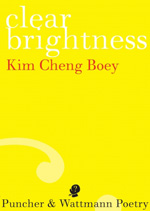
Clear Brightness by Kim Cheng Boey
Puncher & Wattmann, 2012
With Clear Brightness Kim Cheng Boey offers a slim volume that, in addition to addressing notions of place, exile and travel, carries with it a deep melancholy of being written in ‘the lone wastes of middle age’. His explorations of worldliness are welcome, and Boey offers portraits of interconnectedness even as he displays and explores alienation. Moving from markets to Chinatowns, from Singapore’s National Theatre to California’s Santa Barbara, this collection often shows the objects that connect the past to the present, keepsakes available to keepers and gleaners alike.
Boey’s meditations on memory’s presence are inescapable. The poet is watchful as memories resurface, and the collection as a whole is ‘sleeved in the salt of memory’. We see the poet ‘Cruising for charms/ that will be memory’s currency’; contemplating ‘the Persian rug memory’s/ nameless longing fleshed in dye and skein’; following ‘memory’s story/ in the body’s passage through the bazaars’; wandering through ‘These Fez days in trance, in memory’s warp/ and weft, gathering tokens against the future’s loss’; listening for the ‘pentatonic measures between memory/ and home’. Throughout these poems he is ever:
on the fading
trail of letters, the emails, tokens, memories like tracks
fading fast, the memories, souvenirs, a disappearing trail
in the snow, in the shifting sand…
The weight of all this memory! Often bound up in souvenirs and objects, it marks this volume not as the exotic travelogue of a poet displaced – no matter where he finds himself, it seems – but instead as an example of the kind of accounting any of us might undertake upon reaching a certain age. Just as objects may help us understand who we are, we may also use them to:
accumulate
clues to the selves we never became
the shadowy half-lives, collecting and being
collected by these found things.
Such objects are on display in the centres of commerce that Boey describes in his sequence ‘To Markets’. Laid out for the browser are objects that the poet does not buy, that may bleed into the lives of others. These commercial centres offer an endless array of objects, many generic yet rendered haunting by their sheer quantity and repetition. Boey’s poems show us that the age of the Silk Road is still with us. A route that was never singular has grown, in our twenty-first century, more and more confused. The deftly-rhymed sonnets of ‘To Markets’ start in Sydney’s Glebe and then unfurl a complex network of ‘souvenirs and silks’, ‘bootleg cassettes’ in ‘Change Alley’, and ‘polyester shirts, plastic toys and dusty books strewn/ on the pitted, betel-stained ground’ in ‘Calcutta’, as Boey moves across the world to the ‘potent herbs’ of Tangiers and the ‘carved birdcages’ and ‘art-deco tubs and sinks’ on offer in Madrid. He shows us a ‘crazy patchwork/ of tribes, trades and tongues’. In a world obsessed with globalization, these still seem strange to us.
‘The Markets’, like the later sequence ‘Chinatowns’, shows both the mobility of the modern world, and also our efforts to retain a sense of separate history: each poem is marked by the global, the local and the personal. The objects on sale at these markets, from Sydney to Isfahan to Marrakesh to Madrid, bear a decided tendency to blur. Yet the power of the senses draws the reader into Boey’s own particular history, in which, as in Proust’s work, aromas unlock stories. In these moments the senses break the present moment open and flood the poet and the reader with the past. This sensory focus is perhaps most evident in the poems about food, which also reveal the communal importance of shared memories of meals taken. In the poem ‘Soup’ Boey writes,
At the end of his life Carver says it’s all gravy.
For me it will be a bowl of soup, the essence
slow-cooked and distilled from what has eluded
me, what was never said, the forgotten recipes
and untold stories simmered to a broth
of lost time, the ineffable flavours, clarity born
of long brewing, words boiled down
to an essence that restores us, food
we can believe in, right saltiness, right sweetness…
That tempered combination of salt and sweet, the long-brewing that achieves it, is not just the flavour that Boey’s palate craves. It also speaks to the balance that the poet seeks in his writing. Even as absences haunt this description – ’what was never said,’ the stories left untold’ – the poet conjures the bowl of soup into being.
Alongside these urban environments, with the poem ‘Archipelago’ Boey offers us coastlines, a glimpse of how the natural landscape also tells the story of the individual within it. As he shows us ‘beaches lapped by memory’s tide’ he notes that the personal charting of these islands is akin to ‘mapping the meridian/ of yourself, the routes that led you from the coast of forgetting/ to this coast of remembering.’ The landscape itself – its inlets and vanished mangroves, its palm trees and horizons – are as much a part of his subject’s biography as the kampongs and the routes between them. He writes of the journey through the archipelago as an act of ‘riding past the stations/ of your life’, evoking the understanding that we all have such sites and stations.
The poems of Clear Brightness are often deceptive: appearing plain on the surface, the quality of their workmanship makes for an unassuming, unostentatious foundation. There are no pyrotechnics on display here, but instead a steady eye that, despite its steadfast gaze directed at memory, refuses sentimentality. The volume’s title demonstrates the subtlety of Boey’s poetry: the ‘clear brightness’ seems to border on tautology, but of course there is distinction, differentiation, between the two. While the brightness doesn’t turn into unforgiving glare, the light shed on these poems allows for unflinching engagement with a sense of permanent displacement in which, perhaps, the only ‘homecoming’ the poet experiences is in contemplation of the past.
While every so often Boey gives way to ‘poetic’ description (‘Dot joining emerald dot’) the seeming plainness of his language strengthens the poems. Against such plainness, the moments when he stacks adjectives – ’the air/ acrid, shriven, ashen’ – gain extra power, appearing in relief when compared with the sense of reticence that haunts the poems. In rhymed poems, such as the sonnets of ‘The Markets’, the poet’s long lines make the chime of end-rhymes less insistent: another example of the poet’s subtlety. Elsewhere the poet’s use of assonances forms an architecture, as when in the title poem Boey writes ‘The dead were fed/ their abodes swept, and the filial queue/ of joss offered.’ Such shifts in sound show impressive attentiveness to language; such surprises are small in scale and their nuances will not be evident to impatient readers. The clarity of the poems means that you can read them quickly and understand their narratives and their themes. Their strength as poems emerges when subjected to a slower reading and its accompanying close attention. The slimness of the volume is suggestive of the degree of work that has gone into the poems themselves.
Kim Cheng Boey is one of the most well-known ‘Asian-Australian’ poets: this hyphenation is useful insofar as it reminds us that there are other voices among us than the dominant European strain. It is worth remembering how long Asia has been part of our multicultural society, and how long Australia has been part of the Silk Road. Clear Brightness shows us why Boey deserves to be simply a well-known Australian poet. Boey’s true questions – where do I come from? How do I live with the past? – are questions that we all ask. The poet’s invocation of memory is obsessive, but it is obsessively human.
The book ends with an interview with the poet, reflecting on his body of work, both here and in his other books. The interview offers insight into Boey’s consideration of the ethics of writing about his dead and notes that, ‘the poems about my father and grandmother are attempts to memorialize them, to deal with their disappearance.’ This instinct to memorialize spreads through Clear Brightness, extending not only to his own family, but to experience and its emblems more generally. Of his body of work he states, ‘What the poems offer are sundered moments, some sunlit, some dark, clouded. I do, however see each collection as marking out a stage or phase in my life’: the concentrated gaze the poet offers of entry to middle age in this book expands beyond his own specific memories and memorials, opening a quiet space for the reader, no matter his or her own age.
In its way, Clear Brightness reveals that the world has always been multicultural, has always been built on cultural exchange, that the Silk Road began before we imagined it did, and never ended. Boey’s long memory explicitly crosses generations and implicitly evokes a much larger sense of history.
*Kate Middleton is the author of Fire Season (Giramondo, 2009), awarded the Western Australian Premier’s Award for Poetry in 2009. From September 2011-September 2012 she was the inaugural Sydney City Poet.
Website: http://stitchedwithitscolour.tumblr.com
 To Koskino